

Survey link (should take 5-10 mins).
Have you used or shared the ideas around semantic waves in computing education? If you have, please complete our short survey.

We are running this impact survey about the influence on teaching computing of Paul Curzon’s (Queen Mary University of London) Semantic Waves-related research with Jane Waite (formerly QMUL, now Raspberry Pi) and others. This research was done with Karl Maton (University of Sydney) and is based on his earlier research and ideas relating to Legitimation Code Theory.
This is for an Impact Case Study about Paul’s research for the UK Government’s REF 2029 (Research Excellence Framework 2029) for which we need to document how the research ideas have been used and shared in practice.
If you have used the ideas around Semantic Waves in computing education or shared them with others, we would therefore be really grateful if you could spare 5-10 minutes to do the survey at https://forms.cloud.microsoft/e/Kt6FbfBJGj
Please share with others who may have used or shared the ideas around semantic waves. Thank you for your help.
If you are on LinkedIn please share Paul’s post there too.
Background
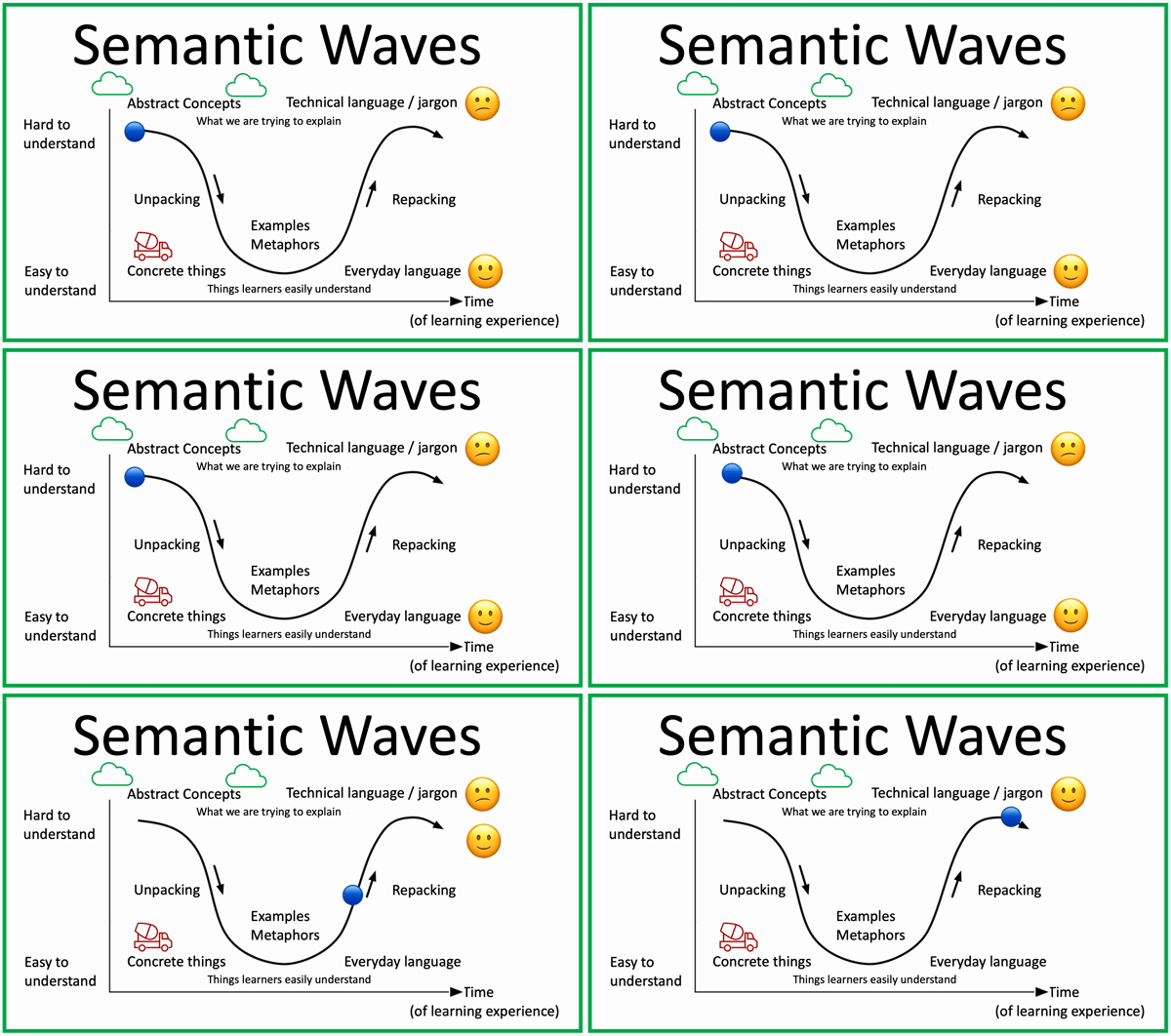
Although Paul’s published a number of papers on Semantic Waves and teaching computing (see below) I think it was really his series of ‘Learning to learn (to program)‘ blog posts (and his talks which highlighted that resource) which helped spread the idea more widely, particularly TIP 9 : Follow semantic waves.
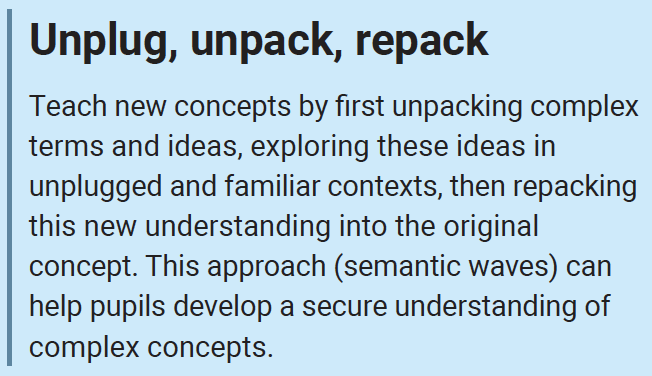
Raspberry Pi created a Pedagogy Quick Read for computing teachers on the topic and cited him*. Then they and the National Centre for Computing Education (NCCE) developed the 12 Pedagogy Principles (the Pi version) for teaching computing which Ofsted, when doing its Research Review into Computing teaching, recommended (along with Paul’s work on storytelling: Ctrl+F storytelling to jump to that section).
*”This Pedagogy Quick Read was adapted from Paul Curzon’s blog [Tip 9, linked above – Jo], which is based on the work of Karl Maton applied to a computing context. We would like to thank them both for their input.“
Research articles
- Curzon, P., Waite, J., Maton, K. (2024) Teaching CS with and through other forms of knowledge. In The 19th WiPSCE Conference on Primary and Secondary Computing Education Research (WiPSCE ’24), September 16–18, 2024, Munich, Germany. DOI: 10.1145/3677619.3678104
- Curzon, P., Waite, J., Maton, K. & Donohue, J. (2020) Using semantic waves to analyse the effectiveness of unplugged computing activities, WiPSCE – The 15th Workshop in Primary and Secondary Computing Education, Online Conference, Oct.
- Curzon, P., Waite, J. & Maton, K. (2020) Semantic waves: Analysing the effectiveness of computing activities, Cambridge Computing Education Research Symposium, Online, Conference presentation, UK, April.
- Waite, J., Maton, K., Curzon, P. & Tuttiett, L. (2019) Unplugged computing and semantic waves: analysing crazy characters, Proceeding of UKICER – The UK and Ireland Computing Education Research Conference, University of Kent, Canterbury, UK, September.
- Curzon, P., McOwan, P., Donohue, J., Wright, S. & Marsh, W. (2018) Teaching Computing Concepts, in Sentance, S., Barendsen, E. & Schulte, C. (eds) Computer Science Education: Perspectives on Teaching and Learning in School (pp. 91–108).
- Maton. K. (2018) Taking autonomy tours: a key to integrative knowledge-building, LCT Centre Occasional Paper 1
- Maton. K. (2013) Making semantic waves: a key to cumulative knowledge-building. Linguistics and Education 24, 8–22

