Aspiring head teachers in London – support available from @MayorOfLondon

The Mayor of London’s “London Schools Excellence Fund” (LSEF) network (which funds some of the work that Teaching London Computing does as part of the CAS London network) has an opportunity for aspiring head teachers in London.

This is open to all hopeful head teachers in London, not just those involved in teaching computing so feel free to pass it on to other colleagues.

Jo


Getting Ahead London
Take the next step on your leadership journey

If you’d like to step up to headship, but aren’t sure how to get there, then consider applying to the Getting Ahead London Programme.

The Mayor is running a second year of his scheme for senior leaders in London:  Getting Ahead London. Delivered by Challenge Partners, a place on this scheme can give you prestigious, bespoke training and support to help you on your journey to becoming a headteacher in the capital.

We know that many London schools are struggling to recruit great leaders. Through a structured, year-long programme of coaching, network building and career advice, Getting Ahead London will give senior leaders the skills and confidence to help them move towards a headship position.

We are particularly keen to ensure that women and BAME senior leaders are well represented among senior leader applicants, to strengthen further the diversity of the successful participant cohort in 2016/17.

The support offered includes:

  • Coaching from highly experienced London heads to help participants fulfil their leadership potential
  • Help to navigate existing leadership opportunities
  • Face to face leadership development and networking events with world-class businesses
  • Online tools and resources to support your development
  • Support with applying for jobs and preparing for interviews
  • Getting Ahead London will run from September 2017 until July 2018.

Getting Ahead London complements existing leadership development programmes and qualifications.

The deadline for applications is 14 June 2017
Interested?  Find out more and apply at: https://www.london.gov.uk/gettingaheadlondon


Using London’s transport network to teach computing – free resource & workshop (12 June)

Summary

  1. Free London computing resource that uses London’s transport system to teach unplugged computing as well as Python programming – as part of the new London Curriculum
  2. Free teachers’ event on 12 June to demonstrate this resource
  3. It’s also #LondonHistoryDay soon – CAS London / Teaching London Computing has some other resources for your classroom

1. A new resource for computing teachers in London
Someone has come up with the rather lovely and brilliant idea of exploiting (in the best way) London itself as a resource to be used in teaching in schools. Obviously London has lots of history, architecture, transport, science and literary links and these aspects can feed into the curriculum for London schools. I wish I’d thought of it.
Teachers, working with the Mayor of London, have developed subject-relevant London-centric curricular packs for the London Curriculum which are free to access after registering.

Clifford French and Trevor Bragg have created a resource pack – The Connected City – for computer science teachers in London, using the theme of transportation on the city’s roads. Students can use Python to interact with freely available Transport for London data on buses, traffic lights, hire-bikes etc (similar to the way smartphone apps work) but also using by learning about computational thinking ideas that don’t involve programming, such as the unit on pedestrian crossings –

The role of computational thinking
This unit focuses on road traffic signals in London and how they are used to manage travel by road. This includes buses and cars but also pedestrians and cyclists. After a  general introduction to transport in London students are introduced to an ‘unplugged’ model of a pedestrian crossing signal.”
Source: The Connected City (available from the link above)

2. Free teachers’ event to demonstrate this new computing resource
To accompany this Trevor and Clifford are running a free event for computing teachers, on Monday 12 June, to demonstrate how they can use this resource in their classrooms.

Connected City – New Mayor of London, KS3 Computing Curriculum Workshop
Monday, June 12, 2017 from 4:00 PM to 6:00 PM (BST) London
Room 2.87 Franklin Wilkings Building
Eventbrite tickets: https://www.eventbrite.co.uk/e/connected-city-new-mayor-of-london-ks3-computing-curriculum-workshop-tickets-34465710869

A Hands on workshop, giving you the chance to try out the Scratch and or Python lessons with support, along with fellow teachers to gain confidence, before you use at your school with your students.

For Scratch there will be modelling of Traffic lights and a Pedestrain Crossing.
For Python you will learn about objects, lists and dictionaries.

Transport for London data can be accessed without any code and from a Python program we will look at both.

This course and the resources it uses are available free.

“London is extraordinary. It has a wealth of cultural, heritage and scientific venues. It is exciting and inspiring. It is also a hotbed of invention and creativity. As such, there is no better classroom than London.

The Mayor’s London Curriculum uses the capital as inspiration to bring the new national curriculum to life at key stages 2 and 3. The programme offers free teaching resources, evening events for teachers and exciting educational activities for students.”
Source: The London Curriculum – learning inspired by London

3. #LondonHistoryDay
London’s first London History Day will take place next Wednesday 31 May 2017 but schools are being invited to encourage their students to take part this Friday (26 May) and dress up as a famous historical Londoner.

We thought schools might be interested in London’s history from a computing perspective and have put together this page which talks about computational thinking and computing ideas as they relate to the Romans, Tudors / Stuarts, Victorians, World War 2 and more modern history.

Find out more at London, History and Computing

Short courses at a glance

Short courses from CAS London
2017 course dates and prices are in brackets, similar prices and dates are envisaged for 2018.

  • KS3 Teach KS3 Computing – January to March
    (8 sessions, £160, 23 Jan to 20 Mar)
  • MA module in Computing Education – January to March
    (10 sessions, £1,150, 17 Jan to 28 Mar)
  • KS4 Teach GCSE Computer Science – April to July
    (10 sessions, £200, 24 Apr to 3 Jul)
  • KS5 Teach A level Computer Science: Algorithms and Data Structures – March
    (5 sessions, £100, 1 Mar to 29 Mar)
  • KS5 Teach A level Computer Science: Object Oriented Programming in Python – June to July
    (5 sessions, £100, 7 Jun to 5 Jul)
  • Diving Deep into Primary Programming – Summer / Winter
    (All-day session, £60, 9 Jun)
  • KS5 Teach A level Computer Science: A2 Projects with Databases and Python – September to November
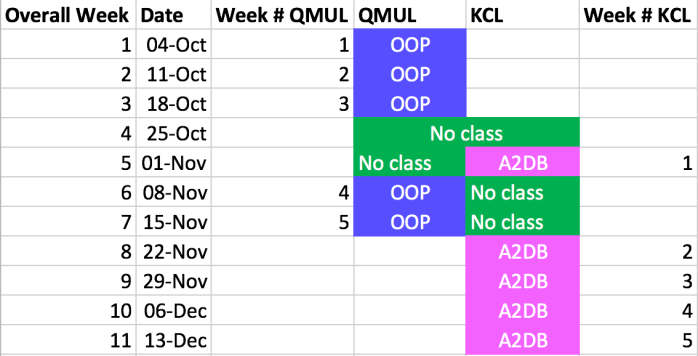
    (5 sessions, £100, 1 Nov to 29 Nov – register of interest full, please contact Jo Brodie (j.brodie@qmul.ac.uk) for waiting list information)
  • Diving Deep into Primary Programming – Winter / Spring
    (All-day session, £60, tbc)

Money available to support London teachers’ CPD / subject knowledge enhancement

Screen Shot 2016-03-23 at 16.09.35

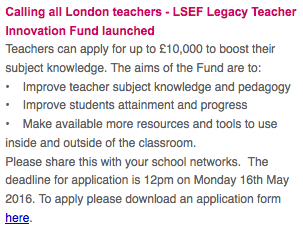
As one of the projects funded by the Mayor of London’s ‘London Schools Excellence Fund’, or LSEF, we receive the regular LSEF bulletins and this caught my eye…

Screen Shot 2016-03-23 at 16.07.39
…its text says…

“Calling all London teachers – LSEF Legacy Teacher Innovation Fund launched
Teachers can apply for up to £10,000 to boost their subject knowledge. The aims of the Fund are to:
•    Improve teacher subject knowledge and pedagogy
•    Improve students attainment and progress
•    Make available more resources and tools to use inside and outside of the classroom.
Please share this with your school networks.  The deadline for application is 12pm on Monday 16th May 2016. To apply please download an application form here.”

There is money available to support teachers in London develop their own knowledge and share their learning with other teachers. Computer Science is explicitly listed among the subject options, which also includes languages, maths, science and tech.

From the FAQ, teachers / applications must satisfy the following London Teachers Fund Criteria –

  • Improve the subject knowledge and pedagogy of teachers
  • Improve students attainment and progress
  • Make available more resources and tools for teachers to use in the classroom
  • You need to be a qualified teacher working in a school or state supported education provision in one of the 33 London Boroughs

Visit the Shine Trust’s website (who are managing the innovation fund for LSEF) for more information and links to application forms and the FAQ etc. Good luck :)

[London only] Friday afternoon cs4fn freebie giveaway

After last week’s rather popular Ada Lovelace magazine giveaway I’ve found some other bits and pieces in my boss’s office where we have enough of them to make 10 ‘packs’. This week it’s just for Londoners as I’m also including a flyer for our free Christmas magic show which is taking place on Wednesday 2 December at 5pm. I’ll definitely do more stuff for non-Londoners next week, promise :)

What’s in the pack?

photo(5)

  • a flyer for our Christmas magic show
  • A magic book
  • A pack of cards
  • A cs4fn magazine
  • A teleporting robot sheet
  • The robot dot illusion sheet
  • Biology loves Technology mini booklet
  • Hexahexaflexagons booklet and a sheet of hexahexaflexagons for you to cut out, fold, glue together and flex.

I couldn’t fit any more into the envelope! (I did a test run).

If you fancy receiving this early next week then fill in this London-centric form below and if you’re in the first ten (and your address is London) I’ll post you a pack. Non-London addresses (ie if you’re not within one of the 33 boroughs of London) will be deleted I’m afraid.

[FREE] BBC micro:bit training for teachers at CAS East London Hub meeting

CAS East London Hub Meeting: BBC micro:bit training [tickets]

Thursday 19 November 2015 from 4:45- 6:15pm, Free.
East London Hub
City & Islington Sixth Form College

BBC micro:bit Training. Hands-on session teachers of year 7’s to find out about using the micro:bit. For further information: Ceinwen Hilton (ceinwen.hilton@candi.ac.uk)

PROGRAMME

Time Topic
16:45 Registration and Refreshments
17:00 Introduction
17:15 Practical
18:00 Feedback

Tickets for this event (free)

An invitation to join our ‘Engagement Network’ for Computer Science teachers in London

The Teaching London Computing project was a two year (2014-2015) project funded by the Mayor of London to support Computing teachers in London who are delivering the new computing curricula. We are currently in the middle of an A-level Computing CPD course and also have some new workshops (free) and miniCPD (not free) sessions coming up as the year ends. We hope to continue providing CPD support to London teachers as it has proved to be a popular and much-needed thing, and we like doing it.

Of course we are not the only organisation offering support and the Events pages at the Computing At School website has information about courses, events, resources etc available across the UK.

Teaching London Computing are applying for extra funding from the Mayor of London to further support teachers of Computing in London, building on the CAS London regional network and Teaching London Computing. As part of this we have been asked to give details of schools that will be involved in our application. If you would like to be part of this network please fill in the details in this Google form. Your data will be stored at QMUL and shared only with the Mayor’s office.

But I’m already on your mailing list, will that do?
Unfortunately not – people signing up to one of our mailing lists have agreed that we can use their contact details to send them information about our courses and events and / or to receive free copies of cs4fn magazines. We can’t assume that they’re happy to be in our engagement network unless they tell us, and we have to let them know how their data will be used as part of that separate purpose.

• Would you like to know about our future events for London teachers? Sign up here
• Would you like to receive free cs4fn magazines for your school? Sign up here (goes to cs4fn website)

What is Teaching London Computing currently up to?
We have around 20 teachers on our A-level Computing CPD evening course and we are running the following events in November and December.

1. Free workshop – £0
Sorting Unplugged with Paul Curzon
Date and time: Wednesday 25 November from 5.00pm until ~6.30pm
Location: Room BR 3.01 (Bancroft Road Teaching Rooms at QMUL)
[More info about Sorting Unplugged] [Get a free ticket for Sorting Unplugged

2. miniCPD sessions – £30 for London teachers, £60 for non-London teachers
Introduction to Arduino with Nicola Plant
Date and time: Saturdays 21 or Saturday 28 November, from 2pm to 5pm
Location: G2 Matlab, Engineering Building at QMUL
[More info about Introduction to Arduino]
[Buy a ticket to Introduction to Arduino – 21 November]  [Buy a ticket to Introduction to Arduino – 28 November]

As you might expect from the name, miniCPD sessions are somewhere between workshops and CPD classes and focus on a particular topic in depth.

3. Free magic show – for secondary school-aged children – £0
The Magic of {Christmas} Computer Science with Paul Curzon and Peter McOwan
We’re delighted to be hosting the IET Christmas Children’s Lecture at the People’s Palace (at QMUL). The Magic of {Christmas} Computer Science is a magic show powered by hidden computer science and will take place from 5pm to 7pm on Wednesday 2 December. Please pass this (and the attached flyer) on to your pupils and their families, thank you.
[More info about the magic show]  [Get a free magic show ticket] [Download a flyer]

Our next events: [teachers] free workshop, not-free ‘Intro to Arduino’ miniCPD, [kids] free magic show

Our diary of events is as follows, everything is taking place at QMUL (Mile End Campus). Details and tickets below.

  • Saturday 21 November (1-5pm) £30/60
    Introduction to Arduino, with Nicola Plant – a ‘miniCPD’ session on programming using an Arduino with simple electronics
  • Wednesday 25 November (5-6.30pm) FREE
    Sorting Unplugged, a free workshop with Paul Curzon
  • Saturday 28 November (1-5pm) £30/60
    Introduction to Arduino, with Nicola Plant – a ‘miniCPD’ session on programming using an Arduino with simple electronics – note that this session is identical to the one on the 21st, we’re running it twice
  • Wednesday 2 December (5-7pm) FREE
    The IET Christmas Children’s Lecture on ‘The Magic of Christmas Computer Science‘ with Paul Curzon and Peter McOwan

More details and tickets
Events for Computing teachers in London

Introduction to Arduino – Aimed at teachers of pupils at KS3 and above our miniCPD session will introduce you to programming using an Arduino with simple electronics. There are two identical sessions on Saturday 21 and Saturday 28 November, from 1-5pm, both capped at 15 guests.
[Tickets for 21 Nov session] [Tickets for 28 Nov session] £30 (London teachers) / £60 for teachers outside London

Sorting Unplugged‘ – demonstrating some practical and powerful ways to teach basic sort algorithms using unplugged methods, Wednesday 25 November 2015, from 5pm.
[Get a free ticket for this workshop]

Aimed at secondary school children and young people

The Magic of Christmas Computer Science‘ – a magic show powered by hidden computer science. Profs Paul Curzon and Peter McOwan present the IET’s Christmas children’s lecture
[Get a free ticket for this magic show]

FREE summer school for 14-18yo at UCL on 3D animated short film – #art #computing

Please pass this information on to arts or computing teachers, and pupils / students who might be interested in a free animation summer school.
3dami
When Wednesday 22 July to Thursday 30 July 2015
Where UCL, London
For whom 14 to 18 year old UK pupils / students
Cost FREE (includes free food, accommodation and transport)
What – 3D animation summer school
3Dami is a 7 day summer school where groups of students run their own studio and create their own animated short film from scratch. It operates at the intersection of art and technology (computer science), and is well suited to students with an interest in both. Students get to experience a semi-realistic studio setup, and create their film as a real studio would – it requires teamwork, thinking on their feet and hard work. The skills taught are directly related to the film effects and computer game industries, both of which are booming in the UK. There will be an industry visit and talks given by experts. The event is completely free for UK students aged 14-18 (includes free food, transport and accommodation!) and runs at UCL (London) from July 22nd to 30th. Please visit the website (3dami.org) to watch last years films and for further details, including how to apply.
Find out more and how to apply at http://www.3dami.org
Supported by
3Dami is supported by Creative Skillset’s Film Skills Fund, which is funded by the BFI with National Lottery funds, through the Skills Investment Funds. The event is happening with support from City and Islington and the CAS Hub. There is also another event happening in Cardiff, see the website for more info.

Two free Computing workshops for London teachers on Tuesday 26 May @QMUL / @QMEECS

We have another two workshops happening next week, on the afternoon of Tuesday 26 May, at Queen Mary University of London. Both are free and you are welcome to attend either or both (but you will need to register for each separately) – there is a half hour break between the two workshops.

Thanks to funding from the Mayor of London we are able to offer these workshops at no charge but we do prioritise London Computing teachers though other Computing teachers are welcome too. The workshops are not suitable for school pupils however.

For more information please contact Jo Brodie (j.brodie@qmul.ac.uk)

The workshops below are named ‘2’ and ‘3’ as they are part of a series of three, however the first one “Explorers need maps: Abstraction, Representations and Graphs” (last Monday) has finished but the information and slides are available on the workshop website.


Workshop QMUL2: Tue 26 May 2015, 1.30 to 3pm

Primary Computing Unplugged

Overview

Computing doesn’t need to be taught at a computer and in fact to get across key concepts it is often better (and more fun) not to. This is especially true of the early stages of learning programming and computing more generally. A core idea behind the new computing syllabus is computational thinking. We will give you a deeper understanding of computational thinking and give practical ways to teach both it and other computing topics such as programming away from computers. Computational thinking is a fundamental skill set that students learn by studying computing. We will demonstrate a range of activities that show how core ideas and concepts can be introduced using fun unplugged activities and games. We will show that computing can be fun for everyone and that it doesn’t have to be taught at a computer.

Session material

This session presents a variety of activities from the other workshops. It will cover:

  • What is Computational Thinking?
  • Inspiring ways to teach Computational Thinking.
  • What is an algorithm
  • Writing your first program

Eventbrite - QMUL 02: Paul Curzon workshop - Primary Computing Unplugged for Workshop 2 – Primary computing unplugged
More information about this workshop on our page for Primary computing unplugged.

Workshop QMUL3: Tue 26 May 2015, 3.30 to 5pm

The Magic of Computer Science

Overview

When you learn to be a magician, it turns out you are learning the skills needed to be a great computer scientist too: computational thinking. Just like software, magic is a combination of algorithms and presentation. In this workshop we will demonstrate some simple to do but strong magic tricks. We teach the group how they are done so they can do the tricks themselves and then use the magic to illustrate the linked basics of computing. Overall we will show what computational thinking is all about and how both magicians and computer scientists rely on it.

Session material

This session will demonstrate a variety of activities from the other workshops. It will cover:

  • What is Computational Thinking?
  • Inspiring ways to teach Computational Thinking using easy to learn magic tricks.

Eventbrite - QMUL 03: Paul Curzon workshop - The Magic of Computing for Workshop 3 – The magic of computing
More information about this workshop on our page for The magic of computing.