List of sessions at the CAS London Conference 2018 – Sat 24th Feb

Updated 6 Feb 2018, v6

The CAS London Conference 2018 will be held on Saturday 24th February at Gladesmore Community College in North London (South Tottenham, N15 6BF). It’s an all day event with an opening keynote from Jon Nixon from Ofsted, and talks, workshops and demos exploring different aspects of Primary and Secondary Computer Science. Download a flyer.

There are four session blocks (2 in the morning, 2 in the aternoon) and you can pick one from each. The full list of workshop and talks is below the ‘plan for the day’.

Doors at 9.10am, opening keynote is at 9.40am, first morning session at 10.20am. There will be other activities and networking opportunities at lunch.

Eventbrite - CAS London Conference

CAS London Conference – plan for the day

Start End Session
09:10 09:35 Delegate registration and morning refreshments
09:40 10:15 Opening keynote John Nixon, Ofsted National Lead for Computing
10:20 11:20 Session 1
11:25 12:25 Session 2
12:30 13:30 Lunch & Drone Demonstration (Staggered lunch start 12:30 and 12:45)
13:35 14:35 Session 3
14:40 15:40 Session 4
15:45 16:15 Plenary: Cyber Schools Programme – Michael Heering (TBC) & Fireflies!

Session 1

  • Primary – Smelly code and primary programming pedagogy with Jane Waite
    In this hands of session, you will mark code and create a practical student checklist of what makes sweet code! Bring along code for marking! We will also look at two very practical methods to review your planning to reveal what pedagogy you already use. We will look at instructional approaches to scaffold learning as well as ideas for encouraging independence and mastery.
  • Primary – iPads Tried and test apps for classroom impact with Gillian Arnold
  • Secondary – pedagogy with William Lau
  • Secondary – AQA exam board session with  Chris Swan
  • Primary –  Using tangible programming to support SEN children with the computing curriculum with Jody Carter
  • Primary/Secondary – Minecraft (using virtual worlds and programming) with Simon Johnson (CLC Cimon)
  • Secondary – Python Introduction with Jon Feleppa
  • Creative projects with the micro:bit (python focus)
  • A level – Databases in Python with Hardip Mothada
  • A level – OOP with William Marsh

Session 2

  • KS2/3 – FastForward. Machine Learning & Big Data including digital identity With Paul Curzon and Jane Waite
    Are driverless cars fact or fiction? Can machines make better AI than humans can? How is our data used? Can we support our young people to understand their online (and real life) persona? Practical ideas for starters, plenaries and projects. 
  • Secondary – Algorithm writing with pseudo code and flow charts with Trevor Bragg
  • Secondary – Edexcel exam board with Atif Khan
  • Primary – Physical computing pedagogy session – not what to teach but how to teach physical – including use of spheros, microbits, bluebots, drones with Nic Hughes
  • Primary – Google classrooms/G Suite – Darren Murphey & Wendy McLeod
  • Secondary – Creating websites with HTML
  • Secondary – Stride (a framebased editor to transition from blocks to text) with Michael Koelling
  • A level – Teaching embedded systems with Arduino and Linker with Michael Jones
  • A level – Teaching Boolean Algebra & Karnaugh Maps with Eliot Williams

Session 3

  • Early Years and KS1 – Cubetto and Early Years with Helen Cheung & Eleni Vasileiadou
  • Drones with the Royal Academy of Engineering (KS3 focus but may be of interest to KS2) with Scott Atkinson & Ivan Gutowski-Smith
    This session will explore how drones work and how they can be used for civilian, humanitarian and commercial purposes. This resource is designed as an introduction to the uses of drones, aimed at dispelling the myth that they are just weapons or toys. In fact they have wider ranging practical civil, humanitarian and commercial applications. We will also explore how drones can be reverse engineered, exploring ways in which enquiring minds can build their own functioning quadcopter. All the resources are also available on our website at: https://www.raeng.org.uk/education/schools/teaching-and-learning-resources/curriculum-resources including Engineering in the Movies and RAF100 ‘Aiming for Awesome’ which will be demonstrated during this session.
  • A level – NEA project assessing/ standardisation with Garfield Godon
  • Secondary – OCR exam board with Vinay Thawait
  • Primary – Scratch Maths (Year 6 resources) with Pier Saunders (UCL)
  • KS1 to KS4 – Networks with Duncan Maidens (back by popular demand)
  • KS4 – Teaching data representation (with practical activities that involve manipulating images and sound in Python) with Alex Hawden-Bennet
  • KS3/4 – Pedagogy for programming – PRIMM with Sue Sentence
  • A level – C# with Martin Richards
  • KS4/5 Data Analysis with Jupyter Notebooks –Michel Wermelinger and Clifford French
    Michel Wermelinger will demonstrate how to use Python in Jupyter Notebooks, running in a browser, to analyse data on world diseases. Jupyter notebooks provide an intuitive, easy to use environment that integrates explanations, exercises and the output of the code so that students program incrementally and get immediate feedback. Teachers will be able to use what they learn both in computer science lessons and in Science or Geography at KS4 (or higher) with no need to install software.

Session 4

  • Primary – Assessment with Phil Bagge
  • KS3/4 – Embedding Computational Thinking with Rob Heathcote (PG Online)
  • Primary – Unplugged programming and programming with Scratch
  • Primary – LGFL cross curricula with VR with Bradely Dardis
  • KS2/3/4 – Cybersecurity with Duncan Maidens
  • KS4 – CraignDave – Challenges of teaching GCSE and flipped classroom solutions.
  • KS4/5 – Sorting and Searching Algorithms in Python with Demetrios Skamiotis
  • A level – Advanced Python e.g. Web Development Frameworks and Python with Sue Sentance
  • A level – Big O notation with Python with Ramzi Ramzi
    This session will cover what Big O is, explaining O(1), O(N), O(N^2), and O(log N). Practical online activities will get you  coding each example in Python using variously sized datasets (whilst hopefully not crashing all of computers!) By the end of the session, you will feel more confident explaining and showing students, what Big O is using Python.
Eventbrite - CAS London Conference

[London] Primary computing CPD events coming up this Spring

Obviously there’s our CAS London Conference on 24 February 2018 (for both primary and secondary teachers) but the following may interest too.

1 Feb 2018: How to use Scratch at KS2 with Nic Hughes – two afternoon sessions, one from 1.30-3.30pm and one from 4-6pm, both £40.

7 Feb 2018: BBC micro:bit in computing, 1 day – ENTHUSE funding available to make this a FREE course.

10 Feb 2018: Makey Makey – 1 day course –  only £15 with Tom Heck from the US Makey team, includes a free Makey Makey

28 February 2018: Teach Algorithms and Data Structures to A-Level using Python 2018 – 5 week twilight course for teachers of A level computer science.
Course now FULLY BOOKED. Contact Jo for a place on the waiting list.

from 5 March 2018: Diving deep for Primary Programming with Jane Waite – only £100 and FREE for Master Teachers, CAS Hub leader and NoE University Contacts. Three day course over two months. [5 March, 19 March and 16 April]

15-16 March: Assessment and progression in primary computing with Phil Bagge – 2 day course – ENTHUSE funding available to make this a FREE course.

Two CAS London Teach A-Level Computer Science courses in Autumn 2017

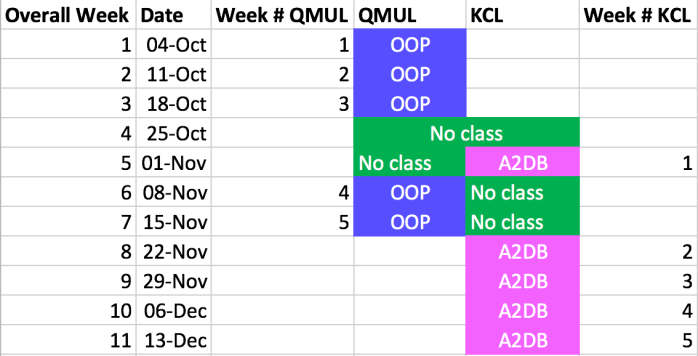
Update 18 September 2017: The A2 Projects with Databases & Python course (pink in the diary image below) is now full but we have spaces on the Object Oriented Programming course at QMUL (blue in the image below). If you’re attending the A2DB course you’ll be able to attend the OOP one as well.

Screenshot 2017-10-13 10.57.40


We have two ‘Teach A Level Computer Science’ courses coming up later this year. Please bookmark this page as it will shortly be updated with details of the earlier course (to be held at Queen Mary University of London in October / Nov). The details of the later course (to be held at King’s College London Waterloo in Nov / Dec) are below. Both cost £100 and free places are available for CAS Master Teachers.

  1. Teach A-Level Computer Science: Object Oriented Programming
  2. Teach A-Level Computer Science: A2 Projects with Databases and Python

Please note that these courses are for in-service teachers who are already confident in teaching computing at GCSE level, Python will be the programming language used.

The course dates are arranged so that it will be possible for teachers to attend both courses.


1. Teach A-Level Computer Science: Object Oriented Programming

Find out more and book a place

Course dates

  • Wed 4 October
  • Wed 11 October
    [Break – Wed 18 Oct]
  • Wed 25 October
    [Break – 1 Nov]
  • Wed 8 Nov
  • Wed 15 Nov

Location: Queen Mary University of London
Tutor: Dr William Marsh, CAS London

2. Teach A-Level Computer Science: A2 Projects with Databases and Python

Find out more | Apply for a place

Course dates

  • Week 1 (1 Nov 2017) – Single table databases and sqlite3
    [Break – 8 Nov]
    [Break – 15 Nov]
  • Week 2 (22 Nov 2017) – Foreign keys and relationships
  • Week 3 (29 Nov 2017) – Many-many relationships
  • Week 4 (6 Dec 2017) – Developing a project for A-Level Part 1
  • Week 5 (13 Dec 2017) – Developing a project for A-Level Part 2

Location: King’s College London, Waterloo
Tutor: Dr Sue Sentance, CAS London

For more information please contact Jo (j.brodie@qmul.ac.uk)

Surveying computing teachers – primary programming and micro:bit use in secondary classes

If you’re a Computer Science or Computing teacher at secondary or primary level we’d be very grateful for your input in any of the surveys below please :)

PRIMARY TEACHERS

1. Using Design in Primary Programming – Research Project
This survey is run by Jane Waite as part of her research at Queen Mary University of London (one of the two universities which forms the CAS London Regional Centre).

Jane says…

Last year, I started research looking for a magic bullet for teaching abstraction in primary schools. However, I discovered that research requires you to look at one tiny aspect of a big subject in order to gradually build a solid body of evidence. So now I am focusing on one aspect of abstraction, how we use design when teaching programming, and how we might reuse our expertise in teaching writing when we teach programming.

My work builds on research from across the world, but all of it with older pupils. From Israel to the US via Scotland, Netherlands and Germany I am knitting threads of theory and practise together but for teaching younger learners.

If you teach programming to primary children, in school, out of school, formally or informally and have 15 minutes to spare, I would be indebted if you could complete our survey, the link is https://goo.gl/forms/EQFaZvBBPjOeZNin2 or https://tinyurl.com/design-JW

2. Please tell us what you thought of A Bit of CS4FN
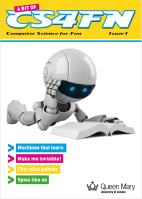
abitofcs4fn front cover screenshotSome of you will have subscribed to receive printed copies of our newest version of CS4FN magazine – the mini ‘A bit of CS4FN’ edition for primary schools. We’ve posted them out and would love to know what you think of them. This survey is also from Queen Mary University of London.
Please tell us how you found the magazine and website:
https://bit.ly/abitofcs4fnsurvey

SECONDARY TEACHERS

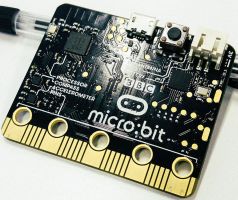
BBC_MicrobitThe research survey below is from the CAS London team at King’s College London, looking at how teachers are using the BBC micro:bit in their classroom.

TEACHING WITH THE BBC MICRO:BIT
You are invited to participate in a web-based online survey on using the BBC micro:bit in your programming classes. This is a research project being conducted by Filiz Kalelioğlu and Sue Sentance at King’s College London. It should take approximately 10-15 minutes to complete.

New 2017 short courses from CAS London at King’s (Waterloo)

We have a series of twilight courses which will take place at King’s College London (Waterloo) campus, under the CAS London (King’s College London / Queen Mary University of London) banner on Monday and Wednesday evenings in 2017. Each lasts between five and eight weeks with courses costs from £100 to £200.

PDF flyer for these events with clickable links.


KS3 Computing

January – March 2017

Teach KS3 Computing
Monday Evenings 5pm to 7pm
23rd January to 20th March (8 sessions)
£160
generic-eventbrite-register-button


MA Module in Computing Education

January – March 2017

Computer Science Education: Theory and Practice (30-credit Masters’ module).
Tuesday evenings 5.30pm to 7.30pm
17th January to 28th March.
Focus on research in computer science education and start working towards a Masters’ degree. Includes 6,000 word assignment.
£1,150

generic-eventbrite-register-button


GCSE Computing

April – July 2017

Teach GCSE Computing
Monday Evenings 5pm to 7:30pm
24th April to 3rd July (10 sessions)
£200
generic-eventbrite-register-button


A level computing

March 2017

Teach A level computing: Algorithms and Data Structures
Five twilights on Wednesdays at King’s College London
Cost: £100
Starts Wednesday 1st March ends Wednesday 29nd March 2017 (5.00-7.30pm)
generic-eventbrite-register-button

(note that this course was originally advertised in November with a start date in the last week of February and this has been moved back to the first week of March – 4 Jan 2016)


June – July 2017

Teach A level computing: Object Oriented Programming in Python
Five wednesday twilights at King’s College London.
Cost £100
Starts Wednesday 7th June 2017 ends Wednesday 5th July 2017 (5.00-7.30pm).
generic-eventbrite-register-button


November 2017

Teach A level computing: A2 Projects with Databases and Python
Five Wednesday twilights at King’s College London.
Cost £100
Starts Wednesday 1st November 2017 ends Wednesday 29th November 2017 (5.00-7.30pm)
generic-eventbrite-register-button

An invitation to join our ‘Engagement Network’ for Computer Science teachers in London

The Teaching London Computing project was a two year (2014-2015) project funded by the Mayor of London to support Computing teachers in London who are delivering the new computing curricula. We are currently in the middle of an A-level Computing CPD course and also have some new workshops (free) and miniCPD (not free) sessions coming up as the year ends. We hope to continue providing CPD support to London teachers as it has proved to be a popular and much-needed thing, and we like doing it.

Of course we are not the only organisation offering support and the Events pages at the Computing At School website has information about courses, events, resources etc available across the UK.

Teaching London Computing are applying for extra funding from the Mayor of London to further support teachers of Computing in London, building on the CAS London regional network and Teaching London Computing. As part of this we have been asked to give details of schools that will be involved in our application. If you would like to be part of this network please fill in the details in this Google form. Your data will be stored at QMUL and shared only with the Mayor’s office.

But I’m already on your mailing list, will that do?
Unfortunately not – people signing up to one of our mailing lists have agreed that we can use their contact details to send them information about our courses and events and / or to receive free copies of cs4fn magazines. We can’t assume that they’re happy to be in our engagement network unless they tell us, and we have to let them know how their data will be used as part of that separate purpose.

• Would you like to know about our future events for London teachers? Sign up here
• Would you like to receive free cs4fn magazines for your school? Sign up here (goes to cs4fn website)

What is Teaching London Computing currently up to?
We have around 20 teachers on our A-level Computing CPD evening course and we are running the following events in November and December.

1. Free workshop – £0
Sorting Unplugged with Paul Curzon
Date and time: Wednesday 25 November from 5.00pm until ~6.30pm
Location: Room BR 3.01 (Bancroft Road Teaching Rooms at QMUL)
[More info about Sorting Unplugged] [Get a free ticket for Sorting Unplugged

2. miniCPD sessions – £30 for London teachers, £60 for non-London teachers
Introduction to Arduino with Nicola Plant
Date and time: Saturdays 21 or Saturday 28 November, from 2pm to 5pm
Location: G2 Matlab, Engineering Building at QMUL
[More info about Introduction to Arduino]
[Buy a ticket to Introduction to Arduino – 21 November]  [Buy a ticket to Introduction to Arduino – 28 November]

As you might expect from the name, miniCPD sessions are somewhere between workshops and CPD classes and focus on a particular topic in depth.

3. Free magic show – for secondary school-aged children – £0
The Magic of {Christmas} Computer Science with Paul Curzon and Peter McOwan
We’re delighted to be hosting the IET Christmas Children’s Lecture at the People’s Palace (at QMUL). The Magic of {Christmas} Computer Science is a magic show powered by hidden computer science and will take place from 5pm to 7pm on Wednesday 2 December. Please pass this (and the attached flyer) on to your pupils and their families, thank you.
[More info about the magic show]  [Get a free magic show ticket] [Download a flyer]

[FREE] Three new workshops for teachers from Teaching London Computing on 18 and 26 May

We’ve added another three workshops to our activities and will be running these across two sessions in a couple of weeks. Our previous workshops (at Queen Mary University of London or as part of an invited talk elsewhere) have been very popular.

Workshop One: Mon 18 May 2015, 5.30 to 7pm

Explorers need maps: Abstraction, Representations and Graphs

Overview

Abstraction – essentially just hiding information – is a core part of computational thinking that is closely linked to the choice of data representation. We will give a deeper understanding of abstraction, providing fun ways to teach it, based on cs4fn / Teaching London Computing resources. The great explorers didn’t just wander around new continents finding things. They drew maps. Maps are just abstractions of the world. Based on games and puzzles, we will see how drawing a special kind of map called a graph and a variation the finite state machine is a part of computational thinking problem solving. They are useful tools for understanding how to use, exploring and designing computer systems.

Session material
This session will cover:

  • What is Computational Thinking?
  • Inspiring ways to teach Computational Thinking.
  • What is abstraction?
  • Why does the choice of data representation matter when solving problems?
  • What is a graph and why are they useful?
  • What is a finite state machine and why are they useful?

Eventbrite - QMUL 01: Paul Curzon workshop - Abstraction, Representations and Graphs for Workshop 1 – Abstraction, Representations and Graphs
More information about this workshop on our page for Abstraction, representations and graphs.

The second and third run on the same day at half-term, on Tuesday 26 May 2015 (you can come to the first or the second or both, but you will need to register for both separately).

Workshop Two: Tue 26 May 2015, 1.30 to 3pm

Primary Computing Unplugged

Overview

Computing doesn’t need to be taught at a computer and in fact to get across key concepts it is often better (and more fun) not to. This is especially true of the early stages of learning programming and computing more generally. A core idea behind the new computing syllabus is computational thinking. We will give you a deeper understanding of computational thinking and give practical ways to teach both it and other computing topics such as programming away from computers. Computational thinking is a fundamental skill set that students learn by studying computing. We will demonstrate a range of activities that show how core ideas and concepts can be introduced using fun unplugged activities and games. We will show that computing can be fun for everyone and that it doesn’t have to be taught at a computer.

Session material

This session presents a variety of activities from the other workshops. It will cover:

  • What is Computational Thinking?
  • Inspiring ways to teach Computational Thinking.
  • What is an algorithm
  • Writing your first program

Eventbrite - QMUL 02: Paul Curzon workshop - Primary Computing Unplugged for Workshop 2 – Primary computing unplugged
More information about this workshop on our page for Primary computing unplugged.

Workshop Three: Tue 26 May 2015, 3.30 to 5pm

The Magic of Computer Science

Overview

When you learn to be a magician, it turns out you are learning the skills needed to be a great computer scientist too: computational thinking. Just like software, magic is a combination of algorithms and presentation. In this workshop we will demonstrate some simple to do but strong magic tricks. We teach the group how they are done so they can do the tricks themselves and then use the magic to illustrate the linked basics of computing. Overall we will show what computational thinking is all about and how both magicians and computer scientists rely on it.

Session material

This session will demonstrate a variety of activities from the other workshops. It will cover:

  • What is Computational Thinking?
  • Inspiring ways to teach Computational Thinking using easy to learn magic tricks.

Eventbrite - QMUL 03: Paul Curzon workshop - The Magic of Computing for Workshop 3 – The magic of computing
More information about this workshop on our page for The magic of computing.

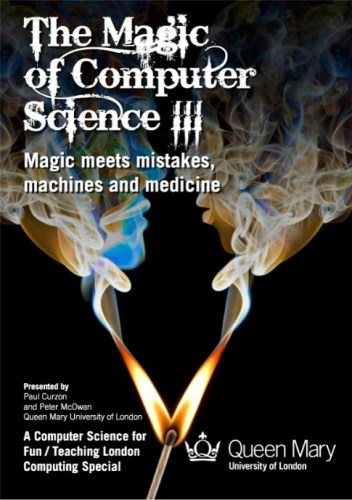
Introducing: free booklet “The magic of computer science: magic meets mistakes, machines and medicine”

Blogpost crossposted on both CHI+MED and Teaching London Computing sites.

We have a new booklet out which you can download as a PDF (click on the picture below to visit the book’s microsite) and find out more about where “magic meets mistakes, machines and medicine”.

The Magic of Computer Science 3: magic meets mistakes, machines and medicine
magicbookcover3cs4fn (Computer Science for Fun) is an outreach project from Queen Mary University of London (QMUL) which aims to enthuse school-aged children about computer science. There’s a website and a magazine (usually two issues a year) with special issues and booklets – this is the latest magic booklet.

Paul Curzon and Peter McOwan who set up cs4fn at QMUL are both magicians and also both work on the CHI+MED project and Teaching London Computing. Previous blog posts have referred to to CHI+MED’s use of magic in our public engagement work.

“The cs4fn magic books are collections of easy to do magic tricks (mainly simple card tricks). The twist is that every trick comes with a link to some computer science too. That means that as you learn the tricks, you will learn something about what computer scientists get up to too.

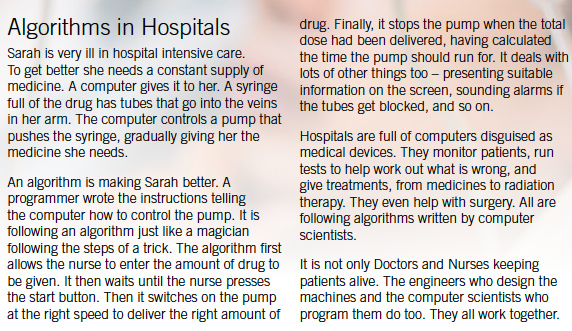
Magic is a combination of a secret method and a presentation. A computer scientist would call the method an algorithm, and that is all a computer program is too. The presentation corresponds to the interaction design of a program. For a magic trick to delight, you must get both the algorithm and presentation right. The same is true for programs.”

Screen Shot 2015-03-25 at 17.22.36

This comes from page 9 of the booklet.

This booklet is published by cs4fn (Computer Science for Fun) in partnership with Teaching London Computing (TLC) and CHI+MED. CHI+MED is funded by the EPSRC and Teaching London Computing by the Mayor of London and the Department for Education.

Download the Magic books