
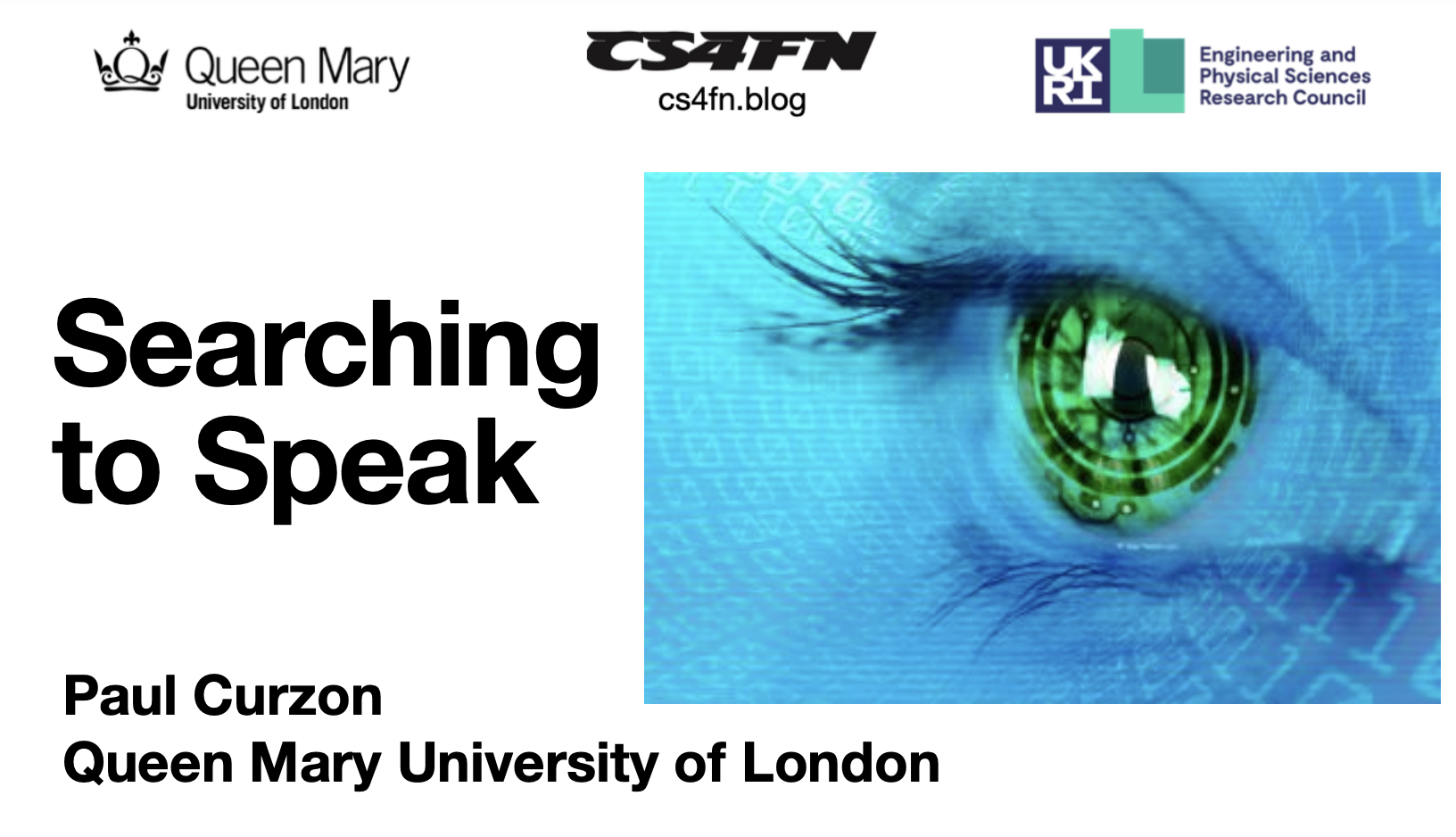
The Primary Maths Masterclass of Searching To Speak highlights some primary school maths embedded in a story about helping people with disability. It shows how lots of simple maths and computation arise when solving the problem of helping a paralysed person communicate. Along the way it teaches some core search algorithms. It was inspired by the book: the Diving Bell and the Butterfly, by Jean-Dominique Bauby.
The workshop was written by Paul Curzon as part of his CS4FN project. It is designed to be 2 hours long including a 10 minute break.
- Explore the design of an algorithm to allow someone with locked-in syndrome to communicate. Locked-in syndrome is a condition resulting from a stroke where a person is totally paralysed. They can see, hear and think but cannot speak. How could a person with Locked-in syndrome write a book? How might they do it if they knew some computational thinking? What maths is used a long the way.
- Use the maths of algorithms and computation, averages, tallying, histograms and data visualisation, frequency and frequency analysis.
- Learn about computational thinking, search algorithms, linear search, binary search, divide and conquer, code cracking, and comparing algorithms.
- Along the way Al-Kindi and Florence Nightingale get name checks.
Slides and Blink Cards
Worksheets for main activities
- Blink Instructions [pdf]
- Frequency Analysis Instructions [pdf]
- Tally Sheet [pdf]
- Decision Tree [pdf]
Extension sheets
Extra activities for a longer session
- Cracking Ciphers [pdf]
- Cracking Ciphers (Answer) [pdf]
- Distributed Frequency Analysis [pdf]
- Distributed Tally Sheet [pdf]
Video
- Find the emotional robot video here:
Related Resources
- Download the full colour booklet: Computational Thinking: Searching To Speak (full colour)
- An earlier black and white plain text version is also available: Computational Thinking: Searching To Speak (plain text).
- Download the classroom activity sheets: Activity: Locked-In and Activity: 20 Questions

EPSRC supports this work through research grant EP/W033615/1,
 Teaching London Computing: A RESOURCE HUB from CAS LONDON & CS4FN