Debugging Spot the Difference

Solve spot the difference puzzles based on programs, practice debugging and develop an attention to detail. 

Spot the difference puzzles are usually done on pictures. Here we do them with code. We have scattered typical mistakes and slips through programs. Do you have the attention to detail to find them all. Check your own code as you write it and when you get compiler errors for similar mistakes. Attention to detail is an important skill for computer scientists to develop.

Learn about:

  • debugging
  • the importance of attention to detail

Resources:

[London only] Friday afternoon cs4fn freebie giveaway

After last week’s rather popular Ada Lovelace magazine giveaway I’ve found some other bits and pieces in my boss’s office where we have enough of them to make 10 ‘packs’. This week it’s just for Londoners as I’m also including a flyer for our free Christmas magic show which is taking place on Wednesday 2 December at 5pm. I’ll definitely do more stuff for non-Londoners next week, promise :)

What’s in the pack?

photo(5)

  • a flyer for our Christmas magic show
  • A magic book
  • A pack of cards
  • A cs4fn magazine
  • A teleporting robot sheet
  • The robot dot illusion sheet
  • Biology loves Technology mini booklet
  • Hexahexaflexagons booklet and a sheet of hexahexaflexagons for you to cut out, fold, glue together and flex.

I couldn’t fit any more into the envelope! (I did a test run).

If you fancy receiving this early next week then fill in this London-centric form below and if you’re in the first ten (and your address is London) I’ll post you a pack. Non-London addresses (ie if you’re not within one of the 33 boroughs of London) will be deleted I’m afraid.

R4 programme on Ada Lovelace (2 days left to listen)

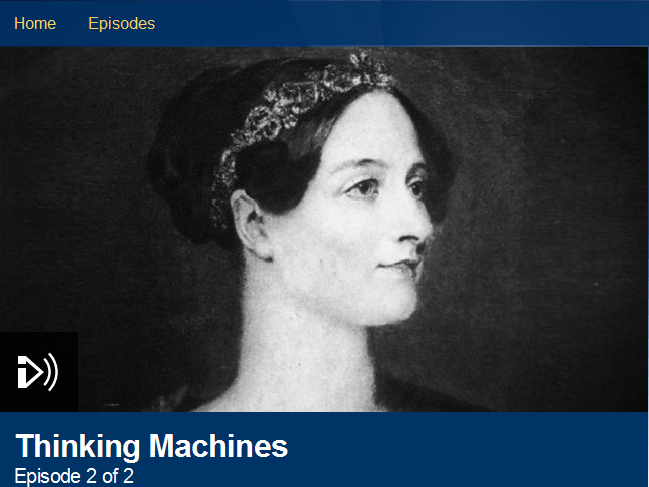
BBC Radio 4 has a two-part series on Ada Lovelace’s letters. Alas Part One of the series has already passed into the ‘programme no longer available’ territory, but Part Two (~28m) is live to listen to online for the next couple of days [at time of writing!].

Our cs4fn magazine special issue on Ada Lovelace isn’t going anywhere though, please download a free PDF at your leisure :)

adaletters.png

“In part two of this dramatization of The Letters of Ada Lovelace, Georgina Ferry reveals the nature of the relationship between the young heiress, Ada Lovelace (Sally Hawkins) and the crusty mathematician, Charles Babbage (Anthony Head), inventor of steam-powered calculating machines.

More info at the programme’s page.

What else are we up to?

1.Saturday 21 Nov – £30/60, 2-5pm
Introduction to Arduino [info] [tickets]
Aimed at teachers of pupils at KS3 and above our miniCPD session will introduce you to programming using an Arduino with simple electronics.

2. Wed 25 Nov – FREE, 5pm
Sorting Unplugged [info] [tickets]
This is a free workshop, aimed at computer science teachers, which introduces sorting algorithms in an ‘unplugged’ style.

3.Sat 28 Nov – £30/60, 2-5pm
Introduction to Arduino [info] [tickets]
Aimed at teachers of pupils at KS3 and above our miniCPD session will introduce you to programming using an Arduino with simple electronics.

4. Wed 2 Dec – FREE, doors 5pm, show at 5.30pm
The magic of {Christmas} Computer Science – free magic show for young people. [info] [tickets]
This is a free public talk aimed at secondary school-aged children and their families & friends. Paul Curzon and Peter McOwan will present a fun magic show powered by hidden computer science. There are rumours of mince pies too.


Woohoo! Our Ada Lovelace issue of the @cs4fn magazine is here :) #lovelaceoxford

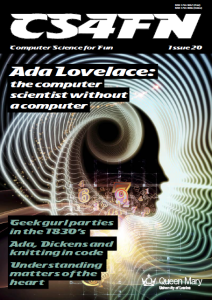
We’re delighted to introduce the 20th issue of cs4fn (Computer Science for Fun) magazine. The latest edition celebrates Ada Lovelace and her lasting influence on computer science today.

Download a free PDF copy of the magazine (see also the magazine’s homepage on cs4fn).

cs4fn 20 cover Ada Lovelace issue2015 is the 200th anniversary of Ada Lovelace’s birth. Famous as ‘the first programmer’ her vision of computer science was far wider. To celebrate, issue 20 of cs4fn magazine explores her life, her ideas and where modern research has taken some of those ideas. Women’s research is also still at the forefront of interdisciplinary computer science. We will look at what other Victorian Computer Science was around at the time and also see how her work linked to the very modern idea of computational thinking.

The magazine was written by Paul Curzon and Peter McOwan from Queen Mary University of London, Jane Waite of QMUL and CAS London, and Ursula Martin of the University of Oxford.

We’re grateful to the EPSRC, Google, the Mayor of London and Department for Education’s for funding support, and cs4fn is also a partner in the BBC’s Make it Digital programme.

To celebrate I’m giving away TEN copies (ie one copy to 10 people) of the magazine to anyone in the UK who fills in the form below. Non-UK submissions will be ignored and the form will (or at least should!) stop accepting submissions once 10 people have filled it in. Your information won’t be used for any other purpose and will be deleted once I’ve posted the magazine(s).

Things I’ve learned while working on the Teaching London Computing project [Pt 1] Eventbrite is fab :)

I’m the Project Manager for Teaching London Computing, a project funded by the Mayor of London and Department for Education which supports London teachers who are delivering the new computing curricula. We do this through a variety of taught courses (covering both subject knowledge and pedgagogy relating to how best to introduce them in the classroom) as well as free workshops and downloadable classroom resources.

Colleagues teach the courses and create the activities and worksheets, other colleagues deal with evaluating the project and its impact (this is a non-commercial research project that takes place in two universities: Queen Mary University of London, where I work, and King’s College London, where I have a visitor’s pass).

At the end of the project (formally 30 September 2015 but we have a no cost extension until the end of the year to finish some bits and pieces off) we submitted a large and detailed self-evaluation document to our funders. In it we tried to capture more than just facts and figures (in fact we were encouraged to by the Mayor’s team as they want to know about challenges and anything that would help someone else running a similar project in future).

I wanted to write a series of blog posts about the day to day minutiae of running a project like this because I think that might also be helpful to people, at least I hope so.

Part One – Eventbrite is fantastic
Screen Shot 2015-11-11 at 18.01.27

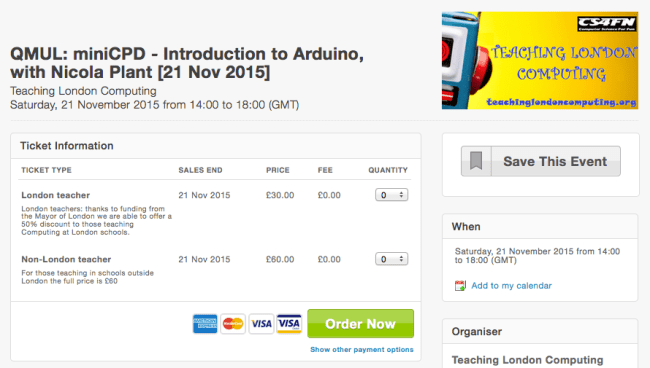
One of our events

For our GCSE and A-level CPD courses, for each place we charge teachers £150 and another £150 to the Mayor’s office (non London teachers aren’t subsidised and must pay the full amount). It is very easy to set up a chargeable event on Eventbrite (the fiddliest bit was finding the IBAN number for QMUL and explaining that we’d be putting money into that account and then later moving it into under our own grant code) and handle payments through credit cards or via invoicing [we do the invoicing ourselves, not via Eventbrite].

I do remember explicitly writing in the report that time spent becoming familiar with the event management tools (and that includes the WordPress blog and Twitter, if you’re less familiar with using those) was time well spent.

We made use of various Eventbrite widgets. On the right hand side of any page on this website you will likely see an orange Eventbrite image / widget which will have information about our event when we’re running them (it will look a bit empty when we’re not). I set this up once and now whenever I publish a new event on Eventbrite it automatically appears here.

I also like the ‘buttons’ widget that lets you choose a button colour and text and then gives you a small piece of code to put on your website or in a blog post, like these, to encourage people to click for tickets. Of course you can just link to the ticketing page with a normal hyperlink, but this seems nice.

Eventbrite - QMUL: miniCPD - Introduction to Arduino, with Nicola Plant [21 Nov 2015]

Eventbrite - QMUL: Paul Curzon computing workshop - Sorting Unplugged – for Sorting Unplugged with Paul Curzon

Eventbrite - QMUL: miniCPD - Introduction to Arduino, with Nicola Plant [28 Nov 2015]

Eventbrite will even let you embed the payment options directly onto your website, again with a bit of code. I’ve not used this as I prefer people to go ‘off site’ to Eventbrite, but perhaps I’ve missed out by not using that option!

It’s extremely easy to gather contact email addresses from people who’ve signed up to our events, so that I can email them with joining instructions and generally keep in touch. Similarly it’s easy for them to send me, as event organiser, an email if they have questions.

Eventbrite also acts as a massive data record of all of the events we’ve hosted at QMUL and I can go back in time and search for any of our events (even once they’ve finished) so there’s little danger of losing any information.

When you sign up to one of our events we ask everyone a series of questions about their school – fortunately we don’t have to remember what these questions are each time we create a new event, thanks to the COPY event option. But we do have to remember to check the ticket prices (our miniCPD events are £30) and make sure that the dates when the tickets go on sale match the time when we want to sell them.

Most of our events involve people arriving once a week for 10 weeks so using the online checkin system for those events isn’t useful but it’s great for our one-off workshops where everyone comes to one event. You can just type in part of someone’s name and any name containing that string will appear.

It did take me a while to become properly familiar with Eventbrite but you can do all the vital things without training, and then spend a bit of time tinkering to get things right. They have fantastic help pages and the team at the company have always been vastly helpful whenever I’ve had a query.

Hopefully there will be more blog posts in this series as I’d like to talk about spreadsheet wrangling (and how I’ve learned some useful shortcuts there), also the fabulous Google Forms (and the resulting Google spreadsheets) and Google Fusion Tables which give you little maps of where you’ve done stuff. I was already familiar with Twitter and WordPress blogs but I might say something about those too.

Obviously there are other products on the market that do Eventbrite-like things. I use Eventbrite because the colleague from whom I took over had set things up already, so I’m not really familiar with ‘the competition’. I should add that neither QMUL nor King’s College London (nor the Mayor’s office) officially endorse Eventbrite, WordPress or even Twitter and this is solely my personal endorsement, because I’ve found it really useful.

Jo Brodie
Teaching London Computing

[FREE] BBC micro:bit training for teachers at CAS East London Hub meeting

CAS East London Hub Meeting: BBC micro:bit training [tickets]

Thursday 19 November 2015 from 4:45- 6:15pm, Free.
East London Hub
City & Islington Sixth Form College

BBC micro:bit Training. Hands-on session teachers of year 7’s to find out about using the micro:bit. For further information: Ceinwen Hilton (ceinwen.hilton@candi.ac.uk)

PROGRAMME

Time Topic
16:45 Registration and Refreshments
17:00 Introduction
17:15 Practical
18:00 Feedback

Tickets for this event (free)

An invitation to join our ‘Engagement Network’ for Computer Science teachers in London

The Teaching London Computing project was a two year (2014-2015) project funded by the Mayor of London to support Computing teachers in London who are delivering the new computing curricula. We are currently in the middle of an A-level Computing CPD course and also have some new workshops (free) and miniCPD (not free) sessions coming up as the year ends. We hope to continue providing CPD support to London teachers as it has proved to be a popular and much-needed thing, and we like doing it.

Of course we are not the only organisation offering support and the Events pages at the Computing At School website has information about courses, events, resources etc available across the UK.

Teaching London Computing are applying for extra funding from the Mayor of London to further support teachers of Computing in London, building on the CAS London regional network and Teaching London Computing. As part of this we have been asked to give details of schools that will be involved in our application. If you would like to be part of this network please fill in the details in this Google form. Your data will be stored at QMUL and shared only with the Mayor’s office.

But I’m already on your mailing list, will that do?
Unfortunately not – people signing up to one of our mailing lists have agreed that we can use their contact details to send them information about our courses and events and / or to receive free copies of cs4fn magazines. We can’t assume that they’re happy to be in our engagement network unless they tell us, and we have to let them know how their data will be used as part of that separate purpose.

• Would you like to know about our future events for London teachers? Sign up here
• Would you like to receive free cs4fn magazines for your school? Sign up here (goes to cs4fn website)

What is Teaching London Computing currently up to?
We have around 20 teachers on our A-level Computing CPD evening course and we are running the following events in November and December.

1. Free workshop – £0
Sorting Unplugged with Paul Curzon
Date and time: Wednesday 25 November from 5.00pm until ~6.30pm
Location: Room BR 3.01 (Bancroft Road Teaching Rooms at QMUL)
[More info about Sorting Unplugged] [Get a free ticket for Sorting Unplugged

2. miniCPD sessions – £30 for London teachers, £60 for non-London teachers
Introduction to Arduino with Nicola Plant
Date and time: Saturdays 21 or Saturday 28 November, from 2pm to 5pm
Location: G2 Matlab, Engineering Building at QMUL
[More info about Introduction to Arduino]
[Buy a ticket to Introduction to Arduino – 21 November]  [Buy a ticket to Introduction to Arduino – 28 November]

As you might expect from the name, miniCPD sessions are somewhere between workshops and CPD classes and focus on a particular topic in depth.

3. Free magic show – for secondary school-aged children – £0
The Magic of {Christmas} Computer Science with Paul Curzon and Peter McOwan
We’re delighted to be hosting the IET Christmas Children’s Lecture at the People’s Palace (at QMUL). The Magic of {Christmas} Computer Science is a magic show powered by hidden computer science and will take place from 5pm to 7pm on Wednesday 2 December. Please pass this (and the attached flyer) on to your pupils and their families, thank you.
[More info about the magic show]  [Get a free magic show ticket] [Download a flyer]

Our next events: [teachers] free workshop, not-free ‘Intro to Arduino’ miniCPD, [kids] free magic show

Our diary of events is as follows, everything is taking place at QMUL (Mile End Campus). Details and tickets below.

  • Saturday 21 November (1-5pm) £30/60
    Introduction to Arduino, with Nicola Plant – a ‘miniCPD’ session on programming using an Arduino with simple electronics
  • Wednesday 25 November (5-6.30pm) FREE
    Sorting Unplugged, a free workshop with Paul Curzon
  • Saturday 28 November (1-5pm) £30/60
    Introduction to Arduino, with Nicola Plant – a ‘miniCPD’ session on programming using an Arduino with simple electronics – note that this session is identical to the one on the 21st, we’re running it twice
  • Wednesday 2 December (5-7pm) FREE
    The IET Christmas Children’s Lecture on ‘The Magic of Christmas Computer Science‘ with Paul Curzon and Peter McOwan

More details and tickets
Events for Computing teachers in London

Introduction to Arduino – Aimed at teachers of pupils at KS3 and above our miniCPD session will introduce you to programming using an Arduino with simple electronics. There are two identical sessions on Saturday 21 and Saturday 28 November, from 1-5pm, both capped at 15 guests.
[Tickets for 21 Nov session] [Tickets for 28 Nov session] £30 (London teachers) / £60 for teachers outside London

Sorting Unplugged‘ – demonstrating some practical and powerful ways to teach basic sort algorithms using unplugged methods, Wednesday 25 November 2015, from 5pm.
[Get a free ticket for this workshop]

Aimed at secondary school children and young people

The Magic of Christmas Computer Science‘ – a magic show powered by hidden computer science. Profs Paul Curzon and Peter McOwan present the IET’s Christmas children’s lecture
[Get a free ticket for this magic show]

Live in London? Have or care for children? Do they like magic, & free talks @QMUL abt computer science? Abracadabra!

Peter McOwan and Paul Curzon, both of QMUL and cs4fn fame, will be delivering the IET’s Christmas children’s lecture in The Great Hall of the People’s Palace at Queen Mary University of London on Wednesday 2 December. It’s completely free and doors will open at 5pm with the lecture starting at 5.30pm. There will be mince pies too.

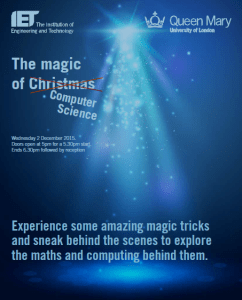
magic of christmas computer science

FREE tickets for the ‘The Magic of Christmas Computer Science’, a magic show powered by hidden computer science, are available from Eventbrite and you can find out more information about the event and the speakers below. Please share this event flyer with others who might be interested.

About this event

Experience some amazing magic tricks and sneak behind the scenes to explore the maths and computing behind them.

Mathematics and computer science are behind today’s technological wizardry… Let Professors Peter McOwan & Paul Curzon, both scientists and magicians, be your guides to the secret world where science meets conjuring…

This special one-off Christmas event – co-hosted by the School of Electronic Engineering and Computer Science at Queen Mary, and The Institution of Engineering and Technology (IET) – will be a fun-filled evening full of surprises.

The evening is aimed at secondary school aged students, but with surprises to be unveiled for both adults and young people alike. All are welcome so if you have a curious mind, book your (free) tickets below quickly as places are vanishing fast!

About the Speakers

Professor Peter McOwan QMUL Vice-Principal (Public Engagement and Student Enterprise) and Professor Paul Curzon.

Peter McOwan and Paul Curzon are Professors of Computer Science in the School of Electronic Engineering and Computer Science at Queen Mary College University of london. As researchers and academics they apply their ‘magic’ to everything from robotics and artificial intelligence to the software of medical devices. Their infectious enthusiasm for exploring the endless possibilities of computer science has led them both to be elected as National Teaching Fellows. They work closely with the ‘Computing at Schools’ network, Peter was a founding member.  Paul also runs ‘Teaching London Computing’, which creates inspiring activities for teachers to use in class.

The speakers also run ‘Computer Science for Fun’, a magazine about the fun side of computing. They have been giving linked computing magic shows for over 10 years.

magic of christmas pdf front cover
Programme

17:00     Registration
17:15     Seating
17:30     Start of Lecture
18:30     Reception
19:15     Close

Reasons to attend

Bring your children, grandchildren, nephews or nieces to show them what a career in Science and Engineering has to offer.

Additional information

There will be a reception and mince pies and some light refreshments for everyone after the lecture. All are welcome.

Information above adapted from IET and QMUL pages advertising the event

Draw your own hexahexaflexagon – blanks for printing and colouring in

It would have been Martin Gardner’s 101st birthday today (he was born in 1914 and died in 2010) and while he certainly didn’t invent, or even discover, hexahexaflexagons he was one of the first people to popularise them with an article in Scientific American in 1956.

We’ve used hexahexaflexagons as an example of a finite-state machine in our workshops and to illustrate computational thinking about graphs and maps.

You can find our free booklet about hexahexaflexagons, and how to use them, on our HexaHexaFlexagon Automata page where you can also download full colour printable flexagons to fold and glue at home (or at school, or at work). And now we also have some blank ones (and here’s one with three on a page) that you can print and colour in with your own designs.

For some inspiration have a look at Vi Hart’s series of YouTube videos on hexaflexagons, which are rather good fun.

If you’ve not folded a hexahexaflexagon before here’s Prof Paul Curzon showing how it’s done

Further reading
Flexagon but Not Forgotten: Celebrating Martin Gardner’s Birthday (Scientific American, 2012)