Tenderfoot computing twilight sessions in London for teachers (14&27 June) FREE

We’ve split the one-day Tenderfoot session for teachers on Computational Thinking (Unit 2) into two evening sessions running on Tuesday 14th and Monday 27th June, details below. You can attend either session, there is no dependency, or you can attend both.

  • Session One introduces graphs and binary trees
  • Session Two looks at arrays, classic and shortest path algorithms.

Session One: Tenderfoot training – Clever Stuff for Common Problems – Developing computational thinking and an understanding of data structures – Focus on Graphs and Binary Trees
Tuesday 14 June 2016, King’s College London
5-7.30pm, Waterloo Bridge Wing Room G14
Tutors: Jane Waite and Trevor Bragg
Tickets: http://community.computingatschool.org.uk/events/4134

  • 02 Activity: Data structures matter (Spit not so, Knights Tour, Tour Guide)
  • 03 Activity: Many problems, one solution (Map colouring)
  • 06 Activity: Beauty of trees (Binary trees)

“Unplugged puzzles are used to explore abstraction, algorithms, decomposition and data structures. Activities can be used in the classroom the next day. KS3 Attainment targets : use and evaluate computational abstractions, understand several key algorithm.”
Eventbrite - Tenderfoot training - Clever Stuff for Common Problems - Developing computational thinking and an understanding of data structures - Focus on Graphs and Binary Trees for Session One

Session Two
Monday 27 June 2016, Lambeth
[precise location and time tbc]
Tutor: Miles Berry

  • 00 Activity: Peg swap puzzle
  • 01 Activity: Perfect shuffle
  • 04 Activity: Toy problems, real world
  • 05 Activity: The oracle of bacon

[Ticket link not yet available]

“Unplugged puzzles are used to explore abstraction, algorithms, decomposition and data structures. Activities can be used in the classroom the next day. KS3 attainment targets: use and evaluate computational abstracts, understand several key algorithms.”

Back issues of (some of) our cs4fn magazines available – free for UK schools

Our CS4FN magazines and Teaching London Computing booklets are hugely popular and read by school students for interest and enjoyment, as well as being used by teachers in computing classes and after-school clubs. We typically post out around 20,000 copies to subscribing UK schools (some schools take 1 copy, others have a class set) and we also send one-off boxes of magazines to UK schools and school-related events to give to visitors or to put in delegate bags.

We keep a few more copies of some of our back issues to give away to UK schools and if you’d like to order some please fill in the blue form below.

Note that this form won’t subscribe you to our mailing list(s) – if you’d like to subscribe to start receiving future cs4fn magazines and booklets please fill in [purple form 2] here, and if you’re a teacher based in London interested in our local events please fill in [orange form 1] on the same page. We’d also recommend familiarising yourself with CAS, Computing At School (it’s free to join) and particularly the CAS London Regional Centre (which is run by the same staff at QMUL and KCL that run Teaching London Computing).


Money available to support London teachers’ CPD / subject knowledge enhancement

Screen Shot 2016-03-23 at 16.09.35

As one of the projects funded by the Mayor of London’s ‘London Schools Excellence Fund’, or LSEF, we receive the regular LSEF bulletins and this caught my eye…

Screen Shot 2016-03-23 at 16.07.39
…its text says…

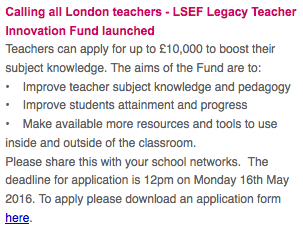
“Calling all London teachers – LSEF Legacy Teacher Innovation Fund launched
Teachers can apply for up to £10,000 to boost their subject knowledge. The aims of the Fund are to:
•    Improve teacher subject knowledge and pedagogy
•    Improve students attainment and progress
•    Make available more resources and tools to use inside and outside of the classroom.
Please share this with your school networks.  The deadline for application is 12pm on Monday 16th May 2016. To apply please download an application form here.”

There is money available to support teachers in London develop their own knowledge and share their learning with other teachers. Computer Science is explicitly listed among the subject options, which also includes languages, maths, science and tech.

From the FAQ, teachers / applications must satisfy the following London Teachers Fund Criteria –

  • Improve the subject knowledge and pedagogy of teachers
  • Improve students attainment and progress
  • Make available more resources and tools for teachers to use in the classroom
  • You need to be a qualified teacher working in a school or state supported education provision in one of the 33 London Boroughs

Visit the Shine Trust’s website (who are managing the innovation fund for LSEF) for more information and links to application forms and the FAQ etc. Good luck :)

If you’re 7-19 there’s a Computer Animation Competition for you – #Animation16

Screen Shot 2016-02-11 at 11.12.05

Animation16 – the 9th Annual UK Schools Computer Animation Competition run by the School of Computer Science at The University of Manchester, is open for registration and entries!

If you’re 7-19 there’s a Computer Animation Competition for you – #Animation16

Funded by Electronic Arts, Autodesk, and Microsoft, in association with Computing At School and cs4fn, the competition is open to all UK school students aged 7-19, and the deadline for entry is on Friday 18th March:

Teacher registration is FREE and carries no obligation to submit any entries. All registered teachers will receive FREE colour A2-sized Animation16 posters for their school. To get your free posters — while stocks last! — register at the website or log in using your existing credentials: http://animation.cs.manchester.ac.uk

Entrants can create their animations (time limit: 1 minute) using any of the following programs: Scratch, Adobe Flash, Alice, Blender, Maya, 3DS Max, Muvizu, Synfig Studio, Serif Draw Plus, KoolMoves, or SWiSH Max4

There are great prizes for the winners, and trophies for schools. Winners will be announced in May 2016 and the Awards Ceremony will be at the National Media Museum in Bradford on 12 July 2016.

Last year’s Animation15 competition was bigger than ever, with over 820 entries from 127 schools across the UK, from 1,057 students. We awarded prizes to 42 students (working as individuals, or in groups, max size 4) from 26 schools. You can see all the winning entries on our Youtube channel: https://www.youtube.com/user/AnimationComp/

Key dates
* 18 March 2016: Deadline for submitting entries
* 12 July 2016: Awards Day at the National Media Museum

Key contacts
* Website:   http://animation.cs.manchester.ac.uk
* Enquiries: toby.howard@manchester.ac.uk
* Twitter: @AnimationComp #Animation16
* Facebook: https://www.facebook.com/AnimationComp

CPD day for London computing teachers at the CAS London annual conference

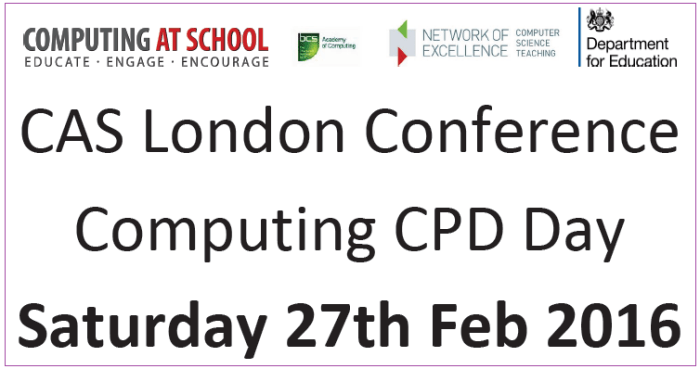
Teaching London Computing’s Paul Curzon and William Marsh will be presenting at the CPD day for London computing teachers at this year’s CAS London conference, £25 for London teachers, £60 for those outside London (BOOK TICKETS). Read on for more information…

Sat 27 Feb

When: Saturday 27th February
Where: London (Gladesmore Community School, Crowland Rd, N15 6EB)
Tickets: £25 (London), £60 (elsewhere) – BOOK HERE
Event flyer: DOWNLOAD and please share with colleagues

Approximate timings of Paul’s and William’s sessions (note timings may change by +/- 10mins).

Paul Curzon
Unplugged Sorting algorithms – 10:00pm

Using Magic to teach computing – 2:30pm

William Marsh
Python Advanced GUI – 12:30pm
LMC 1 – Introduction Afternoon – 2:30pm

Here’s the information from CAS London about the conference –

CAS London’s Regional Conference, a day of CPD for primary and secondary teachers of computing

For those who need to gain confidence to teach programming, those who are brushing up on skills and those looking to find out about recent developments in computer science education.

HANDS ON Workshops, ready to use resources.

  • Select 4 x hour long workshops from 7 workstreams of  more than 28 workshops.
  • Introductory and advanced programming on Scratch, Kodu, Python, Visual Basic, LMC, Java and more.
  • Pedagogy, assessment, exam boards,  magic to teach algorithms, computational thinking, unplugged sorting …
  • Introductory physical computing with BBC Micro:bit, Raspberry Pi and Engduino.
  • Cross curriclar Maths and Scratch, DT and Crumbles.
  • Workshops led by Paul Curzon, Phil Bagge, Mark Dorling, Sue Sentance, Michael Kölling, Rob Leeman (OCR), Matt Walker (AQA) and many other leading CPD providers.

Nominal charge to cover lunch and admin.

We are funded by the Department for Education to support teachers in London, hence the reduced fee for London educators.

Teachers from further afield are very welcome, as are educators working with CLCs, boroughs and Coding Clubs.

Trainee teachers and University/ITT representatives are most welcome and also invited to attend.

At lunch time there will be a market place where voluntary groups, industry and other suppliers will be on hand to share their resources and ideas on careers, coding clubs, ed tech products etc.

If you would like to showcase at the market place please contact jane.waite@computingatschool.org.uk

About CAS London
CAS London, the Computing At School regional centre for London, is run by King’s College London and Queen Mary University of London. It co-ordinates CAS activity in London, supporting teachers of Computing through CAS Master Teachers, Hubs and Lead Schools.

Find out more about CAS and CAS London.


[London only] Friday afternoon cs4fn freebie giveaway

After last week’s rather popular Ada Lovelace magazine giveaway I’ve found some other bits and pieces in my boss’s office where we have enough of them to make 10 ‘packs’. This week it’s just for Londoners as I’m also including a flyer for our free Christmas magic show which is taking place on Wednesday 2 December at 5pm. I’ll definitely do more stuff for non-Londoners next week, promise :)

What’s in the pack?

photo(5)

  • a flyer for our Christmas magic show
  • A magic book
  • A pack of cards
  • A cs4fn magazine
  • A teleporting robot sheet
  • The robot dot illusion sheet
  • Biology loves Technology mini booklet
  • Hexahexaflexagons booklet and a sheet of hexahexaflexagons for you to cut out, fold, glue together and flex.

I couldn’t fit any more into the envelope! (I did a test run).

If you fancy receiving this early next week then fill in this London-centric form below and if you’re in the first ten (and your address is London) I’ll post you a pack. Non-London addresses (ie if you’re not within one of the 33 boroughs of London) will be deleted I’m afraid.

R4 programme on Ada Lovelace (2 days left to listen)

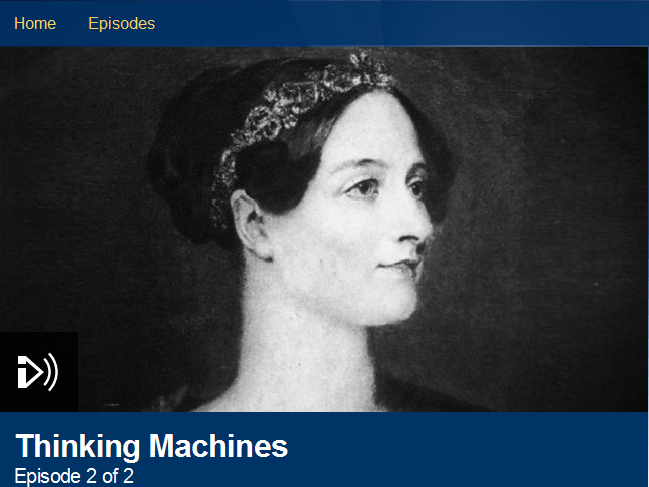
BBC Radio 4 has a two-part series on Ada Lovelace’s letters. Alas Part One of the series has already passed into the ‘programme no longer available’ territory, but Part Two (~28m) is live to listen to online for the next couple of days [at time of writing!].

Our cs4fn magazine special issue on Ada Lovelace isn’t going anywhere though, please download a free PDF at your leisure :)

adaletters.png

“In part two of this dramatization of The Letters of Ada Lovelace, Georgina Ferry reveals the nature of the relationship between the young heiress, Ada Lovelace (Sally Hawkins) and the crusty mathematician, Charles Babbage (Anthony Head), inventor of steam-powered calculating machines.

More info at the programme’s page.

What else are we up to?

1.Saturday 21 Nov – £30/60, 2-5pm
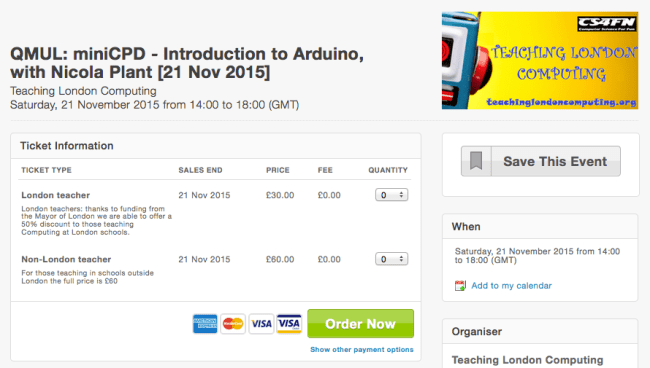
Introduction to Arduino [info] [tickets]
Aimed at teachers of pupils at KS3 and above our miniCPD session will introduce you to programming using an Arduino with simple electronics.

2. Wed 25 Nov – FREE, 5pm
Sorting Unplugged [info] [tickets]
This is a free workshop, aimed at computer science teachers, which introduces sorting algorithms in an ‘unplugged’ style.

3.Sat 28 Nov – £30/60, 2-5pm
Introduction to Arduino [info] [tickets]
Aimed at teachers of pupils at KS3 and above our miniCPD session will introduce you to programming using an Arduino with simple electronics.

4. Wed 2 Dec – FREE, doors 5pm, show at 5.30pm
The magic of {Christmas} Computer Science – free magic show for young people. [info] [tickets]
This is a free public talk aimed at secondary school-aged children and their families & friends. Paul Curzon and Peter McOwan will present a fun magic show powered by hidden computer science. There are rumours of mince pies too.


Woohoo! Our Ada Lovelace issue of the @cs4fn magazine is here :) #lovelaceoxford

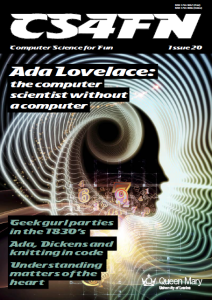
We’re delighted to introduce the 20th issue of cs4fn (Computer Science for Fun) magazine. The latest edition celebrates Ada Lovelace and her lasting influence on computer science today.

Download a free PDF copy of the magazine (see also the magazine’s homepage on cs4fn).

cs4fn 20 cover Ada Lovelace issue2015 is the 200th anniversary of Ada Lovelace’s birth. Famous as ‘the first programmer’ her vision of computer science was far wider. To celebrate, issue 20 of cs4fn magazine explores her life, her ideas and where modern research has taken some of those ideas. Women’s research is also still at the forefront of interdisciplinary computer science. We will look at what other Victorian Computer Science was around at the time and also see how her work linked to the very modern idea of computational thinking.

The magazine was written by Paul Curzon and Peter McOwan from Queen Mary University of London, Jane Waite of QMUL and CAS London, and Ursula Martin of the University of Oxford.

We’re grateful to the EPSRC, Google, the Mayor of London and Department for Education’s for funding support, and cs4fn is also a partner in the BBC’s Make it Digital programme.

To celebrate I’m giving away TEN copies (ie one copy to 10 people) of the magazine to anyone in the UK who fills in the form below. Non-UK submissions will be ignored and the form will (or at least should!) stop accepting submissions once 10 people have filled it in. Your information won’t be used for any other purpose and will be deleted once I’ve posted the magazine(s).

Things I’ve learned while working on the Teaching London Computing project [Pt 1] Eventbrite is fab :)

I’m the Project Manager for Teaching London Computing, a project funded by the Mayor of London and Department for Education which supports London teachers who are delivering the new computing curricula. We do this through a variety of taught courses (covering both subject knowledge and pedgagogy relating to how best to introduce them in the classroom) as well as free workshops and downloadable classroom resources.

Colleagues teach the courses and create the activities and worksheets, other colleagues deal with evaluating the project and its impact (this is a non-commercial research project that takes place in two universities: Queen Mary University of London, where I work, and King’s College London, where I have a visitor’s pass).

At the end of the project (formally 30 September 2015 but we have a no cost extension until the end of the year to finish some bits and pieces off) we submitted a large and detailed self-evaluation document to our funders. In it we tried to capture more than just facts and figures (in fact we were encouraged to by the Mayor’s team as they want to know about challenges and anything that would help someone else running a similar project in future).

I wanted to write a series of blog posts about the day to day minutiae of running a project like this because I think that might also be helpful to people, at least I hope so.

Part One – Eventbrite is fantastic
Screen Shot 2015-11-11 at 18.01.27

One of our events

For our GCSE and A-level CPD courses, for each place we charge teachers £150 and another £150 to the Mayor’s office (non London teachers aren’t subsidised and must pay the full amount). It is very easy to set up a chargeable event on Eventbrite (the fiddliest bit was finding the IBAN number for QMUL and explaining that we’d be putting money into that account and then later moving it into under our own grant code) and handle payments through credit cards or via invoicing [we do the invoicing ourselves, not via Eventbrite].

I do remember explicitly writing in the report that time spent becoming familiar with the event management tools (and that includes the WordPress blog and Twitter, if you’re less familiar with using those) was time well spent.

We made use of various Eventbrite widgets. On the right hand side of any page on this website you will likely see an orange Eventbrite image / widget which will have information about our event when we’re running them (it will look a bit empty when we’re not). I set this up once and now whenever I publish a new event on Eventbrite it automatically appears here.

I also like the ‘buttons’ widget that lets you choose a button colour and text and then gives you a small piece of code to put on your website or in a blog post, like these, to encourage people to click for tickets. Of course you can just link to the ticketing page with a normal hyperlink, but this seems nice.

Eventbrite - QMUL: miniCPD - Introduction to Arduino, with Nicola Plant [21 Nov 2015]

Eventbrite - QMUL: Paul Curzon computing workshop - Sorting Unplugged – for Sorting Unplugged with Paul Curzon

Eventbrite - QMUL: miniCPD - Introduction to Arduino, with Nicola Plant [28 Nov 2015]

Eventbrite will even let you embed the payment options directly onto your website, again with a bit of code. I’ve not used this as I prefer people to go ‘off site’ to Eventbrite, but perhaps I’ve missed out by not using that option!

It’s extremely easy to gather contact email addresses from people who’ve signed up to our events, so that I can email them with joining instructions and generally keep in touch. Similarly it’s easy for them to send me, as event organiser, an email if they have questions.

Eventbrite also acts as a massive data record of all of the events we’ve hosted at QMUL and I can go back in time and search for any of our events (even once they’ve finished) so there’s little danger of losing any information.

When you sign up to one of our events we ask everyone a series of questions about their school – fortunately we don’t have to remember what these questions are each time we create a new event, thanks to the COPY event option. But we do have to remember to check the ticket prices (our miniCPD events are £30) and make sure that the dates when the tickets go on sale match the time when we want to sell them.

Most of our events involve people arriving once a week for 10 weeks so using the online checkin system for those events isn’t useful but it’s great for our one-off workshops where everyone comes to one event. You can just type in part of someone’s name and any name containing that string will appear.

It did take me a while to become properly familiar with Eventbrite but you can do all the vital things without training, and then spend a bit of time tinkering to get things right. They have fantastic help pages and the team at the company have always been vastly helpful whenever I’ve had a query.

Hopefully there will be more blog posts in this series as I’d like to talk about spreadsheet wrangling (and how I’ve learned some useful shortcuts there), also the fabulous Google Forms (and the resulting Google spreadsheets) and Google Fusion Tables which give you little maps of where you’ve done stuff. I was already familiar with Twitter and WordPress blogs but I might say something about those too.

Obviously there are other products on the market that do Eventbrite-like things. I use Eventbrite because the colleague from whom I took over had set things up already, so I’m not really familiar with ‘the competition’. I should add that neither QMUL nor King’s College London (nor the Mayor’s office) officially endorse Eventbrite, WordPress or even Twitter and this is solely my personal endorsement, because I’ve found it really useful.

Jo Brodie
Teaching London Computing