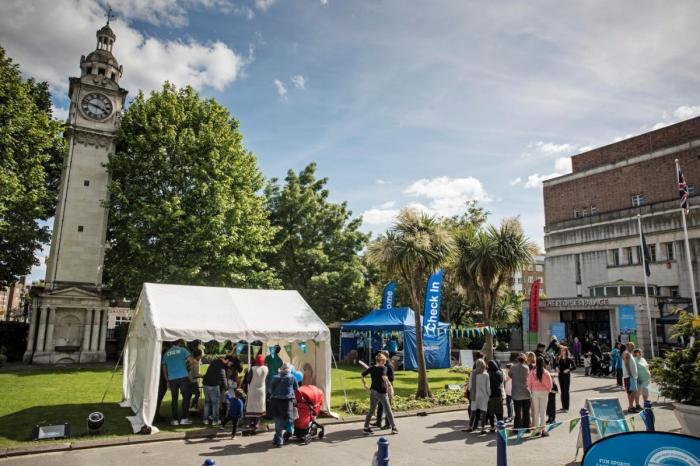
Free family fun: come to @QMUL’s Festival of Communities weekend on 12 and 13 May 2018.

QMUL Campus-1200x800

The text below is from QMUL’s page on the two-day festival. Prof Paul Curzon will be have a CS4FN stall at the festival so come along and say hello.

Our main campus building is the Queen’s Building on Mile End Road next to the People’s Palace. Buses: 25 and 205, nearest tube Stepney Green (Mile End a little bit further away, but not much).

Festival Programme 2018
Sat 12 and Sun 13 May 2018
The Festival of Communities returns on 12 and 13 May 2018. Get hands on with Queen Mary research through games, sports, crafts and other activities at the Festival of Communities. [Facebook]

Over two days, you can:

  • Trek over a tooth using Virtual Reality and meet the brain scanner made of Lego.
  • Jump on a bouncy castle, or Trial a new computer game
  • Get your face painted or play a life-size game of operation
  • Encounter the women who explore harsh Arctic environments for their scientific research and marvel at the award-winning images of life all around us.
  • Play with puppets while contributing to Queen Mary research or find out if your taste buds can predict whether you will get cancer.
  • Discover how 3D printing a new set of teeth can revolutionise healthcare, or find out just how much sugar is in your favourite fizzy drinks.
  • Share your wish for Tower Hamlets in our wishing tree and test your football skills or take part in the basketball hoop challenge.
  • Discover what’s under your skin by looking at your own skin cells under a microscope, and find out who will win in the slime races.
  • Build a musical instrument out of paper or strut your stuff in Britain’s next scientist top model
  • Explore how trauma affects the body in a game of giant jenga and design the ultimate blood cell
  • Become a bioengineer for the day or go on minibeast safari

…and much more to be added!


Please make sure you’re following @CS4FN / @cas_london_crc for updates about our resources

CAS London

Teaching London Computing (TLC) is a resource hub from the CAS Regional Centre London (‘CAS London’) and we are regularly adding free activities and other resources here. TLC’s initial role was in providing CPD support to London computing teachers, which we continue to do through CAS London by supporting Master Teachers.

Although this website will remain we won’t be updating the @TeachingLDNComp Twitter feed (the feed will still be public though as people may come across our resources while searching for related things on Twitter).

The CAS London Regional Centre is one of several university-led regional centres in the UK. Ours is run by King’s College London and Queen Mary University of London (exactly the same people in fact behind Teaching London Computing!) and CS4FN is the flagship schools computing magazine and website from Prof Paul Curzon and colleagues at QMUL.

Please make sure you’re following –
@CS4FN to hear about newly uploaded activities and resources on this site
@cas_london_crc to hear about other support and events for London computing teachers

Thank you!

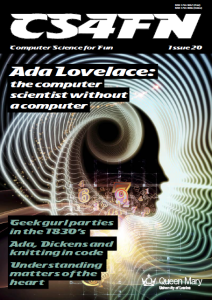
Woohoo! Our Ada Lovelace issue of the @cs4fn magazine is here :) #lovelaceoxford

We’re delighted to introduce the 20th issue of cs4fn (Computer Science for Fun) magazine. The latest edition celebrates Ada Lovelace and her lasting influence on computer science today.

Download a free PDF copy of the magazine (see also the magazine’s homepage on cs4fn).

cs4fn 20 cover Ada Lovelace issue2015 is the 200th anniversary of Ada Lovelace’s birth. Famous as ‘the first programmer’ her vision of computer science was far wider. To celebrate, issue 20 of cs4fn magazine explores her life, her ideas and where modern research has taken some of those ideas. Women’s research is also still at the forefront of interdisciplinary computer science. We will look at what other Victorian Computer Science was around at the time and also see how her work linked to the very modern idea of computational thinking.

The magazine was written by Paul Curzon and Peter McOwan from Queen Mary University of London, Jane Waite of QMUL and CAS London, and Ursula Martin of the University of Oxford.

We’re grateful to the EPSRC, Google, the Mayor of London and Department for Education’s for funding support, and cs4fn is also a partner in the BBC’s Make it Digital programme.

To celebrate I’m giving away TEN copies (ie one copy to 10 people) of the magazine to anyone in the UK who fills in the form below. Non-UK submissions will be ignored and the form will (or at least should!) stop accepting submissions once 10 people have filled it in. Your information won’t be used for any other purpose and will be deleted once I’ve posted the magazine(s).

Summer School 2015 at @Ri_Science, for children 7-12, w Prof Paul Curzon on the magic of computer science

The Royal Institution (21 Albemarle St, London W1S 4BS) hosts public science events for all ages and is currently running a Summer School over the next few weeks with a range of science topics including maths, computing, cryptography, engineering, biomechanics and acoustics. The full programme covers workshops for children aged 7 and above with workshops for different year groups up to and including adults over 18.

Prof Paul Curzon, who has delivered many engaging workshops on the magic of computer science for teachers, will be delivering two workshops for school children on Tuesday 18th August.

The morning session will be for 7-9 year olds and the afternoon one for 10-12 year olds.

“When you learn to be a magician, it turns out you are learning the skills needed to be a great computer scientist too: computational thinking. In this workshop Paul Curzon will demonstrate some real magic tricks and teach the group how they are done so they can do the tricks themselves. Students will then use the magic to learn the linked basics of computer science and see what computational thinking is all about and how both magicians and computer scientists rely on it.

There will be a short break during the workshop and a drink and a small snack will be provided. Students should bring their own snack if they have any allergies.”

Morning workshop (Sunley Room)
The Magic of Computer Science with Prof Paul Curzon
Age group: 7-9 year olds – £30/27 (Faraday members)

Afternoon workshop (Library)
The Magic of Computer Science with Prof Paul Curzon
Age group: 10-12 year olds – £30/27 (Faraday members)

Financial assistance
The Potential Trust may be able to offer financial assistance to enable children to participate in Ri events and activities if this would otherwise be difficult. Please contact Anna Comino–James on 01844 351666 or email her at thepotentialtrust@gmail.com.

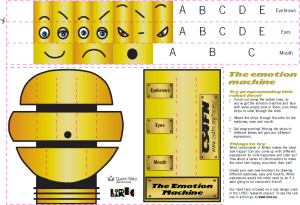
New free activity: The Emotion Machine – ready to download and print, with instructions

Computing teachers might find this useful, newly published on our website.

Emotion Machine bThe Emotion Machine

Age group: 7 – 12
Abilities assumed: None
Time: 40-60 minutes
Size of group: 1 upwards

Focus
• Programming
• Sequences
• Low-level code and high-level commands
• Compilers and interpreters
• Abstraction
Summary
Students create and program a 2D robot made of card to show different emotions. They create a table that can be used to translate emotions (high level commands) into low level machine instructions.

robot pdf

Click to download the PDF. Click the link above to visit the info page for instructions.

Computational creativity – free PDF magazine (issue 18) from @cs4fn

From our sister project cs4fn (Computer Science for Fun) here’s the latest issue (#18) of the magazine, which is all about Computational Creativity. Download your free PDF copy or read some of the example articles at the magazine’s microsite for issue 18.

cs4fn magazine is published by Queen Mary University of London (QMUL) and is aimed at school pupils. QMUL has partnered with King’s College London to provide CPD courses for teachers who are teaching the new Computing curricula at GCSE and A-level. Thanks to funding from the Mayor of London we’re able to offer a 50% discount (£150) on our courses for teachers in London. More about our funding here.

Our next two courses for Computing teachers are happening over Easter – one is a one-week intensive and the other is the same length but spread over a few days.

GCSE Easter

Paul Curzon’s doing two free workshops next Friday afternoon (20th) for Computing teachers in London cc @cs4fn

Paul Curzon’s free workshops, held at Queen Mary University of London’s Mile End campus, are fun and informal and support teachers who want to introduce programming concepts and computational thinking into the classroom in an engaging way. Each workshop is accompanied by downloadable classroom activities (also free) – these can be downloaded from the links below.

Next week’s (Friday 20th February) is a double session but you can choose to come to one workshop, or both.

The first workshop is at 2pm then there will be a half hour break with the second starting at 4pm, we aim to finish at 5.30pm.

Do I have to be a London computing teacher to attend?
The workshops are aimed at those who are currently (or who are about to begin) teaching the Computing curricula (particularly GCSE and A-level, though the information in the workshops has been used with younger children). As we’re funded by the Mayor of London we prioritise those who are currently teaching in London schools. The workshops are not suitable for school pupils though as the events are about how to introduce computing concepts into the classroom. Contact Jo Brodie (j.brodie@qmul.ac.uk) for further information.

Biography
Paul Curzon is a Professor of Computer Science at Queen Mary, University of London. He runs the cs4fn ‘Computer Science for Fun’ (cs4fn) project, www.cs4fn.org. It aims to inspire school students about computer science through a series of free magazines, website and school shows. He regularly gives such shows around the UK as well as continuous professional development talks to teachers about the cs4fn approach to teaching. He is Director of the Teaching London Computing Project. He was made a UK National Teaching Fellow in 2010 in recognition of his excellence in teaching and outreach, was a finalist in the 2009 Times Higher Education Innovative Teacher of the year award and has twice won the student nominated Queen Mary award for excellence in teaching.

Workshop A:
Programming unplugged: learning programming without computers

2.00-3.30pm (free Eventbrite tickets)

Overview
It’s easy to assume that programming is something you have to learn at a computer but if you want your students to deeply understand programming concepts, rather than blindly getting programs to work then unplugged techniques can work really well to get students started. We will see how to program a robot face that is made of students, look at a simple way to give a deep understanding of how variables work by making them physical, and see how to compile programs onto your class instead of onto a computer.

Session material This session will cover:

  • Inspiring ways to introduce programming away from computers.
  • What is a variable?
  • How does assignment work?
  • Programming simple objects
  • Introducing flow of control and if statements

Workshop B:
Computational thinking: it’s about people too

4pm-5.30pm (free Eventbrite tickets)

Overview
Computing is not just about technology, it is about understanding people too. When we solve computing problems we are solving them for people. Computational thinking is the general group of problem solving skills that students learn as a result of studying computing. Often this is equated with algorithmic thinking – a direct result of learning to program. However it just as important to make programs usable by people – or they won’t be used. We will see how magic gives a fun way to introduce these ideas and how a simple game demonstrates why graphical user interfaces are effective.

This session is in collaboration with CHI+MED: an EPSRC-funded project about making medical devices safer.

Session material This session will cover:

  • computational thinking: understanding people
  • human computer interaction
  • why GUIs are better than text-based interfaces
  • The importance of data structures
Round-up of Teaching London Computing’s free workshops, courses – and a CAS hub event

I’ve just emailed this to people who’ve signed up to receive info about our events and thought I’d post it here too.

We’re on Twitter @TeachingLDNComp.


Free workshops
25 June 2014, Hackney
Invisible Palming! Intelligent paper? So what is an algorithm?
4pm, Wednesday 25 June 2014
Cardinal Pole School, 205 Morning Ln, Hackney, London E9 6LG

8 July 2014, New Cross
Prof Paul Curzon will be giving a talk, “Teaching Computing Unplugged to Young Children” for primary school computing teachers on 8 July 2014 at a two-day workshop event at Goldsmiths in London. Please note that registration for this event is via Goldsmiths (given in link).

9 July 2014, Hackney
Programming Unplugged: Learning programming without computers
4pm, Wednesday 9 July 2014
Cardinal Pole School, 205 Morning Ln, Hackney, London E9 6LG

Courses
We have a new short CPD course for GCSE Computing teachers which will take place at KCL from 4-8 August (Mon-Fri) 2014. “Computing CPD GCSE Summer Holiday (1-week intensive)” costs £150 for London teachers (thanks to funding from the Mayor of London) and £300 for those outside London (if space is available).

Other events
Computing At School (CAS) – East London hub meeting, 8 July 2014, 4.30 to 6pm.
This event will take place in Islington at the City & Islington 6th Form College and is free to attend. As well as being a networking event for computing teachers the event will also plan ‘a practical using the Arduino Uno’ and discuss the new CAS document ‘Computing in the National Curriculum – A guide for secondary teachers‘.


FREE workshops next week at QMUL, for GCSE Computing teachers

TLC robot fauxgo title and URL

Prof Paul Curzon will be delivering four FREE workshops during half-term next week at QMUL (Queen Mary University of London) on Monday . These are fun, inspiring ‘unplugged’-style sessions which look at some creative ways of getting students to think about computing and programming concepts, without relying on computers, and are aimed at GCSE Computing teachers who’ll be delivering the new Computing curriculum.

Each session is accompanied by lots of free classroom resources and activity sheets to download, and of course an opportunity to share ideas with other workshop attendees.

We’ve arranged things so that there’s an hour between the morning and afternoon sessions (to make it easier for those who’d like to attend two in a day) but you’re welcome to come to as many of the workshops as you like.

The workshops are

A. Computational thinking: Searching to Speak (Website) (Eventbrite tickets)
Tuesday 27 May, 11.30am to 1pm

B. Computational Thinking: it’s about people too (Website) (Eventbrite tickets)
Tuesday 27 May, 2pm-3.30pm

C. Invisible palming! Intelligent paper? So what is an algorithm? (Website) (Eventbrite tickets)
Wednesday 28 May, 11.30am to 1pm

D. Programming unplugged: learning programming without computers (Website) (Eventbrite tickets)
Wednesday 28 May, 2pm-3.30pm

Cover of the Searching to Speak A5 booklet, click to open the PDF← Download a free copy of our latest booklet ‘Searching to Speak’ (which accompanies the first workshop in the series, on Tuesday morning) – click to open the PDF or right-click / save as to save a copy.


The admin bit:
All the workshops are free and will take place in Room 1.02 in the Law Building on Mile End Road. For those attending both morning and afternoon sessions (there’s an hour between the workshops) there are lunch options on campus (Mucci or Curve as well as snack shops) and plenty of food places on Mile End Road including a Sainsbury’s. You can attend as many workshops as you like.

Please contact me (Jo, j.brodie@qmul.ac.uk) if you have any queries.

Follow us on @TeachingLDNComp