
London, in-person: Royal Institution Holiday Workshops with Paul Curzon (and others)

Full list of Royal Institution Holiday Workshops (in various topics, not just computing, electronics or robotics).

Support to attend holiday workshops
The Potential Trust may be able to offer financial assistance to enable children to participate in Ri events and activities if this would otherwise be financially difficult. Please contact Anna Comino-James preferably via telephone on +44 (0)1844 351666, or at their new email address potentialtrust@gmail.com. Once a bursary is agreed, you will make your workshop bookings directly with the Ri.

1. The magic of computer science: Monday 7th April

Holiday workshops (7 April): 🎩 The magic of computer science (ages 7–8)
11am to 1.15pm, £40 (£32) – in person – this morning workshop is strictly for ages 7-8 only.
Holiday workshops (7 April): 🎩 The magic of computer science (ages 9–11)
2.15 to 4.30pm, £40 (£32) – in person – this afternoon workshop is strictly for ages 9-11 only.

About the workshop
In this workshop, Paul Curzon will demonstrate real magic tricks, showing the group how they are done so they can do the tricks themselves.

When you learn to be a magician, it turns out you are also learning the skills needed to be a great computer scientist: computational thinking.

Students will then use the magic to learn the linked basics of computer science. They’ll see what computational thinking is all about and how both magicians and computer scientists rely on it.

About Paul Curzon
Paul Curzon is a Professor of Computer Science at Queen Mary University of London and a National Teaching Fellow. He runs Computer Science for Fun a magazine about the fun side of computing, and has been giving linked Computing Magic Shows for 10 years.

Paul also runs Teaching London Computing creating inspiring activities for teachers to use in class.


2. Artificial Intelligence, but where is the intelligence? Tuesday 8th April
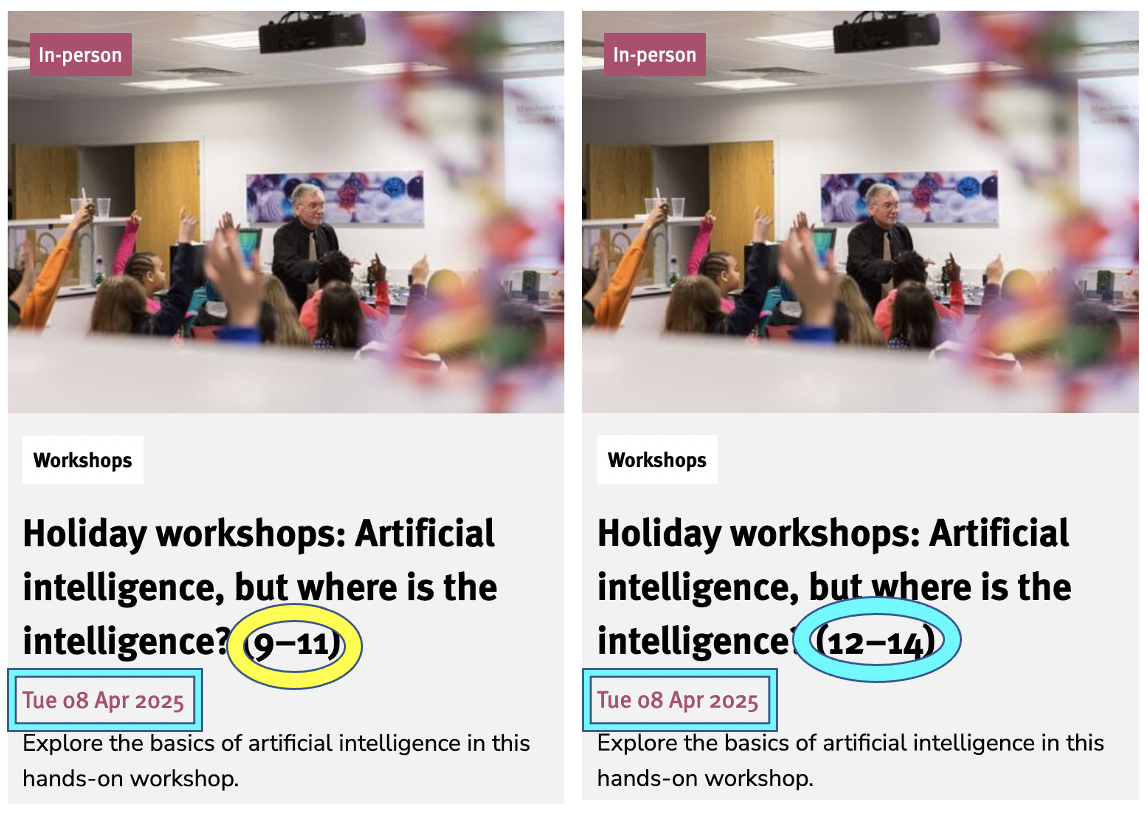
• Holiday workshops (8 April): ✨ Artificial intelligence, but where is the intelligence? (9–11)
11am to 1.15pm, £40 (£32) – in person – this morning workshop is strictly for ages 9-11 only
Holiday workshops (8 April): Artificial intelligence, but where is the intelligence? (12-14)
2.15 to 4.30pm, £40 (£32) – in person – this afternoon workshop is strictly for ages 12-14 only

About the workshop
We all know the movie plots where evil robots and computers take over the world, but what is the reality? This workshop explores artificial intelligence, the field of science that tries to build ‘thinking machines’.

How are they built? Are they really intelligent? And what is intelligence anyway? We will also ask some interesting questions about a well-known ‘thinking machine’, you! Along the way we will play some games including building a working brain out of rope, tubes, and you, and playing snap with it.


3. Coding with LEGO WeDo: Tuesday 8th April
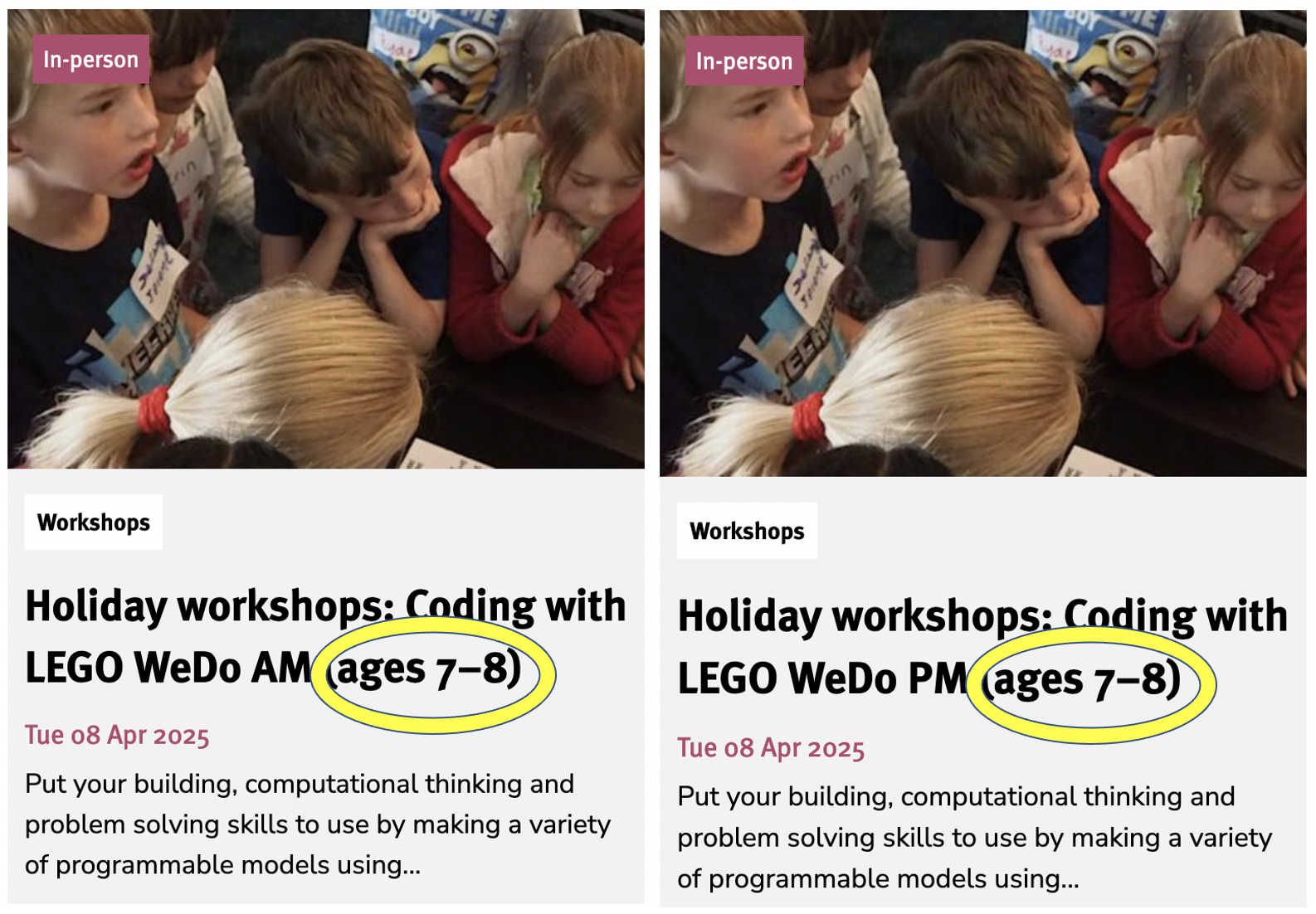
Holiday workshops (8 April): Coding with LEGO WeDo AM (ages 7–8)
11am to 1.15pm, £40 (£32) – in person – this morning workshop is trictly for ages 7–8 only
Holiday workshops (8 April): Coding with LEGO WeDo PM (ages 7–8)
2.15 to 4.30pm, £40 (£32) – in person – this afternoon workshop is also strictly for ages 7–8 only

Note that both the morning and afternoon sessions are aimed at the same 7-8 year old age-group.

About the workshop
In this session with Brian Egles, you will work in pairs to build a variety of models using motors and sensors based on the LEGO WeDo kit. Models include wild animals, amazing mechanisms, adventure stories and football themes. You will code your LEGO models and see them come to life and respond to the world around them.


4. Electronic and Electrical Control: Wednesday 9 April 2025
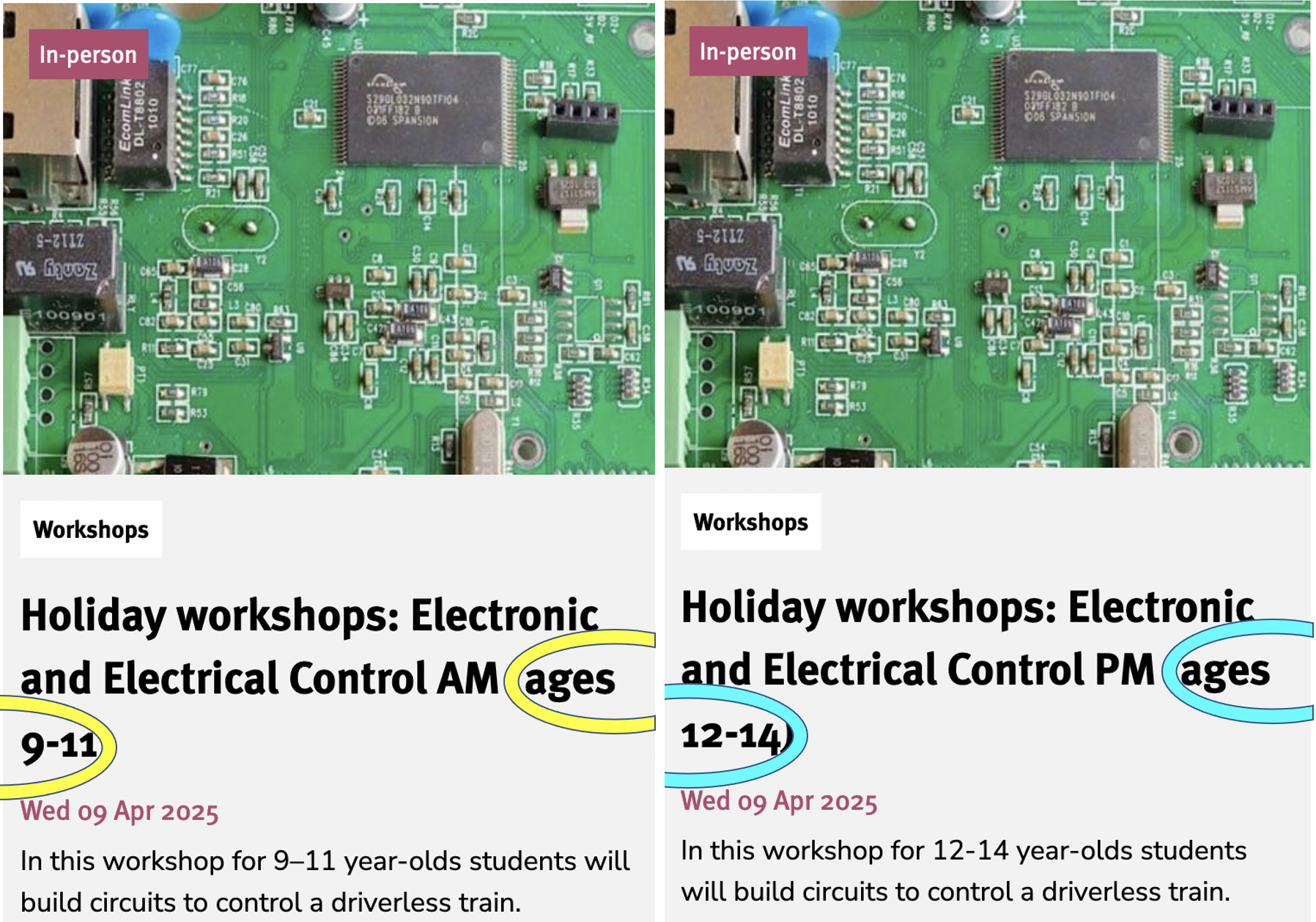
Holiday workshops (9 April): ⚡️Electronic and Electrical Control AM (ages 9-11)
11am to 1.15pm, £40 (£32) – in person – this morning workshop is strictly for ages 9-11 only.
Holiday workshops (9 April): ⚡️Electronic and Electrical Control PM (ages 12-14)
2.15pm to 4.30pm, £40 (£32) – in person – this morning workshop is strictly for ages 12-14 only.
With Jeremy King.

About the workshop
Participants will be working as Electronic and Electrical Engineers with some Mechanical Engineering aspects. They will design and build an increasingly complex electrical and electronic control system. Working in pairs they start by making a pressure switch and use this to control a pre-made electrical buggy to perform four tasks. Using a slide switch there are then three more tasks of increasing complexity. After the last task the buggy should be traveling backwards and forwards between two fixed objects automatically.

Using an on-board computer there are a further four tasks where a programme is built up on the computer to control the buggy to start and stop at specific places. For the twelfth challenge three ‘stations’ are laid out, the buggy needs to be programmed to start at station A, stop at station B briefly, go on to C then return to B & A, all automatically. This activity is modelled on the driverless underground Tracked Transit at Heathrow that transports passengers from Terminal 5A, to 5B to 5C, stopping on its return.

Other switches and tasks are available to those who would like to solve additional challenges.


5. LEGO robotic explorers: Wednesday 9th April
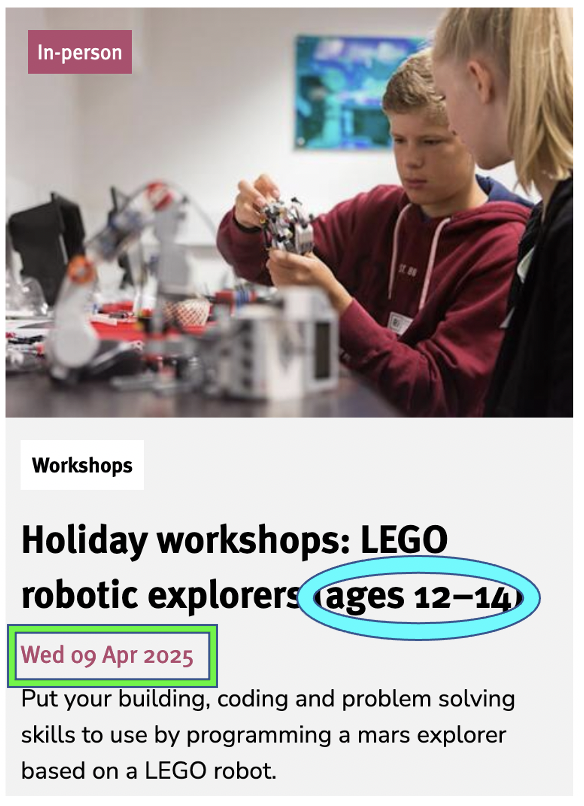
Holiday workshops (9 April): 🤖 LEGO robotic explorers (ages 12–14)
11am to 3pm, £55 (£44) – in person – this morning workshop is trictly for ages 12–14 only

About the workshop
In this session with Brian Egles, you will work in pairs to program a small LEGO mars rover. You will first learn how your robot can be programmed to move around and to behave autonomously to avoid obstacles using sensors.

You will then solve a number of problems based on life on the international space station and on mars exploration. These are taken from the UK and international “First LEGO League” challenge run annually by the IET and other global partners.

This workshop is strictly for 12–14 year-olds and will include a 30 minute lunch break. Students should bring lunch and a drink.


6. Card tricks and computing: Thursday 10th April
Holiday workshops (10 April): Card tricks and computing (ages 9-11)
11am to 1.15pm, £40 (£32) – in person – this morning workshop is trictly for ages 9-11 only
Holiday workshops (10 April): Card tricks and computing (ages 12-14)
2.15pm to 4.30pm, £40 (£32) – in person – this morning workshop is strictly for ages 12-14 only.

About the workshop
Join us for an exciting workshop with Barbara Pellegrino where math meets magic! In this hands-on session, you’ll dive into the fascinating world of binary and ternary number systems, all while learning card tricks that bring these concepts to life. Whether you’re a beginner or a maths enthusiast, this workshop will make abstract concepts like binary and ternary systems both fun and memorable!


Subscribe to be notified whenever we publish a new post to the Teaching London Computing blog.


This blog and post is funded by EPSRC on research agreement EP/W033615/1.

QMUL CS4FN EPSRC logos

Paul Curzon’s doing some Holiday Workshops for young people @Ri_science

Yellow background with black text advertising the names of the three workshop themes. Each theme has two workshops, one for kids age 7-9, one for kids age 10-12

The Royal Institution has a large series of STEM Holiday Workshops for young people, with sessions for different age groups. Paul Curzon is running six workshops over three days, each day having a theme, with a morning session for 7-9 year olds and the afternoon session for 10-12 year olds. Each place costs £35 (£29.75 for Ri Young Members. Financial support may be available from The Potential Trust (info in each link below).

Holiday workshops: The magic of computer science

Learn the logic of computing in this fun magic-based workshop.

In this workshop, Paul Curzon will demonstrate some real magic tricks and teach the group how they are done so they can do the tricks themselves.

When you learn to be a magician, it turns out you are learning the skills needed to be a great computer scientist too: computational thinking.

Students will then use the magic to learn the linked basics of computer science and see what computational thinking is all about and how both magicians and computer scientists rely on it.

[Magic workshop 1, age 7-9, 11am-1pm] [Magic workshop 2, age 10-12, 2-4pm]


Holiday workshops: AI, but where’s the intelligence?

Explore the basics of artificial intelligence in this hands-on workshop.

We all know the movie plot, evil robots and computers taking over the world, but what is the reality? We will explore artificial intelligence, the field of science that tries to build ‘thinking machines’. How are they built? Are they really intelligent? And what is intelligence anyway? We will also ask some interesting questions about a well-known ‘thinking machine’, you! Along the way we will play some games including building a working brain to play snap out of rope, tubes, and you.

[AI workshop 1, age 7-9, 11am-1pm] [AI workshop 2, age 10-12, 2-4pm]


Holiday workshops: Becoming a usability expert: Why are gadgets so hard to use?

Why are so many computer gadgets so hard to use? (especially, apparently, for parents!) It’s because most are poorly designed. To design gadgets better, programmers need to understand people not just technology. Usability experts, who do understand people including why we make mistakes, help programmers improve their designs. We will investigate bad designs and see why they are bad, explore what makes good design and look at how the experts use the science of how people think to make gadgets easier for everyone to use, setting you on the path to becoming a usability expert.

[Usability workshop 1, age 7-9, 11am-1pm] [Usability workshop 2, age 10-12, 2-4pm]


Other workshop topics (given by different people) include the following, and most have a couple of different versions of the session, stratified by audience age. See the full list of holiday workshops (and talks).

  • Forensics
  • ScratchMaths – coding with maths
  • The mathematics of rainbows
  • Anamoprhic art
  • Where is engineering?
  • Geometry, code and embroidery
  • Extract your own DNA
  • Chases and escapes (curvy maths)
  • How big is the universe?
  • The magic of computer science – itemised above
  • AI, but where’s the intelligence – itemised above
  • Making music and sound with BBC Micro:bit
  • Magnets and motors
  • Intro to the BBC Micro:bit
  • Stories from maths
  • Mathematics for astronomers
  • Loudspeakers and acoustics
  • Becoming a usability expert: Why are gadgets so hard to use? – itemised above
  • Fantastic plastic
  • Bacterial evolution
  • Building with STIXX
  • Electrical circuits
  • Drawing Islamic geometry
  • Mathemagics
  • Cosmetic chemistry
  • Skateboards to starships (laws of motion)
  • Mathemagics
  • Networks (Euler)


Vote for RE:CODE London (shortlisted for a Digital Leaders award) which helps young Londoners learn about coding

RE:CODE London from the Mayor of London - helping young Londoners learn about coding Screenshot 2018-04-30 12.14.33

The Mayor of London’s RE:CODE London event series  (which teaches young Londoners coding & problem-solving skills) has been shortlisted for the Digital Leaders ‘Cross-Sector Digital Collaboration of the Year’ Award! The next event dates are at the end of this post.

This recognises that solutions are not delivered by one sector alone, whether public or private, but require cross-sector collaboration – and RE:CODE is the only contender based in London!

The deadline for voting is 11 May,

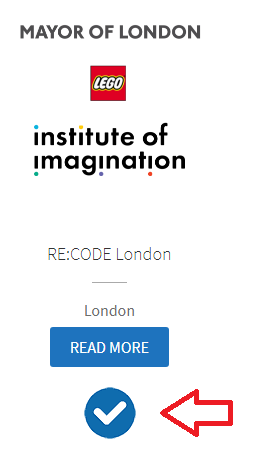
You can vote here by entering your e-mail address, and then clicking the “Tick” under RE:CODE London. The “Tick” will go blue when your vote is registered – see the image below. Once you click the “Tick”, the vote is submitted and cannot be undone – so take care!

Vote for RECODE

The next RE:CODE London events are below and you can find out more about the events here.

  • 9 July 2018
  • 10 July 2018

List of sessions at the CAS London Conference 2018 – Sat 24th Feb

Updated 6 Feb 2018, v6

The CAS London Conference 2018 will be held on Saturday 24th February at Gladesmore Community College in North London (South Tottenham, N15 6BF). It’s an all day event with an opening keynote from Jon Nixon from Ofsted, and talks, workshops and demos exploring different aspects of Primary and Secondary Computer Science. Download a flyer.

There are four session blocks (2 in the morning, 2 in the aternoon) and you can pick one from each. The full list of workshop and talks is below the ‘plan for the day’.

Doors at 9.10am, opening keynote is at 9.40am, first morning session at 10.20am. There will be other activities and networking opportunities at lunch.

Eventbrite - CAS London Conference

CAS London Conference – plan for the day

Start End Session
09:10 09:35 Delegate registration and morning refreshments
09:40 10:15 Opening keynote John Nixon, Ofsted National Lead for Computing
10:20 11:20 Session 1
11:25 12:25 Session 2
12:30 13:30 Lunch & Drone Demonstration (Staggered lunch start 12:30 and 12:45)
13:35 14:35 Session 3
14:40 15:40 Session 4
15:45 16:15 Plenary: Cyber Schools Programme – Michael Heering (TBC) & Fireflies!

Session 1

  • Primary – Smelly code and primary programming pedagogy with Jane Waite
    In this hands of session, you will mark code and create a practical student checklist of what makes sweet code! Bring along code for marking! We will also look at two very practical methods to review your planning to reveal what pedagogy you already use. We will look at instructional approaches to scaffold learning as well as ideas for encouraging independence and mastery.
  • Primary – iPads Tried and test apps for classroom impact with Gillian Arnold
  • Secondary – pedagogy with William Lau
  • Secondary – AQA exam board session with  Chris Swan
  • Primary –  Using tangible programming to support SEN children with the computing curriculum with Jody Carter
  • Primary/Secondary – Minecraft (using virtual worlds and programming) with Simon Johnson (CLC Cimon)
  • Secondary – Python Introduction with Jon Feleppa
  • Creative projects with the micro:bit (python focus)
  • A level – Databases in Python with Hardip Mothada
  • A level – OOP with William Marsh

Session 2

  • KS2/3 – FastForward. Machine Learning & Big Data including digital identity With Paul Curzon and Jane Waite
    Are driverless cars fact or fiction? Can machines make better AI than humans can? How is our data used? Can we support our young people to understand their online (and real life) persona? Practical ideas for starters, plenaries and projects. 
  • Secondary – Algorithm writing with pseudo code and flow charts with Trevor Bragg
  • Secondary – Edexcel exam board with Atif Khan
  • Primary – Physical computing pedagogy session – not what to teach but how to teach physical – including use of spheros, microbits, bluebots, drones with Nic Hughes
  • Primary – Google classrooms/G Suite – Darren Murphey & Wendy McLeod
  • Secondary – Creating websites with HTML
  • Secondary – Stride (a framebased editor to transition from blocks to text) with Michael Koelling
  • A level – Teaching embedded systems with Arduino and Linker with Michael Jones
  • A level – Teaching Boolean Algebra & Karnaugh Maps with Eliot Williams

Session 3

  • Early Years and KS1 – Cubetto and Early Years with Helen Cheung & Eleni Vasileiadou
  • Drones with the Royal Academy of Engineering (KS3 focus but may be of interest to KS2) with Scott Atkinson & Ivan Gutowski-Smith
    This session will explore how drones work and how they can be used for civilian, humanitarian and commercial purposes. This resource is designed as an introduction to the uses of drones, aimed at dispelling the myth that they are just weapons or toys. In fact they have wider ranging practical civil, humanitarian and commercial applications. We will also explore how drones can be reverse engineered, exploring ways in which enquiring minds can build their own functioning quadcopter. All the resources are also available on our website at: https://www.raeng.org.uk/education/schools/teaching-and-learning-resources/curriculum-resources including Engineering in the Movies and RAF100 ‘Aiming for Awesome’ which will be demonstrated during this session.
  • A level – NEA project assessing/ standardisation with Garfield Godon
  • Secondary – OCR exam board with Vinay Thawait
  • Primary – Scratch Maths (Year 6 resources) with Pier Saunders (UCL)
  • KS1 to KS4 – Networks with Duncan Maidens (back by popular demand)
  • KS4 – Teaching data representation (with practical activities that involve manipulating images and sound in Python) with Alex Hawden-Bennet
  • KS3/4 – Pedagogy for programming – PRIMM with Sue Sentence
  • A level – C# with Martin Richards
  • KS4/5 Data Analysis with Jupyter Notebooks –Michel Wermelinger and Clifford French
    Michel Wermelinger will demonstrate how to use Python in Jupyter Notebooks, running in a browser, to analyse data on world diseases. Jupyter notebooks provide an intuitive, easy to use environment that integrates explanations, exercises and the output of the code so that students program incrementally and get immediate feedback. Teachers will be able to use what they learn both in computer science lessons and in Science or Geography at KS4 (or higher) with no need to install software.

Session 4

  • Primary – Assessment with Phil Bagge
  • KS3/4 – Embedding Computational Thinking with Rob Heathcote (PG Online)
  • Primary – Unplugged programming and programming with Scratch
  • Primary – LGFL cross curricula with VR with Bradely Dardis
  • KS2/3/4 – Cybersecurity with Duncan Maidens
  • KS4 – CraignDave – Challenges of teaching GCSE and flipped classroom solutions.
  • KS4/5 – Sorting and Searching Algorithms in Python with Demetrios Skamiotis
  • A level – Advanced Python e.g. Web Development Frameworks and Python with Sue Sentance
  • A level – Big O notation with Python with Ramzi Ramzi
    This session will cover what Big O is, explaining O(1), O(N), O(N^2), and O(log N). Practical online activities will get you  coding each example in Python using variously sized datasets (whilst hopefully not crashing all of computers!) By the end of the session, you will feel more confident explaining and showing students, what Big O is using Python.

Eventbrite - CAS London Conference