[Job, UK] @BCS, Chief Editor (CAS*), <£50k *Computing At School, ^JB

The BCS has announced a new Chief Editor role for someone with knowledge of both computing and the school settings in which it’s taught, and ‘the computing education landscape in the UK and beyond’. Full details in the link and a brief summary below.
BCS
Chief Editor (CAS)
https://www.bcs.org/about-us/careers-at-bcs/vacancy-chief-editor-cas/

The Chief Editor will possess exceptional communication skills, able to develop and deliver interesting and unique content. They will be highly inquisitive, able to stimulate discussion, seeking out inspiring stories and encouraging and supporting others to contribute fully. They will be a natural collaborator, able to build positive relationships quickly, seize opportunities and make good things happen quickly. They will have a proven track record in making complex and technical concepts understandable, writing for a professional audience, engaging communities through content and will play a leading role in communicating and engaging with our community.

The Chief Editor will be responsible for content on the new Computing at School website. They will have a genuine interest in computing education and be passionate about finding and sharing opinions and evidence amongst the Computing at School membership and beyond. They will plan, research, write and edit copy. They will seek contributions and commission others to support their plans to ensure that the content is relevant to the audience.

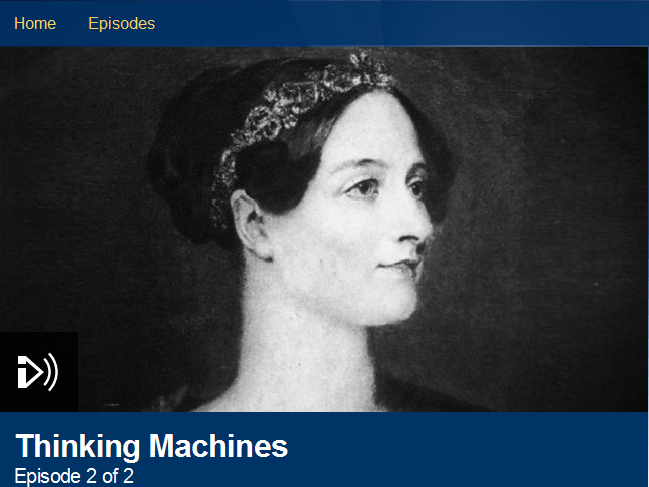
R4 programme on Ada Lovelace (2 days left to listen)

BBC Radio 4 has a two-part series on Ada Lovelace’s letters. Alas Part One of the series has already passed into the ‘programme no longer available’ territory, but Part Two (~28m) is live to listen to online for the next couple of days [at time of writing!].

Our cs4fn magazine special issue on Ada Lovelace isn’t going anywhere though, please download a free PDF at your leisure :)

adaletters.png

“In part two of this dramatization of The Letters of Ada Lovelace, Georgina Ferry reveals the nature of the relationship between the young heiress, Ada Lovelace (Sally Hawkins) and the crusty mathematician, Charles Babbage (Anthony Head), inventor of steam-powered calculating machines.

More info at the programme’s page.

What else are we up to?

1.Saturday 21 Nov – £30/60, 2-5pm
Introduction to Arduino [info] [tickets]
Aimed at teachers of pupils at KS3 and above our miniCPD session will introduce you to programming using an Arduino with simple electronics.

2. Wed 25 Nov – FREE, 5pm
Sorting Unplugged [info] [tickets]
This is a free workshop, aimed at computer science teachers, which introduces sorting algorithms in an ‘unplugged’ style.

3.Sat 28 Nov – £30/60, 2-5pm
Introduction to Arduino [info] [tickets]
Aimed at teachers of pupils at KS3 and above our miniCPD session will introduce you to programming using an Arduino with simple electronics.

4. Wed 2 Dec – FREE, doors 5pm, show at 5.30pm
The magic of {Christmas} Computer Science – free magic show for young people. [info] [tickets]
This is a free public talk aimed at secondary school-aged children and their families & friends. Paul Curzon and Peter McOwan will present a fun magic show powered by hidden computer science. There are rumours of mince pies too.


Draw your own hexahexaflexagon – blanks for printing and colouring in

It would have been Martin Gardner’s 101st birthday today (he was born in 1914 and died in 2010) and while he certainly didn’t invent, or even discover, hexahexaflexagons he was one of the first people to popularise them with an article in Scientific American in 1956.

We’ve used hexahexaflexagons as an example of a finite-state machine in our workshops and to illustrate computational thinking about graphs and maps.

You can find our free booklet about hexahexaflexagons, and how to use them, on our HexaHexaFlexagon Automata page where you can also download full colour printable flexagons to fold and glue at home (or at school, or at work). And now we also have some blank ones (and here’s one with three on a page) that you can print and colour in with your own designs.

For some inspiration have a look at Vi Hart’s series of YouTube videos on hexaflexagons, which are rather good fun.

If you’ve not folded a hexahexaflexagon before here’s Prof Paul Curzon showing how it’s done

Further reading
Flexagon but Not Forgotten: Celebrating Martin Gardner’s Birthday (Scientific American, 2012)

Teachers: Help your students build their own apps in the #AppsforGood course. Apply to deliver in 2015/16

AppsForGood are looking for Education Partners – here’s some information about them (and there’s a printable / shareable flyer at the end).

Print“Apps for Good is an education programme where students learn to build and pitch their own apps – helping students to become real-life entrepreneurs and digital creators.

The course meets the demands of the new curriculum in an engaging way and builds skills in teamwork, communication and problem solving.

Apps for Good provide their course framework, training and connections to tech Expert volunteers, and then let you do what you are best at – inspiring and guiding young people. Join 500 schools across the UK and apply to become an Education Partner: http://www.appsforgood.org/public/teach-apps-for-good – it’s free for non-fee paying schools.”

Follow them on Twitter  Screen Shot 2015-02-25 at 17.23.02  @appsforgoodcdi

Apps for Good – Info Flyer

Computing At School (CAS) community survey – open now

Pinched from the CAS e-newsletter…


National CAS Survey 2015
01 Feb 2015

Cas-logo_bcs

Computing At School and the Network of Excellence team are conducting a short survey about the Computing At School community and Computing in schools.

National CAS Survey 2015

The survey will remain open for the whole of February 2014. To get an accurate picture of how CAS is used and how Computing in schools is developing, we would like as many CAS members as possible to complete this. The survey is open to all (including non-CAS members), although there are some questions that are specific to members of CAS and some that are specific to teachers. It should not take long to complete.

For one lucky person each week, there will be a prize of a £25 Amazon voucher!

The summary data will be published by CAS in the spring.

Thank you!


If you’re interested in the teaching of computing in schools (you might be a teacher, a university partner or in industry or just curious) have a look at http://www.computingatschool.co.uk 

Speaking of surveys, we’ve (Teaching London Computing) just published the preliminary results of our own survey which looks at Computing teachers perceptions of their training needs, more at the snappily titled Surveying schools and Computing teachers – do they need training, and if so what format?

Our survey is still open, at http://bit.ly/TLCsurvey2015a

CAS’s survey link is National CAS Survey 2015