*New course* A-level CPD Computing for London teachers, from @TeachingLDNComp

Our new A-level CPD course will run over Spring and Summer at King’s College London (Waterloo Campus). The course will run on Tuesday evenings from Tuesday 28 April and run for 10 weeks (with a break for half term) until 7 July 2015. William Marsh from QMUL will be the tutor and all materials will be made available to course delegates at the start of the course.

The course dates are below, full course content information is available from our A-level CPD Computing page and tickets are available from Eventbrite.

You might also be interested in the new free material we’ve added to our section on Interdisciplinary Computational Thinking – lots of classroom activity sheets to download and other free resources.


Next A-level CPD course(s): Our next 10 week A-level CPD course will begin on Tuesday 28 April 2015.
Eventbrite - KCL: Summer 2015 - A-level Computing CPD - from Teaching London Computing

Fees
Our courses are reduced by 50% to £150 for London teachers, thanks to our funding, the full price for non-London teachers is £300 – please see our Fees and Funding page for more information. London teachers have priority on our courses.

Eligibility requirements
This course is a follow-on from our GCSE Computing CPD courses. The course assumes that you will be familiar with programming in Python or a similar language.

More information?
Please contact Jo Brodie (j.brodie@qmul.ac.uk)

Course dates: all on Tuesdays

Week 1: 28 April 2015
Week 2: 5 May 2015
Week 3: 12 May 2015
Week 4: 19 May 2015
Half-term: 26 May 2015 (no class)
Week 5: 2 June 2015
Week 6: 9 June 2015
Week 7: 16 June 2015
Week 8: 23 June 2015
Week 9: 30 June 2015
Week 10: 7 July 2015

Please sign-up to be kept informed of future courses.


New free activity: The Emotion Machine – ready to download and print, with instructions

Computing teachers might find this useful, newly published on our website.

Emotion Machine bThe Emotion Machine

Age group: 7 – 12
Abilities assumed: None
Time: 40-60 minutes
Size of group: 1 upwards

Focus
• Programming
• Sequences
• Low-level code and high-level commands
• Compilers and interpreters
• Abstraction
Summary
Students create and program a 2D robot made of card to show different emotions. They create a table that can be used to translate emotions (high level commands) into low level machine instructions.

robot pdf

Click to download the PDF. Click the link above to visit the info page for instructions.

Classroom Sessions to Embed Computational Thinking – at @RoyalHolloway w Prof Dave Cohen

Please note: as we do not know the detailed content of others’ courses we can’t endorse them – but we think you might like to know about what other people and organisations are up to. We’re happy to mention free or paid-for courses and events on our pages that are relevant to London and near-London teachers (and we don’t charge for listing information, or accept any advertising fee).

There are some sessions on computational thinking taking place in April and May 2015 at Royal Holloway University of London, with Professor Dave Cohen.

Classroom Sessions to Embed Computational Thinking

Department of Computer Science
Royal Holloway, University of London
Egham Hill
TW20 0EX Egham
United Kingdom

iStock_000016465426Medium

Schedule

Each session will begin at 4pm and finish by 7pm. There will be thirty places available. The sessions cost £20.


Don’t forget that Teaching London Computing is running some CPD courses for teachers who are teaching the new GCSE Computing curriculum. We have two courses running over Easter, both are the same length but one is split across a couple of weeks and the other is a week-long intensive course. You can find out more about both of them and book tickets here.

Teachers: Help your students build their own apps in the #AppsforGood course. Apply to deliver in 2015/16

AppsForGood are looking for Education Partners – here’s some information about them (and there’s a printable / shareable flyer at the end).

Print“Apps for Good is an education programme where students learn to build and pitch their own apps – helping students to become real-life entrepreneurs and digital creators.

The course meets the demands of the new curriculum in an engaging way and builds skills in teamwork, communication and problem solving.

Apps for Good provide their course framework, training and connections to tech Expert volunteers, and then let you do what you are best at – inspiring and guiding young people. Join 500 schools across the UK and apply to become an Education Partner: http://www.appsforgood.org/public/teach-apps-for-good – it’s free for non-fee paying schools.”

Follow them on Twitter  Screen Shot 2015-02-25 at 17.23.02  @appsforgoodcdi

Apps for Good – Info Flyer

New Easter CPD courses for Computing teachers in London: GCSE courses, at King’s College London

I’m delighted to announce that we have TWO new GCSE courses running soon and they will be held at King’s College London, Waterloo Campus and led by Margaret Derrington. These courses are aimed at experienced ICT teachers who would like to develop their subject knowledge in order to teach the new Computing Curriculum and the new Computing GCSEs.

Tickets are on sale now. The courses cost £300 but thanks to funding from the Mayor of London we can offer a 50% discount to London schools (get in touch if you’re not sure if your school qualifies).

More information and a guide syllabus is available from the links below and from our GCSE Computing page.

Course One

The first course is split into five sessions running over two weeks from the end of March to the second week of April:

Computing CPD GCSE Easter Holidays March 30 – April 10
Teaching London Computing
Monday, 30 March 2015 at 10:00 to Friday, 10 April 2015 at 16:00

5 sessions over two weeks, each class runs from 10am to 4pm.

  • Monday, March 30
  • Wednesday, April 1
  • Wednesday, April 8
  • Thursday, April 9
  • Friday, April 10

Eventbrite - Computing CPD GCSE Easter Holidays March 30 - April 10


Course Two

The second course is a one-week intensive in the third week of April:

Computing CPD GCSE Easter Holidays (1-week intensive) April 13 -17
Teaching London Computing
Monday, 13 April 2015 at 10:00 to Friday, 17 April 2015 at 16:00

Eventbrite - Computing CPD GCSE Easter Holidays (1-week intensive) April 13 -17

Paul Curzon’s doing two free workshops next Friday afternoon (20th) for Computing teachers in London cc @cs4fn

Paul Curzon’s free workshops, held at Queen Mary University of London’s Mile End campus, are fun and informal and support teachers who want to introduce programming concepts and computational thinking into the classroom in an engaging way. Each workshop is accompanied by downloadable classroom activities (also free) – these can be downloaded from the links below.

Next week’s (Friday 20th February) is a double session but you can choose to come to one workshop, or both.

The first workshop is at 2pm then there will be a half hour break with the second starting at 4pm, we aim to finish at 5.30pm.

Do I have to be a London computing teacher to attend?
The workshops are aimed at those who are currently (or who are about to begin) teaching the Computing curricula (particularly GCSE and A-level, though the information in the workshops has been used with younger children). As we’re funded by the Mayor of London we prioritise those who are currently teaching in London schools. The workshops are not suitable for school pupils though as the events are about how to introduce computing concepts into the classroom. Contact Jo Brodie (j.brodie@qmul.ac.uk) for further information.

Biography
Paul Curzon is a Professor of Computer Science at Queen Mary, University of London. He runs the cs4fn ‘Computer Science for Fun’ (cs4fn) project, www.cs4fn.org. It aims to inspire school students about computer science through a series of free magazines, website and school shows. He regularly gives such shows around the UK as well as continuous professional development talks to teachers about the cs4fn approach to teaching. He is Director of the Teaching London Computing Project. He was made a UK National Teaching Fellow in 2010 in recognition of his excellence in teaching and outreach, was a finalist in the 2009 Times Higher Education Innovative Teacher of the year award and has twice won the student nominated Queen Mary award for excellence in teaching.

Workshop A:
Programming unplugged: learning programming without computers

2.00-3.30pm (free Eventbrite tickets)

Overview
It’s easy to assume that programming is something you have to learn at a computer but if you want your students to deeply understand programming concepts, rather than blindly getting programs to work then unplugged techniques can work really well to get students started. We will see how to program a robot face that is made of students, look at a simple way to give a deep understanding of how variables work by making them physical, and see how to compile programs onto your class instead of onto a computer.

Session material This session will cover:

  • Inspiring ways to introduce programming away from computers.
  • What is a variable?
  • How does assignment work?
  • Programming simple objects
  • Introducing flow of control and if statements

Workshop B:
Computational thinking: it’s about people too

4pm-5.30pm (free Eventbrite tickets)

Overview
Computing is not just about technology, it is about understanding people too. When we solve computing problems we are solving them for people. Computational thinking is the general group of problem solving skills that students learn as a result of studying computing. Often this is equated with algorithmic thinking – a direct result of learning to program. However it just as important to make programs usable by people – or they won’t be used. We will see how magic gives a fun way to introduce these ideas and how a simple game demonstrates why graphical user interfaces are effective.

This session is in collaboration with CHI+MED: an EPSRC-funded project about making medical devices safer.

Session material This session will cover:

  • computational thinking: understanding people
  • human computer interaction
  • why GUIs are better than text-based interfaces
  • The importance of data structures

Surveying schools and Computing teachers – do they need training, and if so what format?

As part of the evaluation of the Teaching London Project (funded by the Mayor of London and the Department for Education to support London teachers who’ll be teaching the new Computing curricula) we have been asking Head Teachers about their perceptions of the need (or not) for training for Computing teachers. We want our courses to be helpful to teachers, as part of their CPD, and also to be available to them in a useful format (short courses versus longer ones, in-school hours versus out of hours classes).

We’ve conducted a study, with 32 respondents so far, and the summary of feedback is below, but we’re keen to hear from more teachers and head teachers in London about how schools are thinking about training needs for those teaching the new GCSE or A-level Computing.

Please visit http://bit.ly/TLCsurvey2015a to take part in our survey and pass this link on to colleagues.

In the text below ‘Computing’ refers also to ‘Computer Science’ as both terms are used in the curricula. The survey results were analysed by Nicola Plant, who also wrote the information below.

Summary Results of the Teaching London Computing teachers’ survey

We’ve had 32 responses to our survey so far.

1. Courses currently offered or planned

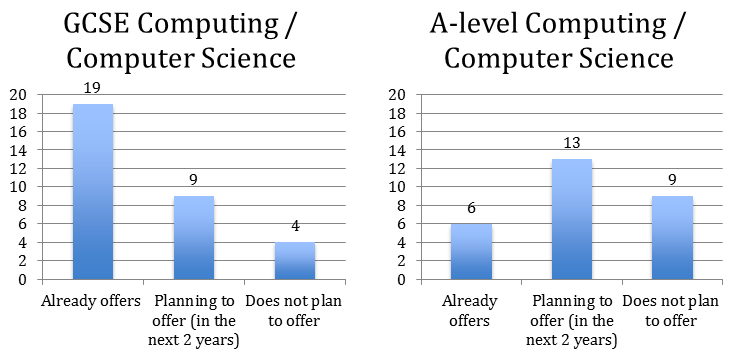
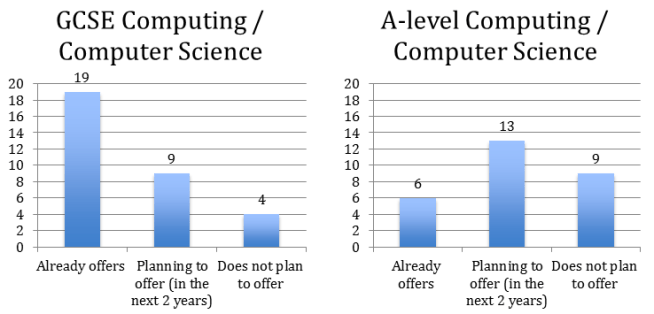
The majority of schools (60%) already offer GCSE Computing and a third of responding schools plan to offer the subject in the next two years with only a small proportion of schools opting not to offer the subject.
Updated graphs by Nicola

y-axis is the number of respondents, out of 32 in total

In contrast, the majority of schools (78%) do not currently offer A-Level Computing, of which two thirds plan to offer the subject in the next 2 years, and a third opts not to offer the subject. (This could be explained by the fact that the new GCSE curriculum has only recently begun to be offered and so there are no students past year 11 to continue).

2. Training requirements

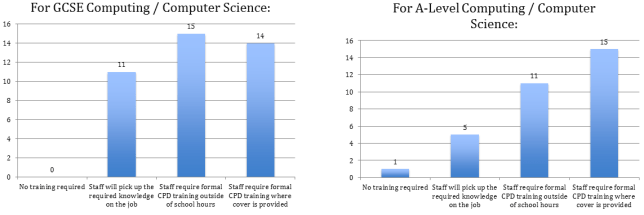
31 of 32 respondents thought that teachers need subject knowledge training. For the GCSE Computing curriculum around half of schools expected that teachers would attend training both inside and outside of school time. A third of schools also expect teachers to pick up the subject as they go along.  For the A-Level perceptions were different, where only 5 schools expected teachers to pick it up as they go along, a third expected teachers to train in their own time, but half would have teachers training inside school hours. However, informal comments explained that cover is a problem as covered students don’t feel supported by cover teachers.
2 graphs

Click to enlarge

3. Format of training

There was no significant difference between GCSE and A-level Computing for a preferred format for training. Around a third to a half of schools (that would encourage staff to attend training) were split equally among workshops, shorter courses and longer CPD courses.

Schools rated staff time, course costs, choosing courses that offered subject knowledge, and choosing courses that offered knowledge of the curricula an equally important consideration for both GCSE and A-level Computing training courses. Just over 50% of schools would provide cover when staff were on training courses.

4. Recruitment

To teach GCSE Computing 40% of schools are looking to recruit more experienced staff but to teach A-Level Computing half of schools were looking to recruit more experienced staff.

5. A-level

Around 80% of schools do not offer A-level Computing because there is a lack of experienced staff and facilities.

2nd FREE workshop with Paul Curzon – NEW: Interdisciplinary Computational Thinking through Modelling (26 Jan)

Our second free workshop of the year with Prof Paul Curzon will also be a brand new one. “Interdisciplinary Computational Thinking through Modelling” takes place on Monday 26 January from 5.30pm at Queen Mary University of London.

These workshops are aimed at Computing teachers in London and demonstrate a number of ways that teachers might introduce computational thinking and computer programming topics into the classroom, as such a workshop is not a ‘show’ (not suitable for pupils for example) and there will probably be some audience participation.

There is also another workshop, Computational Thinking: Searching to Speak, running the week before on Monday 19 January at 5.30 to 7pm at QMUL.


Next workshop: Interdisciplinary Computational Thinking through Modelling
Monday 26 January 2015, 5.30pm, at QMUL
Eventbrite - Free workshop for Computing teachers in London, with Paul Curzon - Interdisciplinary Computational Thinking through Modelling


Interdisciplinary Computational Thinking through Modelling

Monday 26 January 2015, 5.30pm to 7pm
QMUL
Eventbrite tickets
Nearest tube: Stepney Green, Mile End also close by
Buses: 25 and 205 to ‘Ocean Estate

For full details of the workshop and to download some accompanying free classroom resources please take a look at the workshop’s page: Interdisciplinary Computational Thinking through Modelling

Overview
Is computational thinking just for computer scientists? Actually no. It has already revolutionised the way scientists, mathematicians and many others do their jobs.

Computing has changed the way science is done not just because of the availability of more powerful computers, but because it has given scientists a whole new toolset for thinking. In particular algorithmic thinking gives a new way of doing science. We will use  cs4fn activities, games and magic tricks to illustrate how computational modelling can be used both to do and learn about other subjects. We will also use a magic trick to show how algebra plays an important role in logical thinking for computer scientists.

Session material
This session will cover:

  • How Computational Thinking supports other subjects.
  • What is computational modelling and how does it link to algorithmic thinking?
  • How interdisciplinary Computational Thinking can be used to teach topics in Biology, Physics and Mathematics in a powerful and fun way.

Activities are suitable for all age groups and can be adapted to fit your teaching needs.

Biography
Paul Curzon is a Professor of Computer Science at Queen Mary, University of London. He runs the cs4fn ‘Computer Science for Fun’ (cs4fn) project, www.cs4fn.org. It aims to inspire school students about computer science through a series of free magazines, website and school shows. He regularly gives such shows around the UK as well as continuous professional development talks to teachers about the cs4fn approach to teaching. He is Director of the Teaching London Computing Project. He was made a UK National Teaching Fellow in 2010 in recognition of his excellence in teaching and outreach, was a finalist in the 2009 Times Higher Education Innovative Teacher of the year award and has twice won the student nominated Queen Mary award for excellence in teaching.


FREE: Paul Curzon ‘Computational Thinking’ workshop @QMUL for Computing teachers, 19 January

Our first free workshop of the year will be Paul’s exploration of ‘Searching to Speak’. This uses the example of a case of locked-in syndrome to explore the use of computational thinking in solving human problems (human-computer interaction) as well as considering when a technological approach might not actually be the most appropriate solution.

The workshop will take place on Monday 19 January from 5.30pm to 7pm at Queen Mary University of London (QMUL, Mile End Campus) and is free.

These workshops are aimed at Computing teachers in London and demonstrate a number of ways that teachers might introduce computational thinking and computer programming topics into the classroom, as such a workshop is not a ‘show’ (not suitable for pupils for example) and there will probably be some audience participation. There will also be a second workshop, with details to be confirmed, which will take place on Monday 26 January also at 5.30 to 7pm at the same venue.

Computational thinking: searching to speak

Monday 19 January 2015, 5.30pm to 7pm
QMUL
Eventbrite tickets
Nearest tube: Stepney Green, Mile End also close by
Buses: 25 and 205 to ‘Ocean Estate

For full details of the workshop and to download some accompanying free classroom resources please take a look at the workshop’s page: Computational thinking: searching to speak

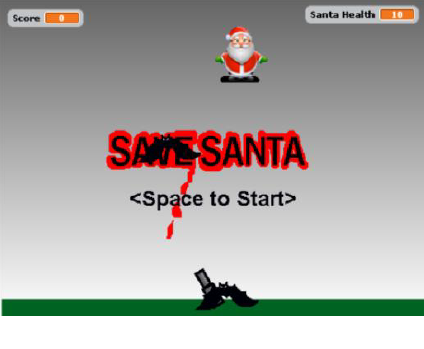
‘Save Santa’ Christmas game in Scratch, shoot the bats that are trying to interfere with his gift delivering :) via @CompAtSch

Computing At School (CAS) is a free resource hub (with info about events and classroom resources) for computer science teachers in the UK. There’s a thriving community section in which people can share their ideas for activities, and one of them is this game ‘Santa Shoot’ game, from Conor Grimes. Players need to shoot down bats that are getting in Santa’s way.

It’s free to become a CAS member and once you’ve done so you’ll be able to access the Scratch game and play it in your classroom.

The game was written in 2012 but thanks to a comment posted more recently the thread has resurfaced.

Game details: Santa Shoot Christmas Game

savesanta

Short description:
Simple Scratch Christmas Activity

Full description:
Key Stage 3 Programming Activity
Level: (Beginner / Intermediate/)
Duration: (1 – 2 Periods)
Teaches: (Basic Scratch programming)