Free computing workshop, Goldsmiths 8-9 July, for KS2 & Y7 teachers, w Paul Curzon

How to use Scratch and unplugged activities to teach programming concepts


Screen Shot 2014-06-16 at 13.11.05
The text below is taken from the accompanying PDF flyer:  8-9July ScratchWorkshopNew

The National Curriculum for Computing involves a large amount of new content, namely programming that will be particularly challenging for KS2 –KS4 teachers. It is acknowledged that teachers will need support to acquire the necessary subject knowledge and skills to deliver this discipline.

This workshop aims to equip you with a good understanding of programming concepts and computational thinking, offering practical ways to teach the related KS2 programmes of study. It is suitable for teachers new to Scratch.

The workshop is part of the ‘Programming 4 Teachers’ project, funded by the Mayor’s Office to trial a CPD model for teaching KS1-3 teachers computer programming concepts, knowledge and skills as well as the trial of teaching resources and pedagogy. Zali Collymore-Hussein is one of the lead trainers on the project.

The ‘Programming 4 Teachers’ resource pack will be available free to delegates attending the workshop.

Complete the attached booking form and email to: TEACHERSCENTRE@GOLD.AC.UK

PLEASE BRING YOUR OWN LAPTOP TO THE WORKSHOP with Scratch 2 installed.

The workshop will take place at Goldsmiths University of London, Education Building, New Cross, London SE14 6NW
Map details: http://www.gold.ac.uk/find-us/

Course Outline

8th July 2014

•  Teaching Computing Unplugged to Young Children – Professor Paul Curzon
Computational thinking is a fundamental skill set that students learn by studying computing. We will demonstrate a range of activities that show how core ideas and concepts can be introduced using fun unplugged activities, games and magic tricks. We will show that computing can be fun for everyone and that it doesn’t have to be taught at a computer. Supporting resources are available at www.teachinglondoncomputing.org.

Introducing programming fundamentals through interactive games made in Scratch – Zali Collymore-Hussein
Suitable for years 4-5. Create programs that implement algorithms to achieve given goals that contains loops, comparative operators, randomized values, variables and if selections. Makey Makey can be used to interact with a game to add a mix of fun and science.

9th July 2014

• Deepen understanding of programming concepts through interactive quizzes made in Scratch – Zali Collymore-Hussein
Suitable for years 5-6. Create programs using procedural abstraction, post tested loops, multiple variables, arithmetic operators and ‘if, else’ selections.

• Tackling Control Projects using Scratch and Raspberry Pi – Zali Collymore-Hussein

Paul Curzon’s biography
Paul Curzon is a Professor of Computer Science at Queen Mary University of London. He runs cs4fn / Computer Science for Fun (www.cs4fn.org) through which he has been enthusing school students about interdisciplinary computer science worldwide for over 10 years. He is also co-Director of ‘Teaching London Computing’ (www.teachinglondoncomputing.org) developing inspiring activities for computing teachers to use in class. He is a UK National Teaching Fellow in recognition of his excellence in teaching and outreach. He also leads research in the area of human computer interaction and verification focussing on making medical devices safer.


Screen Shot 2014-06-16 at 13.43.28


FREE workshops next week at QMUL, for GCSE Computing teachers

TLC robot fauxgo title and URL

Prof Paul Curzon will be delivering four FREE workshops during half-term next week at QMUL (Queen Mary University of London) on Monday . These are fun, inspiring ‘unplugged’-style sessions which look at some creative ways of getting students to think about computing and programming concepts, without relying on computers, and are aimed at GCSE Computing teachers who’ll be delivering the new Computing curriculum.

Each session is accompanied by lots of free classroom resources and activity sheets to download, and of course an opportunity to share ideas with other workshop attendees.

We’ve arranged things so that there’s an hour between the morning and afternoon sessions (to make it easier for those who’d like to attend two in a day) but you’re welcome to come to as many of the workshops as you like.

The workshops are

A. Computational thinking: Searching to Speak (Website) (Eventbrite tickets)
Tuesday 27 May, 11.30am to 1pm

B. Computational Thinking: it’s about people too (Website) (Eventbrite tickets)
Tuesday 27 May, 2pm-3.30pm

C. Invisible palming! Intelligent paper? So what is an algorithm? (Website) (Eventbrite tickets)
Wednesday 28 May, 11.30am to 1pm

D. Programming unplugged: learning programming without computers (Website) (Eventbrite tickets)
Wednesday 28 May, 2pm-3.30pm

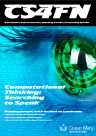
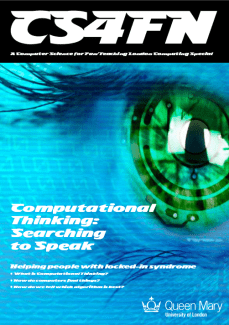
Cover of the Searching to Speak A5 booklet, click to open the PDF← Download a free copy of our latest booklet ‘Searching to Speak’ (which accompanies the first workshop in the series, on Tuesday morning) – click to open the PDF or right-click / save as to save a copy.


The admin bit:
All the workshops are free and will take place in Room 1.02 in the Law Building on Mile End Road. For those attending both morning and afternoon sessions (there’s an hour between the workshops) there are lunch options on campus (Mucci or Curve as well as snack shops) and plenty of food places on Mile End Road including a Sainsbury’s. You can attend as many workshops as you like.

Please contact me (Jo, j.brodie@qmul.ac.uk) if you have any queries.

Follow us on @TeachingLDNComp


New free workshop for Computing teachers – ‘Searching to Speak’ 22 May 2014, London

Cover of the Searching to Speak A5 booklet, click to open the PDF
Prof Paul Curzon will be running his FREE ‘Computational thinking: Searching to Speak‘ workshop for GCSE Computing teachers next Thursday afternoon at a school in London.

Eventbrite - Computational thinking: searching to speak - free workshop for teachers
When: Thursday 22 May 2014, 4pm-5.30pm
Where: Stormont House School, Downs Park Road, London, E5 8NP
Audience: GCSE Computing teachers
Cost: FREE

More info: Contact Jo Brodie (j.brodie@qmul.ac.uk) and see our workshop page for more details and downloadable resources.

Printed copies of the booklet, and other magazines from cs4fn (Computer Science For Fun) will be available for each delegate and you can sign up to receive free copies of our future magazines at the cs4fn website, and hear about our new courses and workshops.

Dates for your diary: Paul Curzon will also be delivering all four of his free workshops for GCSE Computing teachers on 27 and 28 May, at QMUL. More to follow…

Overview
One of the worst medical conditions I can imagine is locked-in syndrome. It leaves you totally paralyzed except perhaps for the blink of an eye. Your intelligent mind is locked inside a useless body, able to sense everything but unable to communicate. How could a computer scientist help? We will use this problem to illustrate a way to introduce computational thinking skills, as well as core computing topics such as search algorithms and how to compare them. More generally we will demonstrate how computational thinking ideas can be introduced in an integrated way using cs4fn ‘unplugged’ activities, games and magic tricks, getting students out of their seats and away from their computers.

Session material
This session will cover:

  • What is Computational Thinking?
  • Inspiring ways to teach Computational Thinking.
  • How do computers find things? Search algorithms.
  • How do we tell which algorithm is best? Efficiency Analysis.
  • An introduction to using magic tricks to teach computing concepts

Activities are suitable for all age groups and can be adapted to fit your teaching needs.


Free 1-day taster course for Y12 school students interested in electronics & computing, in June

Teachers of Y12 students might be interested in this free taster course on computer science and electronic engineering, to be held at Queen Mary University of London (QMUL). This is part of the University of London’s series of short taster courses for school students which QMUL participates in.

Please note that this is not a Teaching London Computing course.

IMG_0023[1]

Taster Course – Electronics and Computing for the Digital Age
Course Date: 26 Jun 2013
Duration: One day (10am – 4.15pm)
Cost: FREE, booking required

“This 1-day course will provide an excellent opportunity for students to experience some of the exciting things that our degrees in Electronic Engineering and/or Computer Science have to offer.

You will be shown just some of the choices that are open to you in terms of specialist skills you can learn and the outstanding career opportunities they afford. During the day you will get “hands-on” experience with various activities. You will also meet staff and some of our existing undergraduate students to get a feel for life with us.”

Subject area/s: Audio Systems Engineering, Computer Science, Electronic Engineering, Engineering (Audio Systems), Engineering (Electronic), Information and Communication Technologies, Information Technology (IT), Multimedia and Arts Technology, Technology, Telecommunications

Course Requirements: This taster course is open to year 12 students and anyone who is planning on starting their undergraduates studies in September 2014. Students should be studying either AS Maths or Physics (or equivalent).

Students can apply here, and will be asked to write 150 words on why they’re interested in studying computer science / electronic engineering.

Can computers be creative? BBC R4 prog 15 May, 11.30am w Prof @Trevor_Cox

For those near a radio tomorrow morning Prof Trevor Cox is exploring whether we can consider computers as having the ability to be creative. His programme “Can a Computer Write Shakespeare?” will be broadcast on Thursday morning (15 May 2014) at 11.30am on BBC Radio 4, or you can listen online at the link given.

“Trevor Cox asks whether computers can ever be truly creative.

An old adage says that a monkey sitting at a typewriter could eventually write Shakespeare. By the same token, could a computer ever create a work of art that could match Shakespeare’s creativity?”

He’s also written a blog post “Can computers compose?” which talks about software used to create pieces of music, including a piece called ‘Adsum’ that had a full orchestral arrangement and premiere (see the video on Trevor’s blog).

For a more unplugged way of creating music have a look at Howard Goodall’s episode on Melody from his ‘How Music Works‘ series. In the video below (from 12min 54sec but Howard introduces the piece a few seconds before that) he asks people at a shopping mall to pick numbers from a bag and uses these to determine which notes to play on the piano, resulting in a piece of crowdsourced music.

Know someone aged 15-18 interested in 3D animation? FREE 3Dami summer school in July/Aug

For UK students aged 15-18 there’s an opportunity to participate in a week-long summer school learning about 3D animation techniques. 3Dami are the people behind the event, which will take place at UCL Engineering in London, and here’s their ‘blurb’:

“3Dami is a 7 day summer school where groups of students run their own studio and create their own animated short film from scratch. It operates at the intersection of art and technology (computer science), and is well suited to students with an interest in both. Students get to experience a semi-realistic studio setup, and create their film as a real studio would – it requires teamwork, thinking on their feet and hard work. The skills taught are directly related to the film effects and computer game industries, both of which are booming in the UK. There will be an industry visit and talks given by experts. The event is completely free for UK students aged 15-18 (includes free food!) and runs at UCL (London) from July 24th to August 1st. Please visit the website (3dami.org) to watch last year’s films and for further details, including how to apply.”

“3Dami London are looking for 24 students to make up 3 film studios.  Students are welcome to apply from all over the UK as long as they can sort out their own transportation and accommodation (hopefully there will be some bursaries available).”

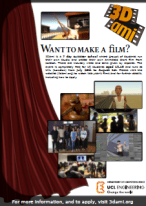
You can also download the PDF poster to advertise in schools, click the picture below to open or right-click save as to save, and there’s a YouTube video below that.

The event will run Thursday 24th July – Friday 1st August (inclusive), most days start at 9am and finish at 5:00pm.  On the final Friday there will be a première of the films to parents, friends and other dignitaries at UCL, this event is likely to finish around 8:30pm.

More information from 3Dami London 2014.

3Dami pdf poster

Click to open / save PDF poster


CAS: 2014 Teacher Conference 21 June 2014 & Teaching Computing CPD Day on 20th, from @CompAtSch

The CAS (Computing At School) Teacher Conference will take place in Birmingham on Friday 20 and Saturday 21 June 2014. The conference itself takes place on the Saturday 21st with a day of teaching CPD happening on Friday 20th.

Tickets and information available from 2014 CAS – Conferences for Teachers of Computing.

2014 CAS – Conference for Teachers of Computing
Computing At School (CAS)
Saturday, June 21, 2014 from 9:00 AM to 5:00 PM (BST)
Birmingham, United Kingdom

For primary school computing teachers: Barefoot Computing website now live & competition

From the Computing At School website’s news page:

Barefoot Computing CAS


“The Barefoot Computing project is about helping primary school teachers get ready for the computer science element of the new computing curriculum.”

 
The website is now live at http://barefootcas.org.uk/ and they’re running a competition “for primary school pupils to design a mascot for the Barefoot Computing Project. There are iPads to be won! The closing date is 23rd June and more information can be found here. ”


An example of a job that people who code might do (at Cancer Research UK)

We often talk about coding as a skill that’s useful in a variety of jobs (as well as just being an enjoyable challenge in itself). Here’s an example of a recently posted job advert from Cancer Research UK – they’re looking for someone with a knowledge of coding. The job description is saved on this blog so you’ll be able to look at it even after the job advert has closed, for example if you want to use it in giving your students an idea of some of the jobs available, and skills wanted by employers.


Information Designer or Coder

Permanent link to job description: Role Profile – Information Designer

Are you a creative and analytical individual who can create infographics and interactive web content to communicate science and statistics?

We’re looking for a driven and self-starting Information Designer or Coder to…

  • Create infographics and data visualisation tools, working with our Senior Information Designer
  • Support our Statistical Information Team with the delivery of visual and interactive content for the web and production of downloadable materials
  • Contribute to new ways of presenting information for a wide range of audiences

Here at Cancer Research UK, we work to inspire volunteers, unite the scientific community, educate the public about cancer prevention and tell our story to the government to bring about change. Every day we achieve extraordinary things by being innovative, imaginative and bold in our work. Now we need an Information Designer to support the Statistical Information Team to present and communicate complex information about cancer to a variety of audiences in a smart and engaging way.

Join our collective force and help us lead the way through your…

  • Knowledge
    • of infographics and data visualisation
    • of interactive web development, design software and content management systems
    • of numbers and statistics
  • Experience (either in the work-place or during relevant qualification)
    • of graphic design, and/or front-end web development (HTML, CSS, SVG, JavaScript)
    • of assimilating, analysing and presenting information to a variety of audiences
  • Skills and Competencies
    • Good understanding of design for web, print and social media
    • Creative and visual thinker with a keen attention to detail
    • Able to understand, interpret and communicate science or statistics
    • Able to find a story or a message in complex information and bring it to life
    • Strong verbal communication skills, organisational skills, initiative and flexibility

Our passion, determination and ambition leads us to set ourselves more and more challenging targets, which means you’ll need to translate concepts and creative briefs into demonstrable solutions, to communicate complex ideas and processes visually. You’ll also provide suggestions, promote best practice and engage with a variety of teams.

Whether your background is primarily in design, science communication or web development, this is a growing area for us with enough flexibility for the right person to find their balance between these three skill sets. If this describes you, you can enjoy a great career with us as, together, we bring forward the day when all cancers are cured.

Closing Date: 18th May 2014
Interviews: 5th and 6th June 2014

Job details
Salary: £23,000 – £28,000 p.a + excellent benefits
Location: Angel Building
Contract: Permanent
Contracted Hours (per week): Full Time (35 hours)
Business Area: Health & Patient Information, PR & Communications, Web and Digital
Closing Date: 18/05/2014 23:55

Visit Cancer Research UK’s website to apply for this job.


Calling UK teachers – free copies of cs4fn issue on computer science and medical devices

Free magazine for UK schools from cs4fn, about computer science, medical devices and patient safety.

cs4fn (Computer Science For Fun, based at Queen Mary University of London, QMUL) has been providing school students and teachers with inspiring resources, including magazines, magic books, puzzles and schools talks, about computer science for almost ten years.

Teaching London Computing is a spin-off project from cs4fn to explicitly support teachers. It is run jointly by QMUL and colleagues at King’s College London and provides courses and classroom resources for teachers who’ll be delivering the new KS3, GCSE and A-level Computing curricula. Primary school teachers are also finding many of the resources useful.

There’s also a bit of overlap with a third project, CHI+MED, which is adding a human dimension to cs4fn and TLC. It is funded by one of the UK’s research councils (EPSRC) to investigate how interactive medical devices could be made safer. That project runs over four universities (UCL, QMUL, Swansea University and City University) and the main investigator at QMUL, Prof Paul Curzon, is also one of the people behind cs4fn.

CHI+MED (computer-human interaction for medical devices) takes a very broad view of medical devices – how they’re designed, how they’re approved for use on the market, how people in hospitals decide which one(s) to buy and how they’re actually used in the real world by busy healthcare professionals. Computing is an important aspect of medical device design (software performs calculations and determines how the machine responds to keypresses when a nurse enters a drug dose) but it’s not the only one. It’s important to look at the people involved (the ‘human’ bit of ‘human-computer interaction) at every stage of device development and use too, for example when trying to reduce the harm that can arise when someone makes a slip in mistyping a drug dose.

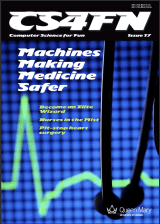
Magazine cover for cs4fn's special issue on medical devices and patient safetyIssue 17 of the cs4fn magazine series is about the research that people on the CHI+MED project are doing along with related work of other groups. It provides a good overview of some of the issues that researchers are thinking about when looking at patient safety in medical devices. It also shows how computer scientists and researchers work with other types of scientists (ergonomists, human-factors experts) in trying to understand and solve a real-world problem.

Sign up for free copies of the magazine
cs4fn already sends copies of the magazines to schools who subscribe. If you are a teacher or school librarian who would like to receive one or more copies (up to a class set of 30*) of this, and future magazines, please fill in your school’s address details (UK addresses only please) on this form and we’ll do the rest (while stocks last). The magazine is free due to support from EPSRC and Google.

*If you need a larger number of copies, eg for an event, please get in touch (cs4fn@eecs.qmul.ac.uk) and we’ll do our best to get more to you.

[This post cross-posted to both Teaching London Computing and CHI+MED blogs]