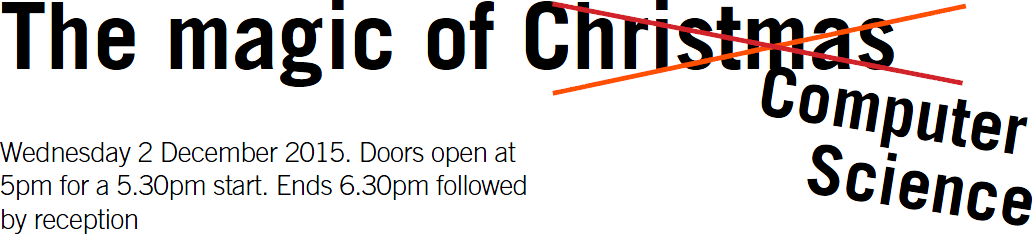
Live in London? Have or care for children? Do they like magic, & free talks @QMUL abt computer science? Abracadabra!

Peter McOwan and Paul Curzon, both of QMUL and cs4fn fame, will be delivering the IET’s Christmas children’s lecture in The Great Hall of the People’s Palace at Queen Mary University of London on Wednesday 2 December. It’s completely free and doors will open at 5pm with the lecture starting at 5.30pm. There will be mince pies too.

magic of christmas computer science

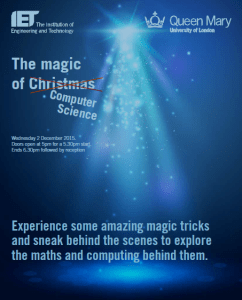
FREE tickets for the ‘The Magic of Christmas Computer Science’, a magic show powered by hidden computer science, are available from Eventbrite and you can find out more information about the event and the speakers below. Please share this event flyer with others who might be interested.

About this event

Experience some amazing magic tricks and sneak behind the scenes to explore the maths and computing behind them.

Mathematics and computer science are behind today’s technological wizardry… Let Professors Peter McOwan & Paul Curzon, both scientists and magicians, be your guides to the secret world where science meets conjuring…

This special one-off Christmas event – co-hosted by the School of Electronic Engineering and Computer Science at Queen Mary, and The Institution of Engineering and Technology (IET) – will be a fun-filled evening full of surprises.

The evening is aimed at secondary school aged students, but with surprises to be unveiled for both adults and young people alike. All are welcome so if you have a curious mind, book your (free) tickets below quickly as places are vanishing fast!

About the Speakers

Professor Peter McOwan QMUL Vice-Principal (Public Engagement and Student Enterprise) and Professor Paul Curzon.

Peter McOwan and Paul Curzon are Professors of Computer Science in the School of Electronic Engineering and Computer Science at Queen Mary College University of london. As researchers and academics they apply their ‘magic’ to everything from robotics and artificial intelligence to the software of medical devices. Their infectious enthusiasm for exploring the endless possibilities of computer science has led them both to be elected as National Teaching Fellows. They work closely with the ‘Computing at Schools’ network, Peter was a founding member.  Paul also runs ‘Teaching London Computing’, which creates inspiring activities for teachers to use in class.

The speakers also run ‘Computer Science for Fun’, a magazine about the fun side of computing. They have been giving linked computing magic shows for over 10 years.

magic of christmas pdf front cover
Programme

17:00     Registration
17:15     Seating
17:30     Start of Lecture
18:30     Reception
19:15     Close

Reasons to attend

Bring your children, grandchildren, nephews or nieces to show them what a career in Science and Engineering has to offer.

Additional information

There will be a reception and mince pies and some light refreshments for everyone after the lecture. All are welcome.

Information above adapted from IET and QMUL pages advertising the event

Draw your own hexahexaflexagon – blanks for printing and colouring in

It would have been Martin Gardner’s 101st birthday today (he was born in 1914 and died in 2010) and while he certainly didn’t invent, or even discover, hexahexaflexagons he was one of the first people to popularise them with an article in Scientific American in 1956.

We’ve used hexahexaflexagons as an example of a finite-state machine in our workshops and to illustrate computational thinking about graphs and maps.

You can find our free booklet about hexahexaflexagons, and how to use them, on our HexaHexaFlexagon Automata page where you can also download full colour printable flexagons to fold and glue at home (or at school, or at work). And now we also have some blank ones (and here’s one with three on a page) that you can print and colour in with your own designs.

For some inspiration have a look at Vi Hart’s series of YouTube videos on hexaflexagons, which are rather good fun.

If you’ve not folded a hexahexaflexagon before here’s Prof Paul Curzon showing how it’s done

Further reading
Flexagon but Not Forgotten: Celebrating Martin Gardner’s Birthday (Scientific American, 2012)

Have you attended one of our courses or workshops? What did you think?

If you’ve attended one of our events we’d love to hear what you thought about it as our project comes to a close. We would like to know if our project has benefitted you as a Computing teacher and, if so, how. Please take a look at https://www.surveymonkey.com/r/TLCFinalSurvey (the survey should take around 10 minutes to complete).

Also – our next A-level Computing CPD course starts next Wednesday with FREE places for London Master Teachers.


The current incarnation of Teaching London Computing aka ‘TLC’ (as funded by the Mayor of London’s London School’s Excellence Fund grant) is coming to an end however we are very keen to continue with the project and make it sustainable.

We know from teachers telling us (thank you!) that they really value our in-depth CPD courses, our ‘miniCPD‘ sessions, and our free workshops are perennially popular too. We also know that lots of teachers in London, the rest of the UK and even from around the world are downloading and using our free classroom resources – hooray! We know this partly because people tell us, but also from the website stats (at time of writing we’ve just passed 87,000 blog ‘hits’) and the figures telling us that our PDF have been downloaded around 28,000 times.

The team behind TLC (staff from Queen Mary University of London and King’s College London) have taken on the role of one of the new CAS regional centres (we’re ‘CAS London’) and we’ve working with CAS to enable Master Teachers to attend free* at our next course (A-level Computing CPD, starting on Wednesday 7 October 2015) *while places last.

Thank you for making this project so interesting and rewarding, from all of us at Teaching London Computing.

New course date: A-level Computing CPD for London teachers – Wed 7 Oct, 10-week course

We will be running our A-level Computing CPD course again this Autumn for London teachers.

The course will run for 10 weeks from 5pm to 7.30pm on Wednesday evenings from 7 October to 16 December 2015 with a half-term break on Wednesday 28 October (ie a 10 week course running within an 11-week timeframe) in the ITL Building, Queen Mary University of London.

As always the course costs £300 but those teaching in London can take advantage of a 50% reduction thanks to funding from the Mayor of London, ie £150. In addition, with support from the new CAS London hub, we are also making FREE places available for London Master teachers only – please note that we will be requesting evidence of Master Teacher status before confirming your free place. The course will be taught by William Marsh and Trevor Bragg.

Full information and guide syllabus on our A-level Computing page, and there are some quick links to register below. Any questions? Contact Jo (j.brodie@qmul.ac.uk) for more.


Next course(s): 10-week Wednesday evening course: 7 October to 16 December 2015 (half-term 28 October 2015), 5.00pm to 7.30pm. For this course we are making free places available for London Master Teachers (you will be sent an application for to confirm your eligibility).

Eventbrite - A-level Computing CPD - Teaching London Computing & CAS London for a place on A-level Computing CPD – Teaching London Computing & CAS London

Please sign-up to be kept informed of future courses.


Summer School 2015 at @Ri_Science, for children 7-12, w Prof Paul Curzon on the magic of computer science

The Royal Institution (21 Albemarle St, London W1S 4BS) hosts public science events for all ages and is currently running a Summer School over the next few weeks with a range of science topics including maths, computing, cryptography, engineering, biomechanics and acoustics. The full programme covers workshops for children aged 7 and above with workshops for different year groups up to and including adults over 18.

Prof Paul Curzon, who has delivered many engaging workshops on the magic of computer science for teachers, will be delivering two workshops for school children on Tuesday 18th August.

The morning session will be for 7-9 year olds and the afternoon one for 10-12 year olds.

“When you learn to be a magician, it turns out you are learning the skills needed to be a great computer scientist too: computational thinking. In this workshop Paul Curzon will demonstrate some real magic tricks and teach the group how they are done so they can do the tricks themselves. Students will then use the magic to learn the linked basics of computer science and see what computational thinking is all about and how both magicians and computer scientists rely on it.

There will be a short break during the workshop and a drink and a small snack will be provided. Students should bring their own snack if they have any allergies.”

Morning workshop (Sunley Room)
The Magic of Computer Science with Prof Paul Curzon
Age group: 7-9 year olds – £30/27 (Faraday members)

Afternoon workshop (Library)
The Magic of Computer Science with Prof Paul Curzon
Age group: 10-12 year olds – £30/27 (Faraday members)

Financial assistance
The Potential Trust may be able to offer financial assistance to enable children to participate in Ri events and activities if this would otherwise be difficult. Please contact Anna Comino–James on 01844 351666 or email her at thepotentialtrust@gmail.com.

Our next events – one free workshop, one (not free) CPD course for A-level Computing teachers

Here’s what we have coming up so far in August… do also sign up to our mailing list to be kept informed of future activities.

1. Course for A-level Computing teachers in London
A-level Computing CPD August one-week intensive 2015 – from Teaching London Computing
Monday, 17 August 2015 at 10:00 – Friday, 21 August 2015 at 16:00 – at QMUL
This is a one-week intensive A-level Computing CPD course from Teaching London Computing. The course equips Computing teachers with the programming subject knowledge and skills to teach the new A-level Computing curricula.
[More information] [Eventbrite tickets]

2. Free workshop for Computing teachers in London
Using Turtle Graphics to Transition from Visual to Textual Programming
Wednesday, 26 August 2015 from 13:00 to 15:30 – at QMUL

How to transition from visual languages (e.g. Scratch) to text based languages (e.g. Python)?
A hands on workshop exploring the use of turtle graphics for making the transition from visual programming (using Scratch) to textual programming (using Python).

  • Comparing programs in Scratch and Python
  • Setting problems that can be soved in both visual and textual languages

Computers are provided but delegates may bring a laptop if they wish
(with MIT Scratch 2 and Python 3 installed). Some knowledge of basic programming assumed.
[More information] [Eventbrite tickets]

Do I have to be a London computing teacher to attend Teaching London Computing courses and workshops?
While we prioritise London computing teachers we do make space available for those from outside London. For our courses we charge non-London teachers the full price (£300) but thanks to funding from the Mayor of London we’re able to offer a 50% discount to London teachers only (£150). Our courses are aimed at those who are currently (or who are about to begin) teaching the Computing curricula (GCSE and A-level). Contact Jo Brodie (j.brodie@qmul.ac.uk) for further information.

An example of a job that computer scientists might do (at Public Health England)

As an example of ‘jobs people with a background in computer science might do’ here’s one from Public Health England. They’re looking for someone wha degree in Computer Science or equivalent qualification with web development skills. The project – e-Bug – is a schools’ outreach project to inform people about microbes, antibiotics and infectious diseases. Always wash your hands :)

See also An example of a job that people who code might do (at Cancer Research UK)


Public Health England
Web Developer (e-Bug)
https://www.jobs.nhs.uk/xi/vacancy/9c1da73a8067c372f30269424f27317e/?vac_ref=913838507

Job Reference: 919-MP-8101122-EXT
Employer:     Public Health England
Department:     Operations Specialist Microbiology Services
Location:     Gloucester
Salary:     £26,717 – £33,816 per annum
Closing Date:  29/07/2015

“The Primary Care Unit undertakes community-based research in the areas of antibiotic resistance and the management of infectious disease. A web designer is required to support e-Bug, a pan-European educational resource for junior and senior schools covering microbes, antibiotic resistance and spread of infection.

The e-bug Website Developer will take responsibility for the continuous delivery, development and support of the e-Bug Content Management System and Flash websites.

They will add translated sub-sites to the existing site and new Flash websites aimed at schools.

The postholder will also be responsible for delivering support, training and project documentation for all website contributors.

The postholder will be experienced in client-side web development with an excellent understanding of HTML, CSS and XML. A good understanding of database management (SQL Server 2005) and web accessibility guidelines would also be beneficial. Microsoft server side development experience would be highly desirable, in particular VB.NET along with Visual Studio 2005. Experience of using Adobe Flash would be of benefit but not essential. A high level of attention to detail is required in ensuring that sites in various languages are correct as changes will need to be applied from supplied translated content.

In addition they will contribute to research of web-related technologies for the development of the e-Bug and PHE websites, and will provide support and guidance to users in applications and other technical developments.

The successful candidate will have a BSc in Computer Science or equivalent, web development experience and through understanding of use or development of Content Management Systems.”

Launch event for the new CAS London Regional Centre (Computing At School) – Fri 10th July

Queen Mary University of London and King’s College London will be involved in running the new CAS London Regional Centre (this is separate from Teaching London Computing project but many of the same people are involved). There will be a launch event [free] from 4.30pm on Friday 10 July and the invitation and details are below. [Eventbrite link for the meeting]

Find out more about CAS London @cas_london_crc.

Here is a map of the CAS regional hubs and Computing at School‘s website, and they’re @CompAtSch on Twitter.


We would like to invite you to the first CAS London Meeting. This is a regional collaboration bringing together primary and secondary teachers, Computing At School master teachers, hub leaders, lead schools, universities, boroughs and other training groups and interested parties to promote and support computing education in London. The meeting aims to start a discussion of how we can best mutually support each other, further developing our London education computing community.

The twilight event is on Friday 10th July 2015, at King’s College London.

Here is the link to eventbrite invitation.

Outline:

  • 4:30 Networking tasks & refreshments
  • 5:30 Keynote speaker Simon Humphreys
  • 5:45 Contributed presentations: What’s happening in London?
  • 6:30 Working together: Tasks
  • 7:00 Finish – more refreshments and networking

We aim to explore three questions about computing CPD and teaching computing in London schools: What is working well? What help do you need? What can you offer others?

If possible, can you create 1 or 2 slides with your answers to the above questions and send them to us. We will share your slides on a rolling display during the networking sessions and ask a number of contributors to talk through their slides in the contributed presentations session (maximum of 4 minutes per presentation).

Join us to celebrate the work done by our fantastic community of computing educators (that’s you) and to find out how we can further grow and develop the network of support and computing CPD provision across London.

For more information and to share your slides please contact Jane (jane.waite@computingatschool.org.uk) or Trevor (trevor.bragg@computingatschool.org.uk)

Many thanks
Paul Curzon, William Marsh, Jane Waite, Trevor Bragg, Sue Sentance

The CAS London meeting is supported by ‘Computing at School’ and ‘Teaching London Computing’, which is funded by the Mayor of London and Department for Education. The meeting is being organised by London’s CAS Regional Centre (CRC) a collaboration between Queen Mary University of London and King’s College London.’

What short courses & workshops do we have available for London Computing teachers at the moment? These!

Newly announced: we have a new free event, Understanding New Careers: Creativity and Technology on 14 July and a one-week intensive A-level CPD course coming up in August (17-21). More details about these below.

We also have space on our evening workshop session, on the 13th July, on GUI Programming in Python. (There’s a waiting list for the earlier one (identical workshop) on Monday 29 June though).

In upcoming-date order…

1. GUI Programming in Python – Monday 29 June 2015 – FREE (limited availability)

Python is a popular language for elementary programming but it not so easy to write programs with a graphical user interface (GUI). This workshop will introduce GUI programming in Python, covering:

  • the concepts common to all GUI frameworks: events, widgets and attributes
  • the role of object-oriented programming in GUIs
  • the choice of GUI frameworks (but looking mainly at tkinter, the default framework)

[Our page on this workshop]
[Link to Eventbrite tickets for 29 June workshop]


2. GUI Programming in Python – Monday 13 July – FREE (spaces available)

This workshop is identical to the one above.

[Our page on this workshop]
[Link to Eventbrite tickets for 13 July workshop]


3. Understanding New Careers: Creativity and Technology – 14 July – FREE

The event is for any London teacher who advises young people on careers, or who teaches art, or technology. Part-presentation, part-panel discussion, we will look at what happens in Tech City and discuss routes into new career opportunities in technology and creativity.

[Eventbrite link to more information and tickets for ‘Understanding new careers: creativity and technology’]


4. A-level Computing CPD: one-week intensive – 17-21 August 2015 – £300/150

This course equips Computing teachers with the programming subject knowledge and skills to teach the new A-level Computing curricula.

The course is taught using Python and includes much practical work. It is essential to have experience in programming, to GCSE level at least, including assignment, if statements, loops and arrays and ideally also function definitions. Delegates should be confident to solve simple programming problems requiring approx 20-50 lines, either with Python or a similar language.

The course costs £300 but thanks to funding from the Mayor of London we are able to reduce this for teachers in London.

[Our page on the A-level computing course]
[Link to Eventbrite tickets for this A-level Computing CPD]