New free activity: The Emotion Machine – ready to download and print, with instructions

Computing teachers might find this useful, newly published on our website.

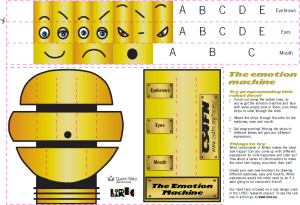
Emotion Machine bThe Emotion Machine

Age group: 7 – 12
Abilities assumed: None
Time: 40-60 minutes
Size of group: 1 upwards

Focus
• Programming
• Sequences
• Low-level code and high-level commands
• Compilers and interpreters
• Abstraction
Summary
Students create and program a 2D robot made of card to show different emotions. They create a table that can be used to translate emotions (high level commands) into low level machine instructions.

robot pdf

Click to download the PDF. Click the link above to visit the info page for instructions.

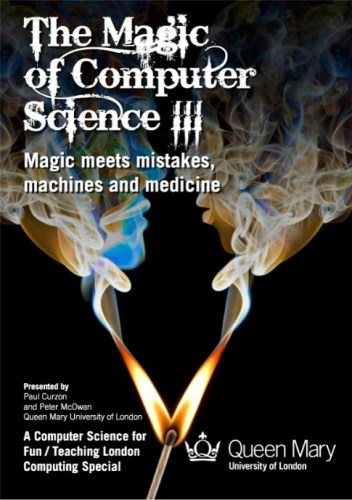
Introducing: free booklet “The magic of computer science: magic meets mistakes, machines and medicine”

Blogpost crossposted on both CHI+MED and Teaching London Computing sites.

We have a new booklet out which you can download as a PDF (click on the picture below to visit the book’s microsite) and find out more about where “magic meets mistakes, machines and medicine”.

The Magic of Computer Science 3: magic meets mistakes, machines and medicine
magicbookcover3cs4fn (Computer Science for Fun) is an outreach project from Queen Mary University of London (QMUL) which aims to enthuse school-aged children about computer science. There’s a website and a magazine (usually two issues a year) with special issues and booklets – this is the latest magic booklet.

Paul Curzon and Peter McOwan who set up cs4fn at QMUL are both magicians and also both work on the CHI+MED project and Teaching London Computing. Previous blog posts have referred to to CHI+MED’s use of magic in our public engagement work.

“The cs4fn magic books are collections of easy to do magic tricks (mainly simple card tricks). The twist is that every trick comes with a link to some computer science too. That means that as you learn the tricks, you will learn something about what computer scientists get up to too.

Magic is a combination of a secret method and a presentation. A computer scientist would call the method an algorithm, and that is all a computer program is too. The presentation corresponds to the interaction design of a program. For a magic trick to delight, you must get both the algorithm and presentation right. The same is true for programs.”

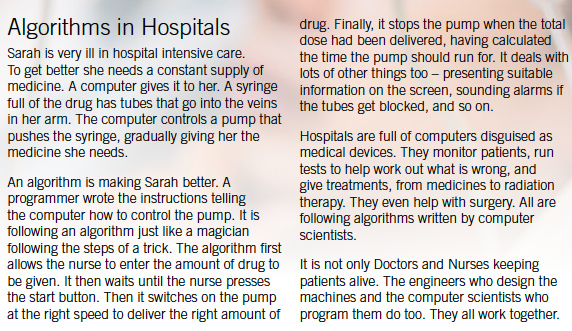
Screen Shot 2015-03-25 at 17.22.36

This comes from page 9 of the booklet.

This booklet is published by cs4fn (Computer Science for Fun) in partnership with Teaching London Computing (TLC) and CHI+MED. CHI+MED is funded by the EPSRC and Teaching London Computing by the Mayor of London and the Department for Education.

Download the Magic books

Paul Curzon from @QMUL and @cs4fn has been making faces at #casneconf :)

Paul Curzon gave a talk at the Computing At School North East conference this morning and judging from the tweets (see below) it seems that people enjoyed themselves. Paul uses magic and audience participation to demonstrate fun and easy ways of introducing programming topics into the classroom and delivers a series of free workshops for London teachers.

(More tweets from the #casneconf below)

If you’re enjoying his talk and wondering about the resources then the links below should help. We’re posting out printed copies to our subscribers but anyone can download free PDFs of our booklets.

The Magic of Computer Science 3: magic meets mistakes, machines and medicine
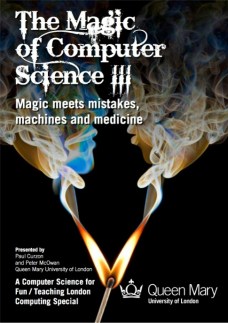
magicbookcover3This book is published by cs4fn (Computer Science for Fun) in partnership with Teaching London Computing (TLC) and CHI+MED. TLC is funded by the Mayor of London and additional funding from the Department for Education has enabled us to send copies to schools of this booklet beyond London. It is also supported by Computing At School. Click on the picture for more information.

“The cs4fn magic books are collections of easy to do magic tricks (mainly simple card tricks). The twist is that every trick comes with a link to some computer science too. That means that as you learn the tricks, you will learn something about what computer scientists get up to too.

Magic is a combination of a secret method and a presentation. A computer scientist would call the method an algorithm, and that is all a computer program is too. The presentation corresponds to the interaction design of a program. For a magic trick to delight, you must get both the algorithm and presentation right. The same is true for programs”

Computational thinking: searching to speak
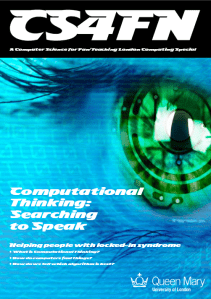
Searching to Speak A5 blueThis booklet was produced as part of the Teaching London Computing activities and has been used in one of our free workshops. It highlights how computational thinking can help people, for example in speeding up tasks, but also focuses on remembering when it’s appropriate to use technological solutions and when it isn’t.

Computational Thinking: Searching To Speak is a glossy booklet that shows computational thinking in action embedded in a story about helping people with disability, even without technology. It shows how the separate elements of computational thinking combine in interdisciplinary problem solving. Along the way it teaches some core search algorithms. It is written by Paul Curzon of Queen Mary University of London based on the cs4fn approach.”

Click on the picture to download a copy of the PDF, or read more about it and also see how it’s used in the workshop.

The Create-A-Face activity
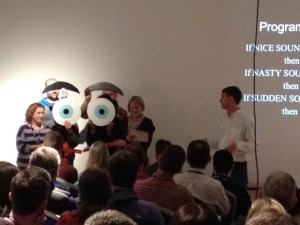
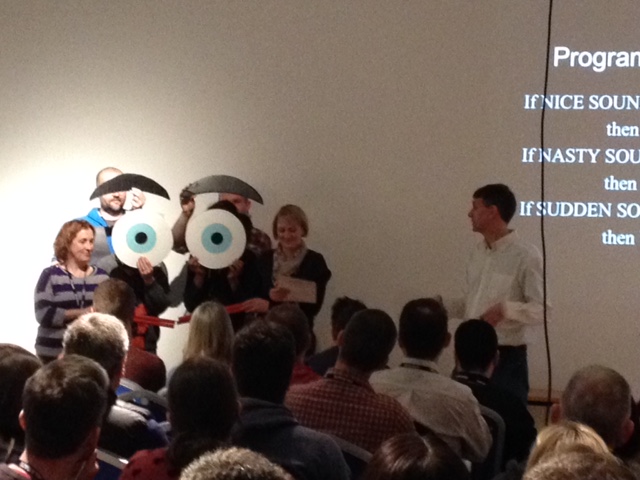
IMG_0942 - Paul Curzon at CASneconfIn the picture on the left (taken by Sue Sentance at the CAS NE Conference) Paul Curzon is instructing members of the audience to create a face whose expression can be programmed with simple instructions.

“Explore programming by making an affective (relating to moods and emotions) robot face out of card, tubes and students. Program it to react to different kinds of sounds (nasty, nice or sudden) and show different emotions (sad, happy, surprised). Then think up some other facial expressions and program rules to make the face respond to sounds with the new expressions.”

Download everything you need (apart from the cardboard tubes!) to recreate this in your classroom, from our Create-A-Face Activity page.


Tweets from the Computing At School North East Conference about Paul Curzon’s talk

The tweets above refer to the Searching to Speak booklet and the one below to the latest magic book. Most of the final tweets refer to the Create A Face activity.

Computational creativity – free PDF magazine (issue 18) from @cs4fn

From our sister project cs4fn (Computer Science for Fun) here’s the latest issue (#18) of the magazine, which is all about Computational Creativity. Download your free PDF copy or read some of the example articles at the magazine’s microsite for issue 18.

cs4fn magazine is published by Queen Mary University of London (QMUL) and is aimed at school pupils. QMUL has partnered with King’s College London to provide CPD courses for teachers who are teaching the new Computing curricula at GCSE and A-level. Thanks to funding from the Mayor of London we’re able to offer a 50% discount (£150) on our courses for teachers in London. More about our funding here.

Our next two courses for Computing teachers are happening over Easter – one is a one-week intensive and the other is the same length but spread over a few days.

GCSE Easter

Classroom Sessions to Embed Computational Thinking – at @RoyalHolloway w Prof Dave Cohen

Please note: as we do not know the detailed content of others’ courses we can’t endorse them – but we think you might like to know about what other people and organisations are up to. We’re happy to mention free or paid-for courses and events on our pages that are relevant to London and near-London teachers (and we don’t charge for listing information, or accept any advertising fee).

There are some sessions on computational thinking taking place in April and May 2015 at Royal Holloway University of London, with Professor Dave Cohen.

Classroom Sessions to Embed Computational Thinking

Department of Computer Science
Royal Holloway, University of London
Egham Hill
TW20 0EX Egham
United Kingdom

iStock_000016465426Medium

Schedule

Each session will begin at 4pm and finish by 7pm. There will be thirty places available. The sessions cost £20.


Don’t forget that Teaching London Computing is running some CPD courses for teachers who are teaching the new GCSE Computing curriculum. We have two courses running over Easter, both are the same length but one is split across a couple of weeks and the other is a week-long intensive course. You can find out more about both of them and book tickets here.

Teachers: Help your students build their own apps in the #AppsforGood course. Apply to deliver in 2015/16

AppsForGood are looking for Education Partners – here’s some information about them (and there’s a printable / shareable flyer at the end).

Print“Apps for Good is an education programme where students learn to build and pitch their own apps – helping students to become real-life entrepreneurs and digital creators.

The course meets the demands of the new curriculum in an engaging way and builds skills in teamwork, communication and problem solving.

Apps for Good provide their course framework, training and connections to tech Expert volunteers, and then let you do what you are best at – inspiring and guiding young people. Join 500 schools across the UK and apply to become an Education Partner: http://www.appsforgood.org/public/teach-apps-for-good – it’s free for non-fee paying schools.”

Follow them on Twitter  Screen Shot 2015-02-25 at 17.23.02  @appsforgoodcdi

Apps for Good – Info Flyer

New Easter CPD courses for Computing teachers in London: GCSE courses, at King’s College London

I’m delighted to announce that we have TWO new GCSE courses running soon and they will be held at King’s College London, Waterloo Campus and led by Margaret Derrington. These courses are aimed at experienced ICT teachers who would like to develop their subject knowledge in order to teach the new Computing Curriculum and the new Computing GCSEs.

Tickets are on sale now. The courses cost £300 but thanks to funding from the Mayor of London we can offer a 50% discount to London schools (get in touch if you’re not sure if your school qualifies).

More information and a guide syllabus is available from the links below and from our GCSE Computing page.

Course One

The first course is split into five sessions running over two weeks from the end of March to the second week of April:

Computing CPD GCSE Easter Holidays March 30 – April 10
Teaching London Computing
Monday, 30 March 2015 at 10:00 to Friday, 10 April 2015 at 16:00

5 sessions over two weeks, each class runs from 10am to 4pm.

  • Monday, March 30
  • Wednesday, April 1
  • Wednesday, April 8
  • Thursday, April 9
  • Friday, April 10

Eventbrite - Computing CPD GCSE Easter Holidays March 30 - April 10


Course Two

The second course is a one-week intensive in the third week of April:

Computing CPD GCSE Easter Holidays (1-week intensive) April 13 -17
Teaching London Computing
Monday, 13 April 2015 at 10:00 to Friday, 17 April 2015 at 16:00

Eventbrite - Computing CPD GCSE Easter Holidays (1-week intensive) April 13 -17

Paul Curzon’s doing two free workshops next Friday afternoon (20th) for Computing teachers in London cc @cs4fn

Paul Curzon’s free workshops, held at Queen Mary University of London’s Mile End campus, are fun and informal and support teachers who want to introduce programming concepts and computational thinking into the classroom in an engaging way. Each workshop is accompanied by downloadable classroom activities (also free) – these can be downloaded from the links below.

Next week’s (Friday 20th February) is a double session but you can choose to come to one workshop, or both.

The first workshop is at 2pm then there will be a half hour break with the second starting at 4pm, we aim to finish at 5.30pm.

Do I have to be a London computing teacher to attend?
The workshops are aimed at those who are currently (or who are about to begin) teaching the Computing curricula (particularly GCSE and A-level, though the information in the workshops has been used with younger children). As we’re funded by the Mayor of London we prioritise those who are currently teaching in London schools. The workshops are not suitable for school pupils though as the events are about how to introduce computing concepts into the classroom. Contact Jo Brodie (j.brodie@qmul.ac.uk) for further information.

Biography
Paul Curzon is a Professor of Computer Science at Queen Mary, University of London. He runs the cs4fn ‘Computer Science for Fun’ (cs4fn) project, www.cs4fn.org. It aims to inspire school students about computer science through a series of free magazines, website and school shows. He regularly gives such shows around the UK as well as continuous professional development talks to teachers about the cs4fn approach to teaching. He is Director of the Teaching London Computing Project. He was made a UK National Teaching Fellow in 2010 in recognition of his excellence in teaching and outreach, was a finalist in the 2009 Times Higher Education Innovative Teacher of the year award and has twice won the student nominated Queen Mary award for excellence in teaching.

Workshop A:
Programming unplugged: learning programming without computers

2.00-3.30pm (free Eventbrite tickets)

Overview
It’s easy to assume that programming is something you have to learn at a computer but if you want your students to deeply understand programming concepts, rather than blindly getting programs to work then unplugged techniques can work really well to get students started. We will see how to program a robot face that is made of students, look at a simple way to give a deep understanding of how variables work by making them physical, and see how to compile programs onto your class instead of onto a computer.

Session material This session will cover:

  • Inspiring ways to introduce programming away from computers.
  • What is a variable?
  • How does assignment work?
  • Programming simple objects
  • Introducing flow of control and if statements

Workshop B:
Computational thinking: it’s about people too

4pm-5.30pm (free Eventbrite tickets)

Overview
Computing is not just about technology, it is about understanding people too. When we solve computing problems we are solving them for people. Computational thinking is the general group of problem solving skills that students learn as a result of studying computing. Often this is equated with algorithmic thinking – a direct result of learning to program. However it just as important to make programs usable by people – or they won’t be used. We will see how magic gives a fun way to introduce these ideas and how a simple game demonstrates why graphical user interfaces are effective.

This session is in collaboration with CHI+MED: an EPSRC-funded project about making medical devices safer.

Session material This session will cover:

  • computational thinking: understanding people
  • human computer interaction
  • why GUIs are better than text-based interfaces
  • The importance of data structures

Friday 20 February 2015 @QMUL – two free workshops for computing teachers, with Paul Curzon

On Friday 20 February we have a double workshop session for computing teachers in London*. These demonstrate ways of introducing programming and computational thinking topics to the classroom in a fun way, without the need to use computers. You are welcome to attend either or both sessions, which are FREE. These will be held at Queen Mary University of London (Mile End Campus).

Next workshops
• Friday 20 February 2015, 2.00-3.30pm – Programming unplugged: learning programming without computers (click to see more information)
Eventbrite - Paul Curzon's free workshop for computing teachers (A): Programming unplugged: learning programming without computers for the first workshop ‘Programming unplugged: learning programming with computers’ at 2pm on 20 February.

• Friday 20 February 2015, 4.00-5.30pm – Computational thinking: it’s about people too (click to see more information)
Eventbrite - Paul Curzon's free workshop for computing teachers (B): Computational Thinking: it’s about people too for the second workshop ‘Computational thinking: it’s about people too’ at 4pm on 20 February.

Sign-up to hear about our workshops as they are advertised.


*Do I have to be a London computing teacher to attend?
The workshops are aimed at those who are currently (or who are about to begin) teaching the Computing curricula (particularly GCSE and A-level, though the information in the workshops has been used with younger children). As we’re funded by the Mayor of London we prioritise those who are currently teaching in London schools. The workshops are not suitable for school pupils though as the events are about how to introduce computing concepts into the classroom. Contact Jo Brodie (j.brodie@qmul.ac.uk) for further information.


Computing At School (CAS) community survey – open now

Pinched from the CAS e-newsletter…


National CAS Survey 2015
01 Feb 2015

Cas-logo_bcs

Computing At School and the Network of Excellence team are conducting a short survey about the Computing At School community and Computing in schools.

National CAS Survey 2015

The survey will remain open for the whole of February 2014. To get an accurate picture of how CAS is used and how Computing in schools is developing, we would like as many CAS members as possible to complete this. The survey is open to all (including non-CAS members), although there are some questions that are specific to members of CAS and some that are specific to teachers. It should not take long to complete.

For one lucky person each week, there will be a prize of a £25 Amazon voucher!

The summary data will be published by CAS in the spring.

Thank you!


If you’re interested in the teaching of computing in schools (you might be a teacher, a university partner or in industry or just curious) have a look at http://www.computingatschool.co.uk 

Speaking of surveys, we’ve (Teaching London Computing) just published the preliminary results of our own survey which looks at Computing teachers perceptions of their training needs, more at the snappily titled Surveying schools and Computing teachers – do they need training, and if so what format?

Our survey is still open, at http://bit.ly/TLCsurvey2015a

CAS’s survey link is National CAS Survey 2015