

This is an occasional post highlighting some talks and events that touch on computer science or computing-adjacent tech and which are not aimed solely at an academic audience. This isn’t a complete list (an impossible task!) but is drawn from a range of venues and organisations, some already computer-focused, some that have a wider focus but who sometimes host computing events. If you have a suitable event, particularly ones for which the public / schools / home educators can get tickets for, please let me (Jo) know, thanks.
28 Apr 2025
What is the Problem with Problems? – Centre for Research in Digital Education, 1-2pm, free, online seminar, with Dr Lina Rahm.
“This presentation explores what happened when I, together with students, designed fictional technologies to solve all the problems in schools. It also discusses a robot that was hired as a reading dog in a library and, finally, what happened when the computer system Gustav became intelligent.”
30 April 2025 (and other dates)
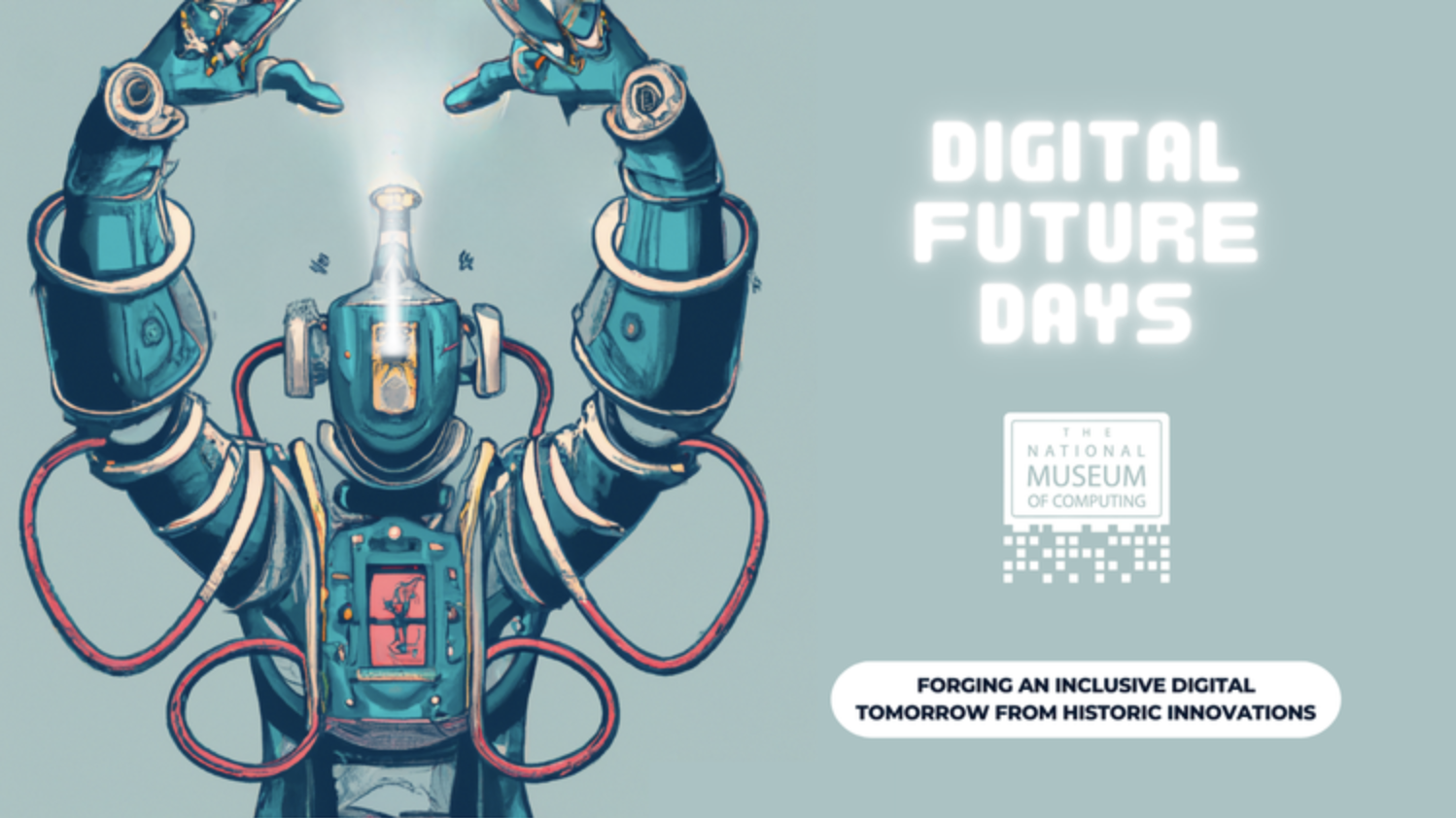
Digital Future Days – Ignite the Tech Leaders of Tomorrow – TNMOC (The National Museum for Computing), in-person (Bletchley), £6.13 (inc Eventbrite fee), 9.45am, for 13-18 year olds.
Are you ready to inspire the next generation of tech enthusiasts and ignite their passion for digital skills? Join us for Digital Future Days at The National Museum of Computing (TNMOC), a thrilling series of educational events designed exclusively for school and home-educator groups, bridging the gap between employers and future employees in the dynamic world of technology. Discover the captivating world of technology within TNMOC’s historic Bletchley Park setting. Immerse yourself in an unparalleled interactive learning experience, surrounded by our unique collection of working historic machines.
There are several events in the Digital Future Days series.
- 19 May – Digital Future Days: AI & Robotics (7-11 years)
- 23 May – Digital Future Days: AI & Robotics (11-16 years)
- 4 June – Digital Future Days: Retro Gaming (11-16 years)
- 18 June – Digital Future Days: Sustainable Tech (11-14 years)
- 25 June – Digital Future Days: Women into Engineering (11-16 years)
- 16 July – Digital Future Days: STEM Exploratorium (11-16 years)
6 May 2025 – 🎂 Happy 20th birthday CS4FN!! 🍰

The Illusion of Good Software Design (part of CS4FN’s 20th anniversary celebration event) – QMUL, 5pm, free, 11+, in-person at the Graduate Centre, Mile End campus, London.
Prof Paul Curzon will be giving the talk at 5pm and performing table magic before and after the event, plus cake and snacks. Doors 4.30pm (it’s free but please register for a ticket on Eventbrite).
“Using examples of good / bad healthcare device design (and illusions) we’ll explore how programmers can prevent human error with good interaction design. When disasters occur, a person is often blamed, but when people make mistakes, don’t blame the person, fix the program so they can’t, and save lives.”
7 May 2025
Do Computers Get Sick? How Humans and Computers Fight Viruses – Gresham College, 6pm, free, hybrid (in-person in London or online), with Professor Robin May.
“Whether you are human or computer, viruses can ruin your day, so taking steps to avoid them is important. This lecture asks whether there are similarities between human immunity and computer immunity? Can we use discoveries in one system to help protect against infections in the other? Might we one day take our laptops for regular vaccinations, or run a ‘software update’ on our own immune systems to avoid an emerging pathogen?”
13 May 2024

AI as a design domain: Empowering students with no-code AI/ML app development in the classroom – Raspberry Pi, 5pm, free, online. With Henriikka Vartiainen and Matti Tedre (University of Eastern Finland)
“In the landscape of AI education, it is important to provide students with the tools and understanding to actively participate in AI-driven environments. This talk introduces ‘GenAI Teachable Machine’, an educational platform designed for students aged 10–16 to explore core AI concepts through making practical, hands-on applications. The talk describes the educational theory, pedagogical strategies, and classroom resources developed to support teachers.”
16 May 2025
Kids Club Night – Centre for Computing History, 6.30pm, £5 (£3 supervising adult), in-person (Cambridge).
“Are your Cubs, Brownies, Scouts or Girl Guides working towards a technology or history themed badge? Perhaps you run a local Woodcraft or chess club and you’re looking for something new for your club’s next excursion?
The Centre for Computing History invites local children’s clubs to come along and enjoy our Kids Club Night. All those attending will have the opportunity to join a tour focusing on the history of computing followed by time to explore the museum’s vast collection of computers and retro computer games.”
20th May 2025
The Moral Case for Stealing Data – Gresham College, 6pm, free, hybrid (in-person in London or online), with Professor Victoria Baines
“Is it moral to steal data? Throughout history, authorities have struggled to manage individuals’ urges to speak out against injustice and malpractice. IT has given us new means to obtain and publish data that others may wish to protect or even conceal. To some, hackers are heroes. To others, they are criminals. This lecture asks, in an era of mass leaks and high-profile whistleblowing, who decides whether data thieves are to be protected or prosecuted? Are the old rules still fit for purpose in the digital age?”
AI and the big human questions – Pint of Science, 6.30pm, £5, in-person at The Prince Albert pub, in Camden (London) from the Alan Turing Institute. “Three researchers from the Alan Turing Institute will take to the stage to help. We’ll hear how AI is being used in the real world and how it relates to the big things in life: health, travel safety and (most important of all) the weather. Plus join in with our annual Big Quiz of AI!” Features Dr Beatriz Costa Gomes (Research Fellow), Nicholas Harbour (Enrichment Student), Dr. Dewi Gould (Research Associate, Turing) and Dr Nathan Simpson (Research Software Engineer).
20-24 May 2025
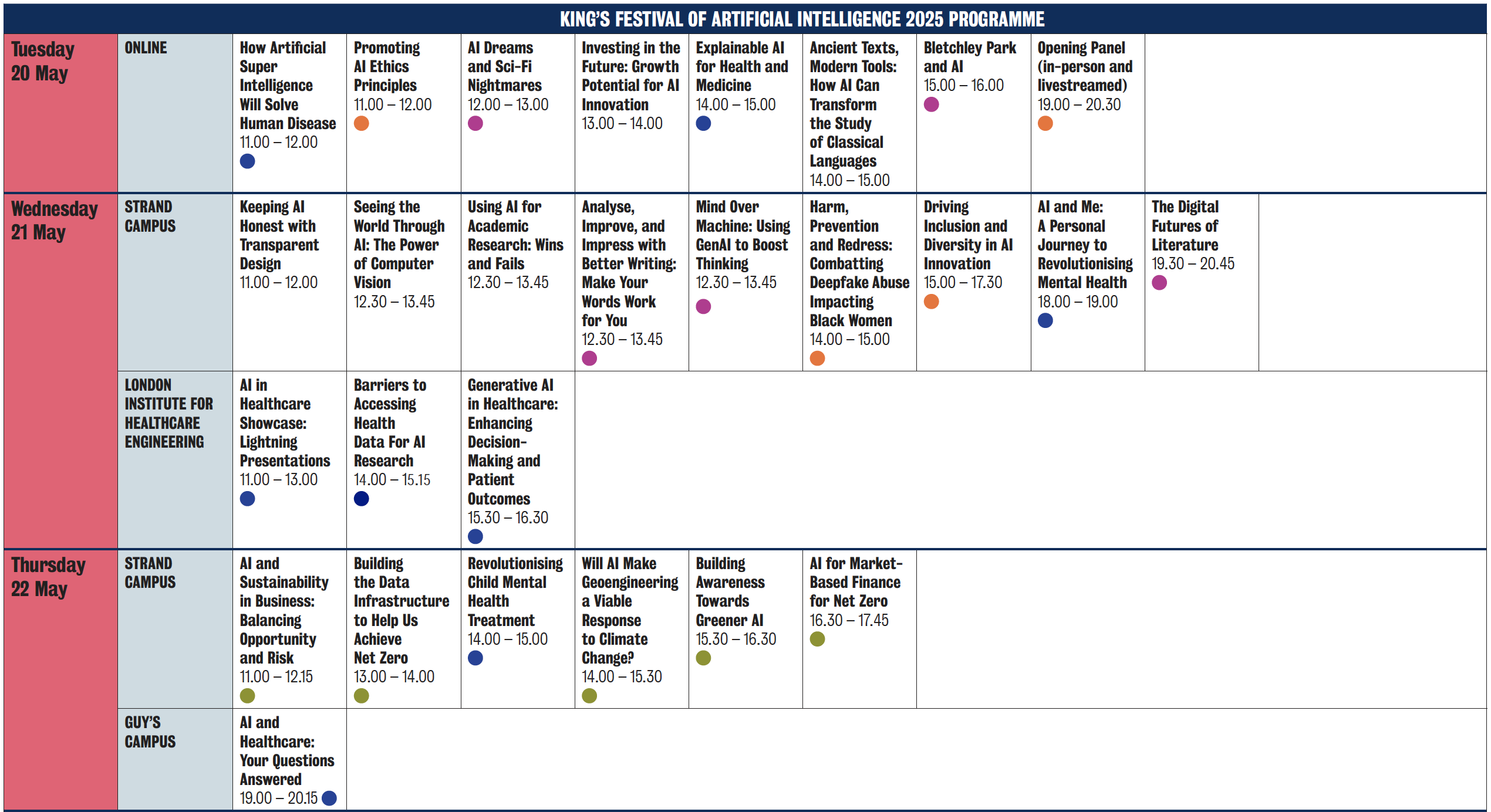
The King’s Festival of AI – King’s Institute for Artificial Intelligence, multiple events over four days, free, online (20th) and in-person (London, Strand Campus, Guy’s campus and other London venues). Friday 23rd May has several events aimed at educators and Saturday (24th) is the free King’s Festival of Artificial Intelligence Family Day (tickets) – Paul Curzon will be running a session at the family day.
Below is a screenshot of the programme’s PDF. Right click to open in a new tab on a computer or pinch to expand on a phone.

22 May 2025

Lore Harp & Vector Graphic: Silicon Valley’s Forgotten Female Microcomputer Pioneers – Computer Conservation Society, 2.30pm, free, hybrid (in-person in London @ BCS offices or on Zoom). A talk from Gareth Edwards.
“Inspired by the release of the Altair 8800, Vector Graphic became one of the first computer manufacturers developing pre-built microcomputers optimised for the small-business market. It was also a female founded and managed business. In 1981, it became only the second female-founded company on the Nasdaq stock exchange, missing out on being the first by a matter of days. In this talk I’ll cover the history of Vector Graphic and its primary founder Lore Harp. We’ll look at it its foundation as a memory board supplier operating out of the back room of a Californian home to its peak as one of the most respected suppliers of business computers in America.”
30 May 2025

Discourse: Digital intelligence vs biological intelligence – Royal Institution, 7.20pm, hybrid (in-person, £20, in London or online, £5).
“Tech headlines in the last couple of years have been dominated by Artificial Intelligence. But what do we mean by intelligence? What has AI learned from biological intelligence, and how do they still differ? Acclaimed computer scientist, and winner of the 2024 Nobel Prize in Physics, Geoffrey Hinton will examine the similarities and differences between artificial and biological intelligence, following his decades of ground-breaking work which has enabled the neural networks of today.”
2 June 2025
Mathematicians helping art historians and art conservators – Royal Society, hybrid (in-person, London or online streamed via YouTube), free, 6.30pm.
“The Bakerian Medal and Lecture 2025 is awarded to Professor Ingrid Daubechies for her outstanding work on wavelets and image compression and her exceptional contributions to a wide spectrum of physical, technological, and mathematical applications.
Professor Daubechies will discuss the recent years where mathematical algorithms have helped art historians and art conservators put together the thousands of fragments into which an unfortunate WWII bombing destroyed world famous frescos by Mantegna, decide that certain paintings by masters were “roll mates” (their canvases were cut from the same bolt), virtually remove artefacts in preparation for a restoration campaign and get more insight into paintings hidden underneath a visible one. … / … some of her work is used in the image compression standard JPEG-2000.”
Note also their upcoming (in July) Summer Science Exhibition.
9 June 2025
Quantum is coming – Royal Institution, 7pm, £16, (in-person, London).
“Quantum information technology is expected to disrupt critical communication, computing, and sensing infrastructure. Importantly, each near-term application of quantum information is recognised globally as a challenge in both a scientific and technological sense. Just as important as technical advancements, the quantum industry also requires a trained, skilled workforce and a vast investment in quantum education.
Now, in the International Year of Quantum Science and Technology, join quantum engineer Thomas A. Searles as he uncovers the origin stories of African-American quantum scientists and their contributions to the quantum revolution, but also how people can be involved in the quantum revolution of today. Keen to inspire the next generation of quantum scientists, Thomas will be sharing activities and experiments fit for all ages to create opportunities for collaboration while building a safer, quantum-smart future.”
Save the date(s)
- 1-6 July 2025 – Summer Science Exhibition – Royal Society
- 2 July 2025 – Festival of Computing 2025 with Craig ‘n’ Dave (for secondary educators)
- 7 July 2025 – Decoding life with AI – Royal Institution, in-person, £16, 7pm
- 7-13 July 2025 – London Data Week, LOTI (The London Office of Technology & Innovation), the Mayor of London and The Alan Turing Institute
- 24 October 2025 – CAS Conference, Computing At School, Birmingham
Back to the main page
Places which have computing-themed talks and events
- Ada Lovelace Institute, London
- Alan Turing Institute, London
- BCS – British Computer Society, London and national
- Centre for Computing History, Cambridge
- Centre for Digital Education, Edinburgh University
- Computer Conservation Society
- Design Museum, London
- Edinburgh Futures Institute, Edinburgh University
- Gresham College, London
- Highgate Literary & Scientific Institution, London
- Imperial College, London
- The National Museum of Computing, Bletchley Park
- OSHUG – Open Source Hardware User Group
- Oxford Internet Institute, Oxford University
- Raspberry Pi Foundation, Cambridge
- Royal Institution, London
- Royal Society, London
- TEDI (The Engineering & Design Institute), London
- U Can Too – schools computing workshops
- UCL Lunch Hour Lectures, London
- Warwick Data, Warwick
Subscribe to be notified whenever we publish a new post to the Teaching London Computing blog.

This blog is supported through EPSRC grant EP/W033615/1.
 Teaching London Computing: A RESOURCE HUB from CAS LONDON & CS4FN