


Events for teachers, schoolkids, families, general public
This is an occasional post highlighting some talks and events that touch on computer science or computing-adjacent tech and which are not aimed solely at an academic audience. This isn’t a complete list (an impossible task!) but is drawn from a range of venues and organisations, some already computer-focused, some that have a wider focus but who sometimes host computing events. If you have a suitable event, particularly ones for which the public / schools can get tickets for, please let me (Jo) know, thanks.
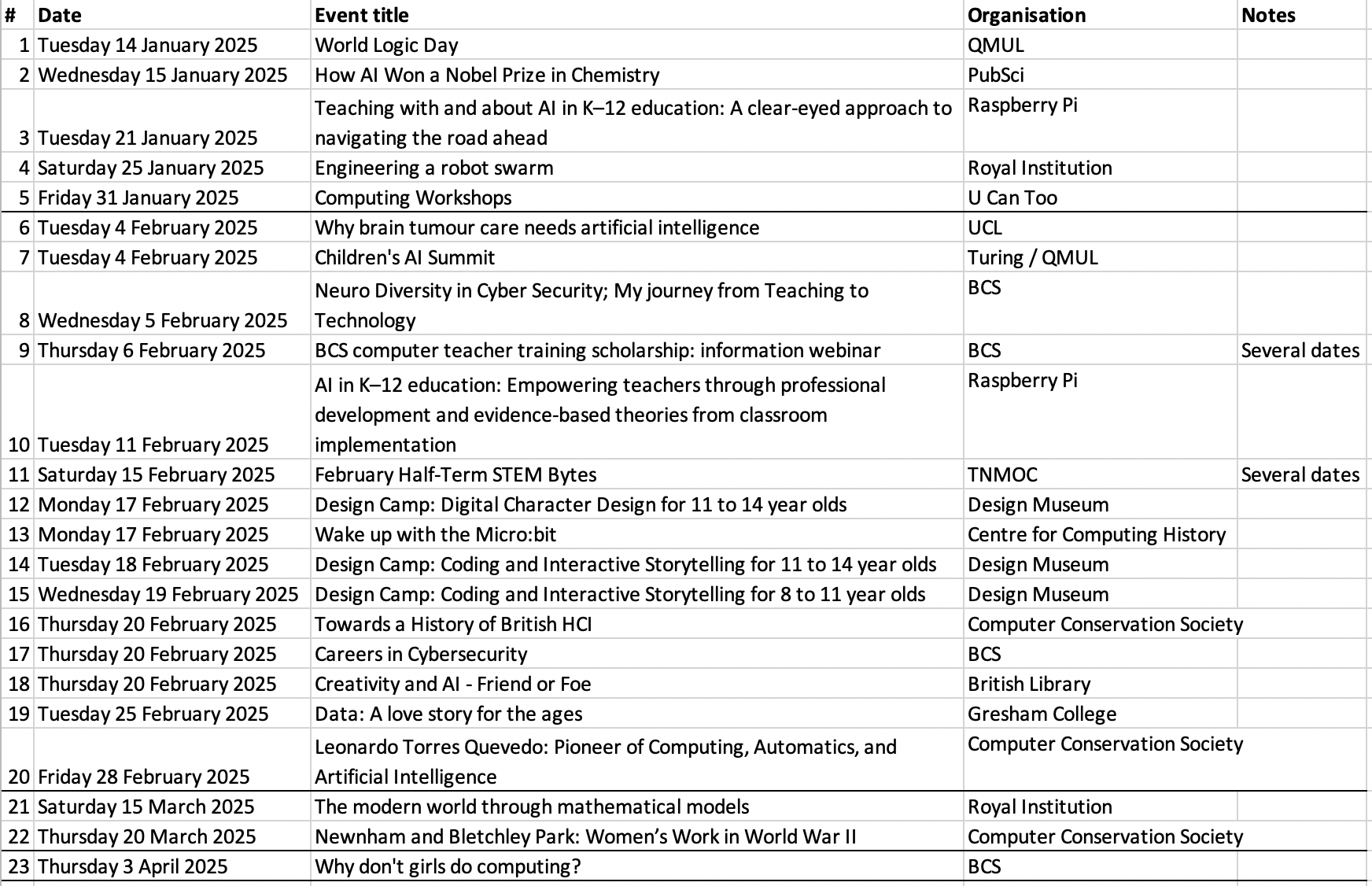
Summary of 23 events listed at-a-glance (click to enlarge)
Tuesday 14 January 2025
1. World Logic Day – London, in person and streamed on Teams. FREE
Paul Curzon: Conjuring with Logic (5.30 – 6pm) – table magic (not streamed, in person only)
Paulo Oliva: Self-reference and Paradoxes: To Infinity and Back! – public talk. (streamed or in person)
This is part of a whole afternoon event from QMUL’s Computer Science department.
Wednesday 15 January 2025
2. How AI Won a Nobel Prize in Chemistry – 6.30pm, London, in person, donations
PubSci returns on Wednesday 15th January when Prof. Rivka Isaacson explores proteins, protein folding, and the power of AI. PubSci talks are suitable for a general audience and open to all.
Tuesday 21 January 2025

3. Teaching with and about AI in K–12 education: A clear-eyed approach to navigating the road ahead – Online, FREE, 5-6.30pm
Speaker: Shuchi Grover (Looking Glass Ventures)
“AI has a dual role in K–12 education: it can be used as a teaching tool (teaching with AI) and it necessitates the promotion of AI literacy (teaching about AI).
Through these two themes, Shuchi Grover will look at how generative AI can be used in STEM and computer science (CS) classrooms to ethically support teaching and learning. She will also explore how foundational AI literacy and AI concepts can be integrated into CS curricula, to develop students’ understanding of AI and machine learning as well as AI ethics.
Through concrete examples and recently developed frameworks, this seminar aims to equip educators with practical insights to understand AI’s impact on society and its role in the future of education.”
Saturday 25 January 2025

4. Engineering a robot swarm – London, in person, £16, 7-8.30pm
For the past 20 years, swarm robotics has taken inspiration from nature to make large numbers of robots work together to achieve common goals. With progress in swarm hardware and AI, the field is now ready to translate these swarms from laboratory to application. Join swarm engineering expert Sabine Hauert as she explores the mechanisms to make ‘swarms for people’, in applications ranging from nanomedicine to environmental monitoring and logistics. See also the CS4FN article on Sabine Hauert’s work.
Friday 31 January 2025 (more dates in February and onward)
5. U Can Too – 6 hour in-school workshops
A series of computing workshops for schools including Drone Assault Course, Crazy Golf Creations, Robot Petting Zoo, Protect the Treasure, Circuit Game Maker, Activated Art Kandinsky, Iron Man CupBot, Chatterbox Box-Bot and Storytelling Through Games. Calendar of availability.
Tuesday 4 February 2025
6. Why brain tumour care needs artificial intelligence – in-person, 1-2pm, FREE. Lunchtime lecture

“In this lecture, we shall explore the opportunities artificial intelligence may bring to personalise and enhance brain tumour care.”
7. Children’s AI Summit
Expressions of interest for bringing a group of young people to the The Children’s AI Summit have now closed; more information at https://www.turing.ac.uk/events/childrens-ai-summit
Wednesday 5 February 2025
8. Neuro Diversity in Cyber Security; My journey from Teaching to Technology – online webinar, free, 6.30-8pm.
“Showcasing a neurodiverse journey from teaching to InfoSec, proving career transitions to tech are achievable for all backgrounds.”
Thursday 6 February 2025
9. BCS computer teacher training scholarship: information webinar – online, FREE, 7-8pm
“The BCS Computing teacher training scholarships programme is a government funded financial incentive to train to teach in England. (If living in Wales, Northern Ireland or Scotland at the time of application you must secure a teacher training place at an institution in England. This scholarship is not available to overseas students.) / Hold a Computer Science or related degree with a proven or predicted grade of a 2:2 or above by September 2025.”
This event will also run again on these dates
- 30 April 2025, 12.30pm
- 17 June 2025, 5pm
Tuesday 11 February 2025
10. AI in K–12 education: Empowering teachers through professional development and evidence-based theories from classroom implementation – Online, FREE, 5-6.30pm
Speaker: Franz Jetzinger (Technical University of Munich)
“It’s true — AI is everywhere! Consequently, AI-related competencies are gradually being integrated into computer science (CS) curricula across the globe. However, this raises two challenges: first, teachers are not adequately prepared for this topic, which requires both AI and pedagogical knowledge. Second, evidence-based theories on teaching and learning about AI in K–12 education are still lacking. Franz Jetzinger will address both issues in this talk.
In the first part, Franz will present the implementation and evaluation of a scalable professional development (PD) programme that addresses relevant challenges such as limited resources, a large number of teachers to be trained, and the considerable heterogeneity of teachers’ backgrounds.
In the second part, he will share findings from an action research project investigating how teachers implement the topic in their classrooms and the difficulties teachers and students face, to provide a foundation for evidence-based advancements of teaching AI.”
Saturday 15 February 2025
11. February Half-Term STEM Bytes – Milton Keynes, 11am-1pm, 2-4pm, ~£12/~£9 (family: ~£28)
Several dates: 15th (Sat), 16th (Sun), 19th (Wed), 20th (Thu), 21st (Fri) and 22nd (Sat) Feburary.
“Our educational STEM activities are a must-visit event in Milton Keynes, perfect for children (and parents) seeking creative fun during school holidays. We offer a wide range of activities, including Sphero Bolts, Minecraft, OSMO Augmented Reality, and programming with BBC Micros and micro:bits. There’s something for everyone to enjoy and plenty to captivate kids throughout the holidays.”
Monday 17 February 2025
12. Design Camp: Digital Character Design for 11 to 14 year olds – 10.15am to 4.15pm, London, £67

“Young people will be introduced to character design inspired by Tim Burton’s imagination. They will design their own characters with plasticine and then learn how to redesign them using 3D modelling software. (TinkerCAD and Blender)”
13. Wake up with the Micro:bit – Cambridge, £16/12, 3-4.30pm, Centre for Computing History
“We need an extra prod to wake up on cold, dark mornings! Making it digital and something you have programmed will be even more cool (at least you won’t be irritated when it won’t let you sleep in!). Come and learn how to code the micro:bit to become a light-sensitive wake-up alarm. Put it under a lamp with a timer and you’re all good to go! / Please note that we will be using our classroom kits for the session and you will not be able to take these away at the end. We will however have micro:bit kits available for sale in our shop to purchase.”
Tuesday 18 February 2025
14. Design Camp: Coding and Interactive Storytelling for 11 to 14 year olds – 10.15am to 4.15pm, London, £67
“In this introductory workshop, young people will learn to code by writing interactive stories inspired by Tim Burton’s unique imagination. They will write exciting narratives and turn them into simple text-based video games using the coding engine Twine.”
Wednesday 19 February 2025
15. Design Camp: Coding and Interactive Storytelling for 8 to 11 year olds – 10am to 4pm, London, £67
“In this introductory workshop, young people will learn to code by writing interactive stories inspired by Tim Burton’s unique imagination. They will write exciting narratives and turn them into simple text-based video games using the coding engine Twine.”
Thursday 20 February 2025
16. Towards a History of British HCI – 2.30pm, FREE, London or online (Zoom), Computer Conservation Society

“The seminar will share with the public the speaker’s recent research on the History of Human-Computer Interaction in the UK, enhanced by a series of new oral history interviews with academics and practitioners in the field. The history of British HCI is rich: Brian Shackel’s article Ergonomics for a Computer, published as early as 1959, is considered one of the first articles in the history of HCI. From the 1970s onwards several British centres in the UK focused on HCI research and development such as the Man-Machine Interaction Group at the NPL and the HUSAT at the University of Loughborough, among many others. The BCS Specialist Group on Human-Computer Interaction was established in 1984, playing a role in the development of the field in the UK and in connecting with the international community. The British HCI conference was one of the main early international conferences that shaped the discipline, while the Alvey Programme, driven by industrial priorities, influenced and gave strength to HCI in the UK.”
17. Careers in Cybersecurity – 6-8.30pm, Canterbury or online, FREE
“This talk will explore the many opportunities available to someone interested in a career in cybersecurity in a large corporation. / his talk will discuss the huge range of cybersecurity threats that a large corporation (or any other organisation) may face, and what processes are followed to provide protection from them. This will give some idea of what working in a large cybersecurity team is really like.”
18. Creativity and AI – Friend or Foe – 7-8.30pm, London, FREE

“The emergence of generative AI has put the spotlight on the relationship between human creativity and AI. Generative AI technology uses text, visual or audio output, mostly created by humans over time, to generate new content, sometimes similar to the source content that was used in AI training. There is a regular stream of claims and, ever more frequently, of legal action alleging that AI companies disregard copyright and rights of content creators. In addition, AI is disrupting business models in creative industries, many question the quality of AI generated creative output, and there is regular speculation if AI will replace or augment human creativity.” Part of the AI Debates series.
Tuesday 25 February 2025
19. Data: A love story for the ages – 6pm, FREE, London or online (YouTube)

“It’s become a cliché to say data is the new oil. That isn’t the full story. For centuries it has proved itself to be infinitely reusable. It has enabled the creation and reinforcement of collective memory. It has been documented in innumerable formats, from maps to databases, taxonomies and infographics. / We make sense of the world through the technology we use to process and visualise data. This lecture explores our enduring love for it.”
Friday 28 February 2025
20. Leonardo Torres Quevedo: Pioneer of Computing, Automatics, and Artificial Intelligence – 2.30pm, FREE, London or online (Zoom)
“The history of computing is a fascinating story. The search for little known pioneers of automation, missed fathers of the computer, unfamiliar founders of computer science, or unrecognized creators of artificial intelligence, invites us to look at the past with an open mind. In this article, we provide a comprehensive examination of the almost unknown contribution of a Spanish pioneer in all those fields during the first two decades of the 20th century, the engineer and mathematician Leonardo Torres Quevedo (1852-1936).”
Saturday 15 March 2025
21. The modern world through mathematical models – London, 7-8.30pm, £16/10
“How long is the security queue at the airport going to be? How many calls can a call centre handle each day? Availability of resources affects the behaviour of countless systems which we interact with on a daily basis. Formulae developed decades ago are still used to model aspects of our lives, treating resources as “servers” and resource-users as “customers”. However, in this modern, highly connected world, how do we move beyond simple queueing networks to represent systems of interest?”
Thursday 20 March 2025
22. Newnham and Bletchley Park: Women’s Work in World War II – FREE, 2.30pm, London and online (Zoom)
“An exhibition unveiled in 2024 revealed the hidden stories of a large number of women from Newnham College, Cambridge, who were quietly recruited for secret work at Bletchley Park in World War II. In this talk Dr Sally Waugh, one of the three curators of the exhibition, will discuss how research identified the women involved, describe some of the women and the work that they did, and consider the impact on the private lives of this group of previously unrecognized women.”
Thursday 3 April 2025
23. Why don’t girls do computing? – FREE, 6-8.30pm, Canterbury or online
“This event will discuss and attempt to determine what prevents women and girls from entering IT as a career.
Nationally, and internationally, there’s a shortage of computing specialists. Hays reported in 2023 that over 90% of employers looking for tech talent said there was a skills shortage. This is impacting current and future projects, with estimates of the financial impact on the UK economy being between £2bn and £5bn per year. Between 75% and 85% of the IT workforce is male. So, what is it that prevents women and girls from entering IT as a career? Hint: It’s NOT that they can’t do it.”
Back to the main page
Places which have computing-themed talks and events
- Ada Lovelace Institute, London
- Alan Turing Institute, London
- BCS – British Computer Society, London and national
- Centre for Computing History, Cambridge
- Centre for Digital Education, Edinburgh University
- Computer Conservation Society
- Design Museum, London
- Edinburgh Futures Institute, Edinburgh University
- Gresham College, London
- Highgate Literary & Scientific Institution, London
- Imperial College, London
- The National Museum of Computing, Bletchley Park
- OSHUG – Open Source Hardware User Group
- Oxford Internet Institute, Oxford University
- Raspberry Pi Foundation, Cambridge
- Royal Institution, London
- Royal Society, London
- TEDI (The Engineering & Design Institute), London
- U Can Too – schools computing workshops
- UCL Lunch Hour Lectures, London
- Warwick Data, Warwick
Subscribe to be notified whenever we publish a new post to the Teaching London Computing blog.

This blog is supported through EPSRC grant EP/W033615/1.
 Teaching London Computing: A RESOURCE HUB from CAS LONDON & CS4FN