


Events for teachers, schoolkids, families, general public
This is an occasional post highlighting some talks and events that touch on computer science or computing-adjacent tech and which are not aimed solely at an academic audience. This isn’t a complete list (an impossible task!) but is drawn from a range of venues and organisations, some already computer-focused, some that have a wider focus but who sometimes host computing events. If you have a suitable event, particularly ones for which the public / schools can get tickets for, please let me (Jo) know, thanks.
1. Wednesday 20 November 2024
1a. Gravesend Innovation Showcase
1b. Ada: Sixth Form open evening
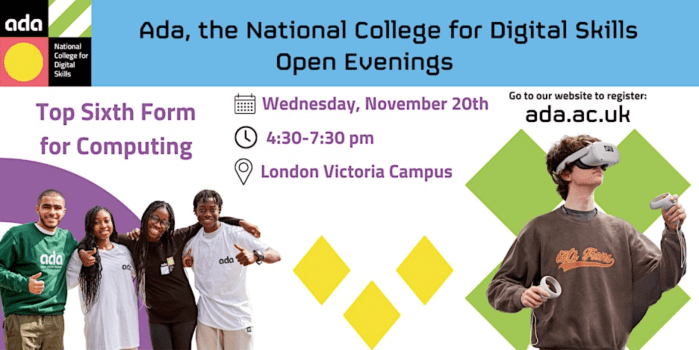
Sixth Form Open Evening at Ada, the National College for Digital Skills
4:30 – 7:30pm, London
“Meet our staff, chat with our students and visit our campus. See how Ada can help you kickstart your journey into tech!”
1c. Introducing Colossus
Introducing Colossus: the World’s First Digital, Electronic Computer
6.30-7.30pm, Bletchley.
“Colossus machines – the world’s first electronic, digital computers – had a single purpose: to help decipher the Lorenz-encrypted messages between Hitler and his generals during World War II. The information gleaned from the decrypted messages is widely acknowledged to have shortened the war by many months, saving tens of thousands of lives.”
2. Thursday 21 November 2024 – computing history event

The Web Before the Web: Putting the Hype into Hypertext
2.30pm, online or in person (London)
“The talk will describe where the technology (hypertext) which enables the World Wide Web came from, which surprisingly, dates back as far as 1945. My company launched the first hypertext application in 1986 (which won the BCS Award) and I’ve written a book on this subject.
Along the way I will cover the first 20 years of the personal computer — from the launch of the Apple II in the mid-70s to the mid-90s, by which time GUI is the normal PC interface (Mouse, Windows etc), the Internet and the World Wide Web are all established. Today’s computer is a more powerful version of this environment.”
3. Friday 22 November 2024 (deadline) – event in Feb 2025
4. Tuesday 26 November 2024 – education event

Enacting and sharing digital practices in the early years (free, online or in-person) with Professor Susan Edwards
10-11am, Online or in-person, Edinburgh Futures Institute room 3.52
“This seminar provides an overview of a large Australian Research Council Linkage Project conducted in collaboration with leading national organisations involved in early years education, digital content production, law enforcement, parenting education and online safety education based on the Early Childhood Australia Statement on Young Children and Digital Technologies. An overview of the theoretical framework used to define and identify digital practices enacted by children, families and educators is provided. The approach to co-designing resources with organisations to further share identified digital practices intended to support children, families and educators with digital technology use in the best interest of the child is detailed and illustrated with exemplars from the project.”
5. Wednesday 27 November 2024
5a. Education in Action – with Paul Curzon
5b. Digital Future Days – for teachers / home educators
Digital Future Days: Networks and Communication (13-18 years)
9:30am to 3.30pm, in-person, Bletchley.
Digital Future Days – Ignite the Tech Leaders of Tomorrow
Are you ready to inspire the next generation of tech enthusiasts and ignite their passion for digital skills? Join us for Digital Future Days at The National Museum of Computing (TNMOC), a thrilling series of educational events designed exclusively for school and home-educator groups, bridging the gap between employers and future employees in the dynamic world of technology.
6. Thursday 28 November 2024

Science and the Atomic Human
7.30pm, online or in-person, with Professor Neil Lawrence
“Neil’s work has given him a unique perspective on the practical challenges of implementing AI in large-scale industrial systems. His broad understanding ranges from the cutting edge of AI research to its application in developing nations
For all we know, humans are unique when considered in a machine context. Some of our science perspectives though may have undermined our understanding of this uniqueness. Fortunately, the possibility of new forms of automated decision-making, commonly referred to as “artificial intelligence” also gives us a “place to stand”, allowing us to muse and reflect on who we are and what makes us special. The talk will be partly based on Neil’s book “The Atomic Human”, a limited number of heavily discounted copies of which will be available for purchase.
Perhaps few people are as well placed to explain the possible impact of AI in diverse areas of the modern world.”
7. December 2024 (multiple dates)
Schools Computing Workshops
Full-Day School Workshop Reservation: 3rd, 6th, 17th, 23rd and 24th December.
“We provide all the tools and materials required for each workshop. This includes laptops, computer hardware, electronics, leads, battery packs and other materials that may be needed for the session.
Occasionally, we may encourage your school to collect recyclable household items, such as cereal boxes, which the children can use in their make. This helps to build interest and excitement around the session, and engages parents too.”
- Drone Assault Course
- Crazy Golf Creations
- Robot Petting Zoo
- Protect the Treasure
- Circuit Game Maker
- Activated Art – Kandinsky
- Iron Man CupBot
- ChatterBox BoxBot
- Storytelling through Games
8. Saturday 7 December 2024 – retro games event
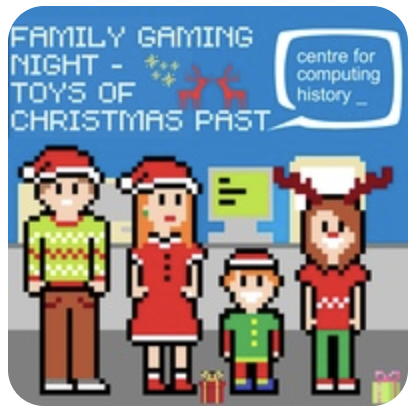
Family Gaming Night – Toys of Christmas Past
An evening of Christmas themed gaming for all the family!
Cambridge.
9. Monday 9 December 2024 – public event
The Turing Lectures: Can we live with AI?
Monday 09 Dec 2024, 7.30-9.30pm – hybrid
(free online, £10 in person at King’s Place)
“In this series we’ll explore the complex relationship between artificial intelligence and society, examining its impact on our democratic processes, decision-making systems and, crucially, trust.
As AI becomes increasingly integrated into our lives, we face key questions about its role in shaping our future. From its influence on political landscapes to its potential for perpetuating societal biases, AI presents both opportunities and challenges. This lecture series aims to equip attendees with a comprehensive understanding of these issues, exploring how we can harness AI’s potential responsibly.
By exploring AI’s impact on government, decision-making processes, and our broader society, these talks will provide valuable insights for citizens, policymakers and technologists alike. The series will ultimately help guide us towards a future where AI serves as a tool for progress, without compromising the core human elements that define our societies and interpersonal relationships.” [Tickets]
10. Tuesday 10 December 2024 – computing education seminar

Integrating generative AI with introductory programming
Online, with Professor Leo Porter
17:00–18:30 GMT / 12:00–13:30 ET / 9:00–10:30 PT / 18:00–19:30 CET
“It’s clear that many computing courses will need to change in response to the challenges and opportunities of generative AI. Research on what these changes will look like is ongoing, with some areas of focus better understood than others. For example, the research community has made considerable progress in using generative AI as tutors, but we know much less about generative AI’s impact on student learning and how learning outcomes should change. This seminar will briefly summarise the main areas of ongoing research related to generative AI. Next, it will describe the design goals and findings emerging from the Computing Education Research Laboratory’s work at UC San Diego to create an introductory programming course for majors and non-majors that fully incorporates generative AI into the learning goals of the course. The session will close with a discussion of how faculty can adopt similar courses, areas for innovation, and the next steps for the community.”
11. 27 – 30 December 2024
Christmas Holidays STEM Bytes
11am to 6pm, in-person, Bletchley.
27th and 30th – Robotics
28th – Programming
29th – Engineering
“We offer a variety of activities from Sphero Bolts and OSMO Augmented Reality to programming BBC Micros and making 3D art in Virtual Reality! Between the sessions, you can explore the rest of our museum or have a go with our Digital Trails (available at the main entrance).”
12. Tuesday 7 January 2025
Who’s afraid of robots?
6pm, online or in-person (Holborn, London) with Professor Victoria Baines
“Artificial Intelligence is a very recent invention…or is it? Humans have been fascinated by intelligent machines for thousands of years. Some exist only in our collective imagination, in art and literature. Others have seen the light of day as mechanical marvels, although a few were later exposed as elaborate frauds.
The robots of today might not be what our ancestors imagined. This lecture argues that the relationship between humans and machines has always been complex, and that we still can’t decide whether we really want them to be like us.”
Back to the main page
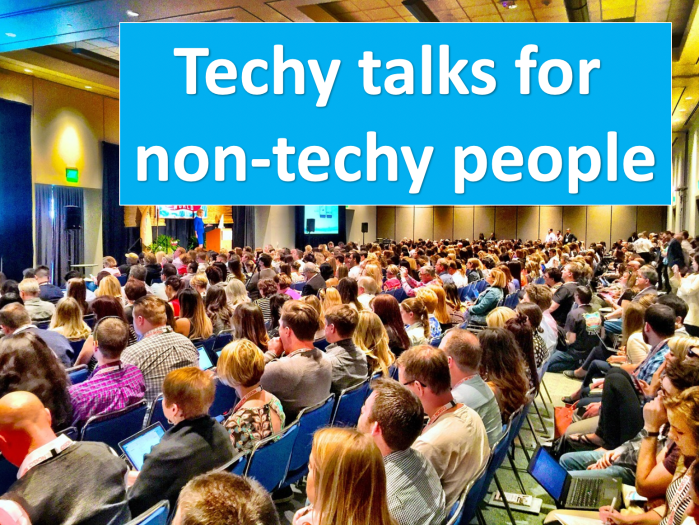
Places which have computing-themed talks and events
- Ada Lovelace Institute, London
- Alan Turing Institute, London (see also their Fringe Events)
- BCS – British Computer Society, London and national
- Centre for Computing History, Cambridge
- Centre for Digital Education, Edinburgh University
- Computer Conservation Society
- Edinburgh Futures Institute, Edinburgh University
- Gresham College, London
- Highgate Literary & Scientific Institution, London
- Imperial College, London
- The National Museum of Computing, Bletchley Park
- OSHUG – Open Source Hardware User Group
- Oxford Internet Institute, Oxford University
- Raspberry Pi Foundation, Cambridge
- Royal Institution, London
- Royal Society, London
- TEDI (The Engineering & Design Institute), London
- U Can Too – schools computing workshops
- UCL Lunch Hour Lectures, London
- Warwick Data, Warwick
Subscribe to be notified whenever we publish a new post to the Teaching London Computing blog.

This blog is supported through EPSRC grant EP/W033615/1.
 Teaching London Computing: A RESOURCE HUB from CAS LONDON & CS4FN