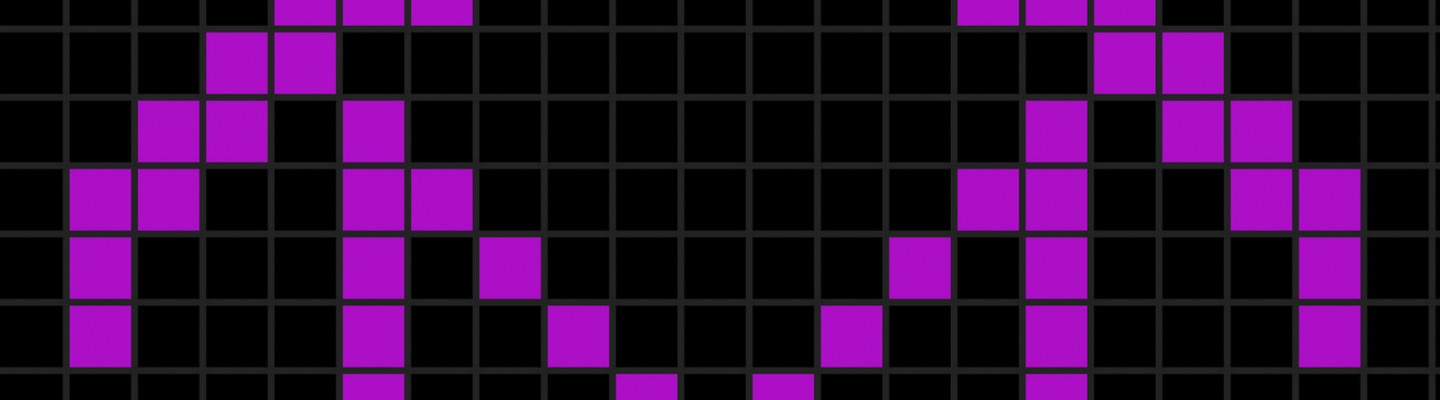


On 16th November 1974 the newly upgraded telescope at the Arecibo Observatory in Puerto Rico sent out a radio wave beam towards Messier 13 (M13) in the constellation of Hercules. The radio wave contained a binary message generated by slightly varying the wave’s frequency – a rise in pitch for “1” and a drop in pitch for “0”. Too high for humans to hear the high pitched warbling message was sent on its way by the powerful transmitter, travelling at the speed of light – though as M13 is 25,000 light years away it’s only completed a tiny part of its journey fifty years later.
More a PR exercise to show off the telescope’s upgrade than a serious attempt at communicating with aliens (whose reply would take another 25,000 years to reach us) the message was constructed, by Frank Drake (of the Drake equation), so that a degree of intelligent life was required to decode it. First of all the aliens would need to have radio communications technology to receive the message in the first place. Then they’d need to work out that it wasn’t just ‘noise’ but actually contained a message, encoded into the warbling pitch shifts. There are 1,679 bits in the binary message which might sound like some are missing but this number is a semi prime; the product of 23 and 73. If the aliens had some squared paper to hand they could plot this either as a grid of 73 columns and 23 rows which would result in a disappointing mess, or they might try the other way around and land on 23 columns and 73 rows to produce the famous Arecibo Message (below).

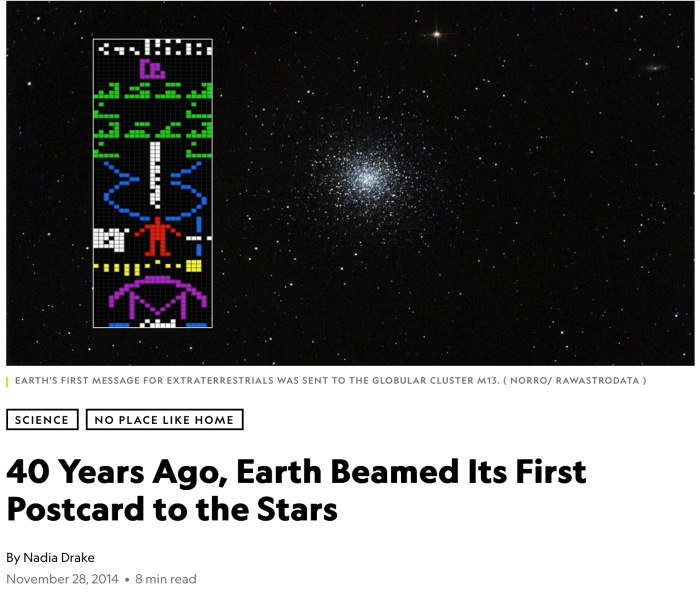
The top of the message contains the numbers one to ten (shown in white), then there are the numbers for the chemical elements that make up DNA shown in purple and below that in green there are the sugars that make up the nucleotides of DNA. Next comes a blue and white section showing the structure of DNA (blue) and the white vertical bar is the number of base pairs. Below that is a red humanoid figure whose height (blue vertical bar) is given by the number on the left (white) – this is expressed in units of the wavelength used to send the message (12.6cm). On the right the white block is the number of people populating the Earth in 1974.
The yellow panel shows our solar system which then still included Pluto (it was reclassified as a dwarf plant in 2006). Note that the Earth (the third planet from the Sun) is raised up and in line with both the red humanoid and the purple icon below it, which represents the Arecibo telescope. The diameter of the telescope (blue horizontal bar) is given by the number in white, again as a multiple of units of the transmitting wavelength (12.6cm).
In this series of expanding classroom activities (more to come!) we’ve created a colouring in pixel puzzle, a quiz and you can try and listen to an audible version of one row from the message to see how well you can decode it, and make sense of it.
We’ll continue to add more activities but for now we’ll leave the last word to Frank Drake’s daughter Nadia who wrote this (in 2014) about the message’s transmission: “40 years ago, Earth beamed its first postcard to the stars” (make sure you read right to the end!).
Visit our Arecibo Message classroom activities
Subscribe to be notified whenever we publish a new post to the Teaching London Computing blog.

This blog is supported through EPSRC grant EP/W033615/1.
 Teaching London Computing: A RESOURCE HUB from CAS LONDON & CS4FN