Teaching London Computing: A RESOURCE HUB from CAS LONDON & CS4FN

Menu

Skip to content
  • Home
  • Puzzles
  • Booklets
  • Activities
    • Learning about Machine Learning
      • The Intelligent Piece of Paper Activity
      • The Brain-in-a-bag Activity
      • The Sweet Learning Computer Activity
    • Christmas Computing
    • Halloween Computing
    • Valentine Computing
    • Magic-based Activities
      • The Invisible Palming Activity
      • Magical Book Magic
      • The Australian Magician’s Dream Activity
      • The Red Black Mind Meld Activity
      • The Four Aces Activity
      • The Teleporting Robot (and Melting Snowman) Activity
    • Puzzle based activities
    • Art-based activities
    • Craft-based activities
    • Sort Algorithms
      • The Bubble Sort and Sort Dance Activities
      • The Divide and Conquer Sorting Activity
      • The Punch Card Sorting Activity
    • JFLAP: Creating Finite State Machines
    • The 20-questions Activity
    • The Box Variable Activity
    • The Assignment Dry Run Activity
    • The create-a-face activity
    • The Emotion Machine Activity
    • The Imp Computer Activity
    • Microwave Racing Video
    • The Locked-in Activity
    • The Punch-card searching activity
    • The Spit-not-so Activity
    • The Sodarace Evolution Activity
    • The Soda Constructor Physics Activity
  • Mix Subjects
  • Research
  • Resources
    • Home Learning
    • Re-using our material
    • A cs4fn guide to Secondary School Computing Topics
    • Video CPD
    • Primary School Resources
    • Puzzles, Computer Science and Computational Thinking
      • Puzzle Book 1
      • Bakuro and Binary
      • Pixel Puzzles and Images
      • Computational Thinking: Number Hive Puzzles
      • Computational Thinking: Cut Block Logic Puzzles
      • Word Searches and Linear Search
      • Compression Code Puzzles
      • Spot the Difference and Debugging
    • Magic and Computational Thinking
      • Magic Book 3 – for schools
      • Computational Thinking: Magical Book Magic
    • Great Reading for budding computer scientists
    • Books
    • Developing computational thinking
      • Abstraction
      • Algorithmic Thinking
      • Decomposition
      • Evaluation
      • Generalisation
    • Other Useful Resources
    • Computing Summer Schools in London
  • Courses/Workshops
    • Online-live-lectures
    • CAS London 2020 Conference
    • Teacher training in London
    • Teaching GCSE Computing
      • GCSE Computing CPD Resources
        • Introduction and Programming Challenges
        • 1: Introducing Python Expressions and Variables
        • 2: Binary
        • 3: Conditional Statements and Booleans
        • 4: While Loops
        • 5: Computer Components
        • 6: Arrays and Testing
        • 7: Networks
        • 8: Functions
        • 9: Logic Circuits
        • 10: Files
    • Teaching A-level Computing
      • A-level Computing CPD Resources
        • 1: GCSE Python Recap
        • 3: Arrays and Exceptions, Representing information
        • 2: Searching and Sorting
        • 4: Recursion
        • 5: Computer architecture
        • 6: Object Oriented Programming
        • 7: Running programs and operating systems
        • 8: Software development
        • 9: Data Structures
        • 10: FSM, Regular expressions, Syntax and parsing
    • Workshops
      • 1. Computational Thinking: Searching to Speak
      • 2. Invisible palming! Intelligent paper? So what is an algorithm?
      • 3. Programming unplugged: learning programming without computers
      • 4. Computational Thinking: it’s about people too
      • 5. Interdisciplinary Computational Thinking through Modelling
      • 6. Explorers need maps: Abstraction, Representations and Graphs
      • 7. KS2 and KS3 Computing Unplugged
      • 8. The Magic of Computing
      • 9. GUI Programming in Python
      • 10. Turtle Graphics: from Visual to Textual Programming
      • 11. Sorting Unplugged
    • miniCPD – short courses
      • miniCPD – Controlled Assessment
      • miniCPD – GUI Programming in Python
      • miniCPD: Introduction to Arduino
    • TechPathways Courses
      • Games Development Course 2020
      • 3DAmi Animations Course 2020
      • GIS Course 2020
    • ABC for Schools
    • LCT Centre Online Roundtable
    • Semantic Waves Course 2020
    • Industry pedagogy course Nov/Dec 2020
  • Diversity
    • Women in Computing
    • Black history
    • LGBTQ+
    • Disability
  • Sign up
  • Contact
  • Blog
    • Testimonials
    • Project private
    • Index / Site-map
    • Volunteering
    • Previous courses
  • Home Learning
An audience at a talk.
  • An illustration showing a hand holding a smartphone with its camera app open, capturing an image of a cartoon purple cat. The camera screen displays the cat framed with a square outline, and several facial features—such as the eyes, ears, and nose—are highlighted with smaller boxes and connected by thin lines, illustrating an AI recognition process. The cat is slightly blurred in the background outside the phone screen, emphasising the focus on the camera's view.
  • A microphone against a blurred backdrop of seats in a lecture theatre
  • Royal Institution RIGB logo
3 July 2024 by Jo Brodie

Techy Talks Summer 2024 – talks, workshops, events for families / schools / teachers

Events for teachers, schoolkids, families, general public

This is an occasional post highlighting some talks and events that touch on computer science or computing-adjacent tech and which are not aimed solely at an academic audience. This isn’t a complete list (an impossible task!) but is drawn from a range of venues and organisations, some already computer-focused, some that have a wider focus but who sometimes host computing events. If you have a suitable event, particularly ones for which the public / schools can get tickets for, please let me (Jo) know, thanks.

Jump to: [London Data Week] [Royal Society Summer Science Exhibition] [CAS Conference 2024] [Imperial College] [Raspberry Pi] [The National Museum of Computing] [Centre for Computing History] [Royal Institution] [Wuthering Bytes]

July & August 2024

1-7 July
London Data Week (London, hybrid)
London Data Week 2024 in white text on a black background. 2024 is written in a separate pink box, and the word data has some coloured accents added.

Happening NOW! This week London hosts London Data Week 2024 with series of events looking at data relevant to Londoners. Some of the events are held on Zoom but most are in-person. Members of the public are welcome (and encouraged) to attend and the event aims to increase good public engagement with data. Full list of events.

2-7 July
Royal Society – Summer Science Exhibition (London, hybrid)

Happening NOW! “Meet world-leading researchers from universities and science institutions across the UK at the Royal Society’s free annual celebration of cutting-edge science.” In-person exhibition (Carlton House Terrace, London) and online events (more info).

Talk: AI and creativity with Eric Drass (part of the Royal Society Summer Science Exhibition)
• Thursday 4 July, 3-3.30pm, in-person or online via their YouTube channel
• Saturday 6 July, 2-2.30pm, in-person or online via their YouTube channel

Talk: The Atomic Human – understanding ourselves in the age of AI
• Friday 5 July, 3-3.30pm, in-person or online via their YouTube channel
• Sunday 7 July, 1.15-1.45pm, in-person or online via their YouTube channel

13 July (Saturday)
Ada College (London)
CAS Conference 2024 from Computing At School.

The conference (see the workshop programme) will take place from 9am to 4.30pm at Ada, the National College for Digital Skills, 1 Sutherland St, London. It’s sold out (it’s free) but you can add yourself to the waiting list at Eventbrite.

15 July
Imperial College (London, hybrid)

From theorems to serums, from cryptology to cosmology… and The Simpsons – with Simon Singh, free, in-person only, 7-8pm.

16 July
Raspberry Pi – research seminar (online)

How should we teach debugging to secondary school students? with PhD student Laurie Gale (Raspberry Pi Computing Education Research Centre, University of Cambridge), 5pm, online.

The National Museum of Computing (Bletchley Park)
Summer Holidays STEM Bytes in July and August, STEM Family Activities! Fun for the Whole Family. Each day involves a morning and afternoon drop-in session.
• Robotics: Days: 20th July, 23rd July, 3rd August, 13th August, 15th August, 24th August
• Programming: Days: 21st July, 25th July, 1st August, 6th August,10th August, 17th August, 22nd August, 31st August
• Virtual & Augmented Reality: Days: 27th July, 30th July, 4th August, 8th August, 18th August, 27th August, 29th August

Centre for Computing History (Cambridge)
Full list of events.

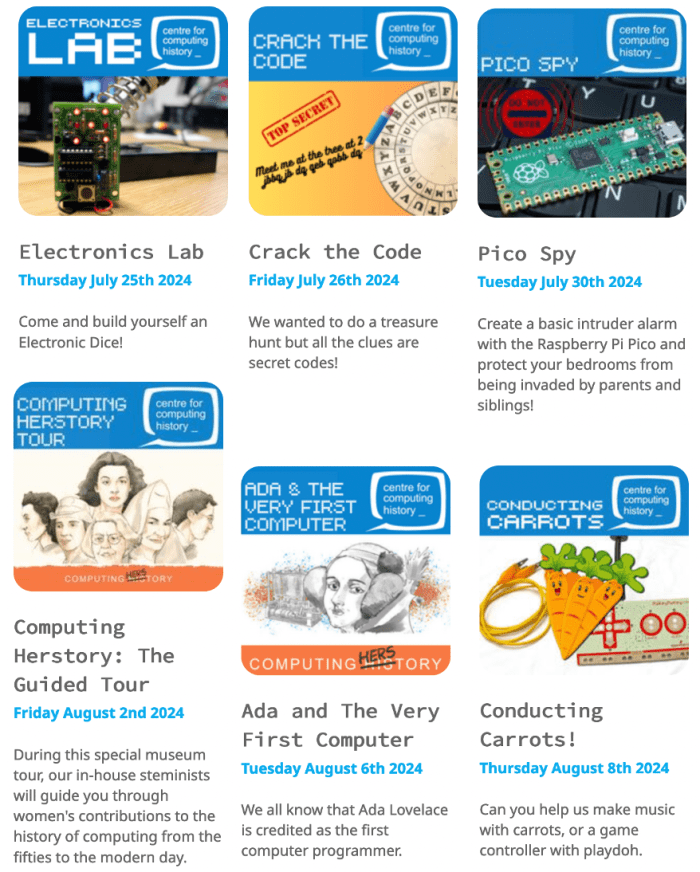
• Build electronic dice (25 July)
• Crack the Code (26 July)
• Pico Spy (30 July)
• Computing Herstory guided tour (2 August)
• Ada Lovelace and the very first computer (6 August)
• Conducting Carrots (8 August)
Royal Institution (London)
Holiday Workshops

Download a timetable of their full programme of Holiday Workshops in PDF format here.

Royal Institution RIGB logo

Intro to the BBC Micro:bit
• Ages 7-8, Monday 29 July, 11am – 1.15pm
• Ages 9-11, Monday 29 July 2.15pm – 4.30pm

Introduction to robotics week (week long event)
• Ages 15-18, Monday 29 July – Friday 2 August, 11am – 4pm

Making music and sound with BBC Micro:bit
• Ages 12-14, Tuesday 30 July, 11am to 3pm

Codes and ciphers
• Age 7-8, Thursday 1 August, 11am to 1.15pm
• Age 7-8, Tuesday 6 August, 11am to 1.15pm
• Age 9-11, Thursday 1 August, 2.15-4.30pm
• Age 9-11, Tuesday 6 August, 2.15-4.30pm

Computing with cards and dominoes
• Ages 13-15, Tuesday 6 August, 11am to 3pm

Electrical circuits
• Ages 9-11 (morning session), Thursday 8 August, 11am to 1.15pm
• Ages 9-11 (afternoon session), Thursday 8 August, 2.15-4.30pm

The magic of computer science
with Prof Paul Curzon (CS4FN and Teaching London Computing)
• Ages 7-8, Tuesday 13 August, 11am to 1.15pm
• Ages 9-11, Tuesday 13 August, 2.15-4.30pm
• Ages 7-8, Monday 19 August, 11am to 1.15pm
• Ages 9-11, Monday 19 August, 2.15-4.30pm

Artificial Intelligence, but where is the intelligence?
with Prof Paul Curzon (CS4FN and Teaching London Computing)
• Ages 7-8, Friday 16 August, 11am to 1.15pm
• Ages 9-11, Friday 16 August, 2.15-4.30pm

Crafting with Code
• Ages 9-11 (morning session), Wednesday 21 August, 11am to 1.15pm
• Ages 9-11 (afternoon session), Wednesday 21 August, 2.15pm to 4.30pm

Domino computing master class
• Ages 12-14, Tuesday 27 August, 11am to 3pm

23 August
Wuthering Bytes (Hebden Bridge)
“Science, software, technology & you! Fascinating insights, inspiring stories and mind-boggling tech.” – 23-31 August, admittedly a bit far from London as this is in West Yorkshire! https://wutheringbytes.com/

The event will also host the annual general meeting of OSHUG, the open source hardware users’ group – “The annual conference of the Open Source Hardware User Group, featuring talks and hands-on workshops covering a diverse range of topics related electronics, hardware hacking, open source, tools, techniques and more.”

Places which have computing-themed talks and events

  • Ada Lovelace Institute, London
  • Alan Turing Institute, London (see also their Fringe Events)
  • BCS – British Computer Society, London and national
  • Centre for Computing History, Cambridge
  • Centre for Digital Education, Edinburgh University
  • Computer Conservation Society
  • Edinburgh Futures Institute, Edinburgh University
  • Gresham College, London
  • Highgate Literary & Scientific Institution, London
  • Imperial College, London
  • The National Museum of Computing, Bletchley Park
  • OSHUG – Open Source Hardware User Group
  • Oxford Internet Institute, Oxford University
  • Raspberry Pi Foundation, Cambridge
  • Royal Institution, London
  • Royal Society, London
  • TEDI (The Engineering & Design Institute), London
  • UCL Lunch Hour Lectures, London
  • Warwick Data, Warwick

Subscribe to be notified whenever we publish a new post to the Teaching London Computing blog.


This blog is supported through EPSRC grant EP/W033615/1.

Share this:

  • Click to share on X (Opens in new window) X
  • Click to share on Facebook (Opens in new window) Facebook
  • Click to email a link to a friend (Opens in new window) Email
Like Loading...

Related

This entry was posted in Conferences and events, events, From around the web, Techy Talks and tagged Ada College, AI, artificial intelligence, Centre for Computing History, computer science, computing, education, events, Imperial College, London Data Week, public engagement, Raspberry Pi, Royal Institution, Royal Society, scicomm, science communication, Summer Science Exhibition, technology, The National Museum of Computing, Wuthering Bytes. Bookmark the permalink.

Post navigation

Recently added to the @CS4FN blog – a round-up of computing stories, classroom ideas and discussion points – 2 July 2024
Closing on 21 July 2024: DfE consultation on proposed updates to GCSE Computer Science

Search this blog

Enter your email address to follow this blog and receive notifications of new posts by email.

Join 889 other subscribers
Follow Teaching London Computing: A RESOURCE HUB from CAS LONDON & CS4FN on WordPress.com

Blog Stats

  • 2,704,984 hits
  • RSS - Posts
  • RSS - Comments
Blog at WordPress.com.
  • Reblog
  • Subscribe Subscribed
    • Teaching London Computing: A RESOURCE HUB from CAS LONDON & CS4FN
    • Join 889 other subscribers
    • Already have a WordPress.com account? Log in now.
    • Teaching London Computing: A RESOURCE HUB from CAS LONDON & CS4FN
    • Subscribe Subscribed
    • Sign up
    • Log in
    • Copy shortlink
    • Report this content
    • View post in Reader
    • Manage subscriptions
    • Collapse this bar
 

Loading Comments...
 

    %d