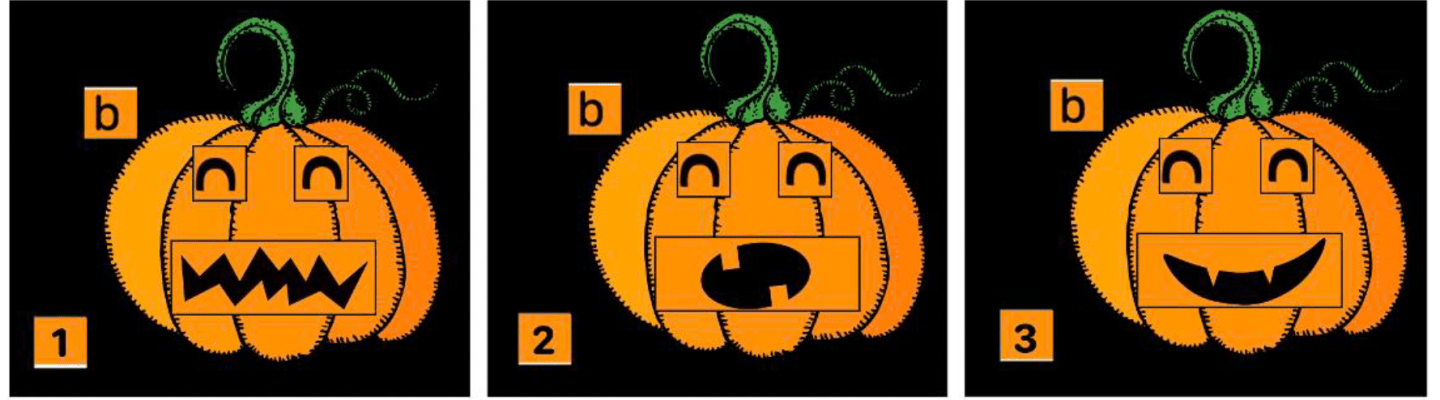
A paper-based pumpkin programming project! It’s a customisable toy for younger kids, but older kids can learn some linked computer science concepts and about real computing research. Find out why computer scientists are interesed in human emotions – whether they’re expressed on your face or through text.
This is a very simple way to introduce the idea of programs and sequences of instructions as well as high level commands and low level code.
There are two versions (both available for A4 and US letter): a version to print out and use on a desk and a version that can be taped to a jam jar. If a battery-operated LED light is placed in the jar it will shine through and make the pumpkin look a bit spookier (if using wax candles please don’t leave unattended). There’s also an activity sheet which contains assembly instructions, suggested activities, instructions for ‘programming’ the pumpkin and code tables to fill in, suggestions for classroom discussion and links to computing research (see excerpt below).

More info, and where you can buy battery-operated LED tea lights (in the UK) at The Pumpkin Patch on the CS4FN site.
Learn about:
- programming
- sequences of instructions
- compilers / interpreters
- abstraction
Pick your preferred printer (A4 or US Letter)
A4 (PDF)
⬇️ 📄 Activity sheet for Program A Pumpkin
⬇️ 🎃 ✂️ Pumpkin and expressions to cut out
⬇️ 🎃 ✂️ Pumpkin and expressions to cut out for jam jars with LED tea lights
⬇️ 🧳 Or download the zipped A4 pack
US Letter
⬇️ 📄 Activity sheet for Program A Pumpkin
⬇️ 🎃 ✂️ Pumpkin and expressions to cut out
⬇️ 🎃 ✂️ Pumpkin and expressions to cut out for jam jars with LED tea lights
⬇️ 🧳 Or download the zipped US Letter pack
Class discussion and links with research
At the end summarise the computing lessons from the activity. Programs are sequences of instructions (like “c3” or “b2”) that when followed lead to something happening like a pumpkin face showing different expressions. Computer instructions are just low-level codes.
Programming languages need to be understood first by people so use high-level commands (more like “smiling” or “scary”) to make programs easier to write – this uses abstraction to hide the detail of the low level codes. We can take a program made of high level commands and compile it into a program that is used to operate the machine. Or we can use an interpreter that translates the instructions as we get to them.
Read our 3 minute blog post about Fran Allen’s work making computer compilers more efficient: Fran Allen: Smart Translation https://bit.ly/franallen
Why are computer scientists interested in human emotions?
There are several reasons.
Recognise and understand emotions
One is so that they can design robots and things like virtual assistants that can recognise and understand different human emotions and respond in an appropriate way.
Display appropriate emotions
Another is so that the robots and virtual assistants can display natural-seeming emotions, and to do so correctly in situations where humans naturally would.
Read our 5 minute blog post about ‘Blade’ the emotional robot made from Lego Mindstorm which learned to change its facial expression depending on the tone of voice it heard:
Blade: the emotional robot https://bit.ly/bladerobot
Making sense of text: sentiment analysis
Another area of research is in understanding the meanings and emotion behind written text, particularly on social media posts or in customer service chats so that the assistant can determine when people are distressed or angry and respond in a way that supports and calms them (or at least doesn’t make the matter worse).
Words don’t always encode emotion (for example “thanks, that’s great” could be enthusiasm or sarcasm) and people often use smileys (emoticons) or emoji to help make their meaning clearer.
Read our 3 minute blog post about the history of emoticons in different cultures Emotions and Emoticons https://bit.ly/emoticonhistory
Also this 2 minute blog post about how your use of emoji can give away something about who you are. The Emoji Crystal Ball https://bit.ly/emojicrystalball
Read our 5 minute article about making chatbots convincing
Meet the chatbots https://bit.ly/meetthechatbots
By creating models of human emotions and the situations in which we show emotions (or how we react to others’ emotions) computer scientists can help us better understand the importance of emotions and how we use and interpret them in social situations.•
• Other Hallowe’en puzzles and activities
• Other unplugged classroom activities
Credits
Design: Program A Pumpkin is a Hallowe’en variation of our popular Emotion Machine activity https://bit.ly/EmotionMachineActivity (developed by Paul Curzon and Peter McOwan) which lets you ‘programme’ different emotions. The adaptation for jam jars was inspired by Ho Huen’s version using empty Pringle cans (https://bit.ly/cs4fnpringles).
Images: main pumpkin image (https://pixabay.com/vectors/pumpkin-winter-squash-fruits-23479/) and expressions (https://pixabay.com/vectors/pumpkins-grimaces-halloween-fall-1777667/).

This blog is supported through EPSRC grant EP/W033615/1.
 Teaching London Computing: A RESOURCE HUB from CAS LONDON & CS4FN
Pingback: Program a Pumpkin – free Hallowe’en-themed unplugged computing activity | Teaching London Computing: A RESOURCE HUB from CAS LONDON & CS4FN