Calling UK teachers – free copies of cs4fn issue on computer science and medical devices

Free magazine for UK schools from cs4fn, about computer science, medical devices and patient safety.

cs4fn (Computer Science For Fun, based at Queen Mary University of London, QMUL) has been providing school students and teachers with inspiring resources, including magazines, magic books, puzzles and schools talks, about computer science for almost ten years.

Teaching London Computing is a spin-off project from cs4fn to explicitly support teachers. It is run jointly by QMUL and colleagues at King’s College London and provides courses and classroom resources for teachers who’ll be delivering the new KS3, GCSE and A-level Computing curricula. Primary school teachers are also finding many of the resources useful.

There’s also a bit of overlap with a third project, CHI+MED, which is adding a human dimension to cs4fn and TLC. It is funded by one of the UK’s research councils (EPSRC) to investigate how interactive medical devices could be made safer. That project runs over four universities (UCL, QMUL, Swansea University and City University) and the main investigator at QMUL, Prof Paul Curzon, is also one of the people behind cs4fn.

CHI+MED (computer-human interaction for medical devices) takes a very broad view of medical devices – how they’re designed, how they’re approved for use on the market, how people in hospitals decide which one(s) to buy and how they’re actually used in the real world by busy healthcare professionals. Computing is an important aspect of medical device design (software performs calculations and determines how the machine responds to keypresses when a nurse enters a drug dose) but it’s not the only one. It’s important to look at the people involved (the ‘human’ bit of ‘human-computer interaction) at every stage of device development and use too, for example when trying to reduce the harm that can arise when someone makes a slip in mistyping a drug dose.
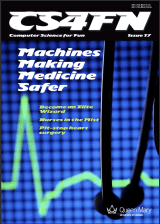
Magazine cover for cs4fn's special issue on medical devices and patient safetyIssue 17 of the cs4fn magazine series is about the research that people on the CHI+MED project are doing along with related work of other groups. It provides a good overview of some of the issues that researchers are thinking about when looking at patient safety in medical devices. It also shows how computer scientists and researchers work with other types of scientists (ergonomists, human-factors experts) in trying to understand and solve a real-world problem.

Sign up for free copies of the magazine
cs4fn already sends copies of the magazines to schools who subscribe. If you are a teacher or school librarian who would like to receive one or more copies (up to a class set of 30*) of this, and future magazines, please fill in your school’s address details (UK addresses only please) on this form and we’ll do the rest (while stocks last). The magazine is free due to support from EPSRC and Google.

*If you need a larger number of copies, eg for an event, please get in touch (cs4fn@eecs.qmul.ac.uk) and we’ll do our best to get more to you.

[This post cross-posted to both Teaching London Computing and CHI+MED blogs]
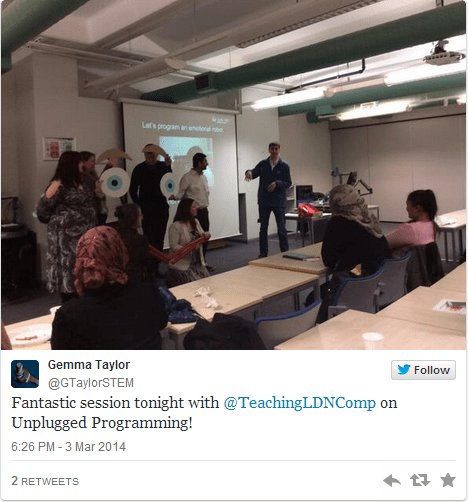


What do we get up to in our free programming workshops for computing teachers? Pics from @GTaylorSTEM

Paul Curzon from Queen Mary University of London has been running a series of free Monday evening workshops for computing teachers, on introducing programming concepts into the classroom in fun and creative ways. The next workshop (the last in this series, but they’ll be repeated) is on Monday 17 March at 5.30, more details and free tickets available from Computational Thinking: it’s about people too

Gemma Taylor was kind enough to share a couple of pictures she took from the most recent workshop (Programming unplugged: learning programming without computers) on Monday 3 March, and she’s given us permission to share them here – thanks Gemma!

TLC audience pic01

Naturally you might be wondering what on earth is going on above – Paul has corralled audience volunteers into forming an ’emotional robot’ which can be programmed to react to certain sounds. You can find out the instructions for making your own in our PDF Create-a-face: programming an emotional robot which comes from our workshop page on Programming unplugged: learning programming without computers – an excerpt is below.

SUMMARY
The class make an affective (relating to moods and emotions) robot face out of card, tubes and themselves. It is programmed to react to different kinds of sounds (nasty, nice or sudden) and show different emotions (sad, happy, surprised). The class then think up some other facial expressions and program sets of rules to make the face respond to sounds with the new expressions.

AIMS
The aim of this activity is to demonstrate how apparently complicated behaviour can be programmed using some simple rules. It also shows how programs are just rules followed by computes and specifically introduces object-based programming. The activity shows how breaking a program into objects can be much easier to write than trying to write it in one go. The class get to write some simple programs to control the face they created.

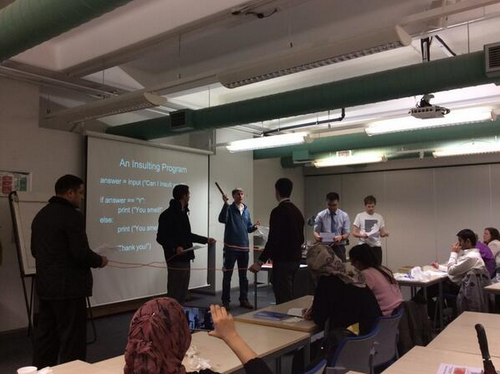
In the picture below the class have created an ‘insulting program’ which comes from the classroom activity ‘The Imp Computer‘ (PDF). That resource and all the other workshop resources can be downloaded from the Programming unplugged: learning programming without computers page.

TLC audience pic02


*New free workshop* Computational Thinking: it’s about people too – 17 March 2014 @QMUL

Prof Paul Curzon is running a series of FREE workshops for London computing teachers on Monday evenings (every second Monday) at Queen Mary University of London (QML). The next one: Programming unplugged: learning programming without computers will take place on Monday 3 March 2014 (there are still tickets available).

The last in this series Computational Thinking: it’s about people too will take place on Monday 17 March at 5.30pm (registration from 5pm) in The Bancroft Building, Mile End campus.

Location: Room 1.13a, The Bancroft Building, Queen Mary University of London, Mile End Rd. E1 4NS

Eventbrite - Teaching London Computing FREE workshop - Computational Thinking: it's about people too for the session on Monday 17th March 2014, 17:30-19:00 (refreshments and registration from 5pm).

2014-02-15-12-45-58

Overview
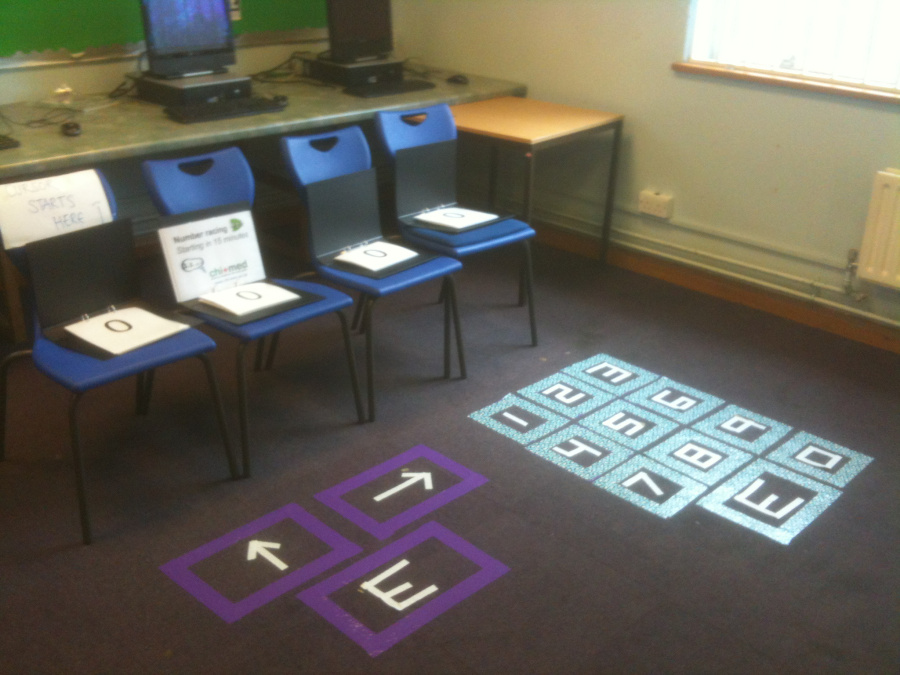
Computing is not just about technology, it is about understanding people too. When we solve computing problems we are solving them for people. Computational thinking is the general group of problem solving skills that students learn as a result of studying computing. Often this is equated with algorithmic thinking – a direct result of learning to program. However it just as important to make programs usable by people – or they won’t be used. We will see how magic gives a fun way to introduce these ideas, how a simple game demonstrates why graphical user interfaces are effective, ways of evaluating interface designs, and by creating an interface out of kids, see how something as simple as entering numbers can tax designers and lead to trade-offs between speed and accuracy.

Session material
This session will cover:

  • computational thinking: understanding people
  • human computer interaction
  • why GUIs are better than text-based interfaces
  • evaluating interfaces
  • number entry

Activities are suitable for all age groups and can be adapted to fit your teaching needs.

Resources
This session comes with linked activity sheets and ‘story’ write-ups that you’ll be able to download from the page for this event: Computational Thinking: it’s about people too

Format
This is a self-contained evening interactive seminar session. It will last 60-90 minutes plus time for networking. The event starts at 5pm with refreshments and a chance to network. The talk will start at 5.30. For our programme of longer courses for teachers please see CPD courses.

Biography
Paul Curzon is a Professor of Computer Science at Queen Mary, University of London. He runs the cs4fn ‘Computer Science for Fun’ (cs4fn) project, www.cs4fn.org. It aims to inspire school students about computer science through a series of free magazines, website and school shows. He regularly gives such shows around the UK as well as continuous professional development talks to teachers about the cs4fn approach to teaching. He is Director of the Teaching London Computing Project. He was made a UK National Teaching Fellow in 2010 in recognition of his excellence in teaching and outreach, was a finalist in the 2009 Times Higher Education Innovative Teacher of the year award and has twice won the student nominated Queen Mary award for excellence in teaching.

About us
Teaching London Computing is a joint project between QML and King’s College London (KCL), with support from Computing At School (CAS). We are supporting London computing teachers with a variety of classroom resources (free) and programming CPD courses for computing teachers (£150 for London teachers, £300 for others if space is available). We’re funded by the Mayor of London and Department for Education to provide this support.

New free workshop: Learning programming without computers

Prof Paul Curzon is currently running a series of free workshops for London computing teachers on Monday evenings (every second Monday) at Queen Mary University of London (QML). The next free session Learning programming without computers will take place on Monday 3 March at 5.30pm (registration from 5pm) in The Bancroft Building, Mile End campus.

Lego laptop

“It’s easy to assume that programming is something you have to learn at a computer but if you want your students to deeply understand programming concepts, rather than blindly getting programs to work then unplugged techniques can work really well to get students started. We will see how to program a robot face that is made of students, look at a simple way to give a deep understanding of how variables work by making them physical, and see how to compile programs onto your class instead of onto a computer.”

For more information please visit the workshop’s information page: Learning programming without computers, and you can register for a free ticket using the Eventbrite button below.

Eventbrite - [Free workshop] Learning programming without computing for the free session on Monday 3rd March 2014, 17:30-19:00 (registration and refreshments from 5pm).

About us
Teaching London Computing is a joint project between QML and King’s College London (KCL), with support from Computing At School (CAS). We are supporting London computing teachers with a variety of classroom resources (free) and programming CPD courses for computing teachers (£150 for London teachers, £300 for others if space is available). We’re funded by the Mayor of London and Department for Education to provide this support.