[FREE] Three new workshops for teachers from Teaching London Computing on 18 and 26 May

We’ve added another three workshops to our activities and will be running these across two sessions in a couple of weeks. Our previous workshops (at Queen Mary University of London or as part of an invited talk elsewhere) have been very popular.

Workshop One: Mon 18 May 2015, 5.30 to 7pm

Explorers need maps: Abstraction, Representations and Graphs

Overview

Abstraction – essentially just hiding information – is a core part of computational thinking that is closely linked to the choice of data representation. We will give a deeper understanding of abstraction, providing fun ways to teach it, based on cs4fn / Teaching London Computing resources. The great explorers didn’t just wander around new continents finding things. They drew maps. Maps are just abstractions of the world. Based on games and puzzles, we will see how drawing a special kind of map called a graph and a variation the finite state machine is a part of computational thinking problem solving. They are useful tools for understanding how to use, exploring and designing computer systems.

Session material
This session will cover:

  • What is Computational Thinking?
  • Inspiring ways to teach Computational Thinking.
  • What is abstraction?
  • Why does the choice of data representation matter when solving problems?
  • What is a graph and why are they useful?
  • What is a finite state machine and why are they useful?

Eventbrite - QMUL 01: Paul Curzon workshop - Abstraction, Representations and Graphs for Workshop 1 – Abstraction, Representations and Graphs
More information about this workshop on our page for Abstraction, representations and graphs.

The second and third run on the same day at half-term, on Tuesday 26 May 2015 (you can come to the first or the second or both, but you will need to register for both separately).

Workshop Two: Tue 26 May 2015, 1.30 to 3pm

Primary Computing Unplugged

Overview

Computing doesn’t need to be taught at a computer and in fact to get across key concepts it is often better (and more fun) not to. This is especially true of the early stages of learning programming and computing more generally. A core idea behind the new computing syllabus is computational thinking. We will give you a deeper understanding of computational thinking and give practical ways to teach both it and other computing topics such as programming away from computers. Computational thinking is a fundamental skill set that students learn by studying computing. We will demonstrate a range of activities that show how core ideas and concepts can be introduced using fun unplugged activities and games. We will show that computing can be fun for everyone and that it doesn’t have to be taught at a computer.

Session material

This session presents a variety of activities from the other workshops. It will cover:

  • What is Computational Thinking?
  • Inspiring ways to teach Computational Thinking.
  • What is an algorithm
  • Writing your first program

Eventbrite - QMUL 02: Paul Curzon workshop - Primary Computing Unplugged for Workshop 2 – Primary computing unplugged
More information about this workshop on our page for Primary computing unplugged.

Workshop Three: Tue 26 May 2015, 3.30 to 5pm

The Magic of Computer Science

Overview

When you learn to be a magician, it turns out you are learning the skills needed to be a great computer scientist too: computational thinking. Just like software, magic is a combination of algorithms and presentation. In this workshop we will demonstrate some simple to do but strong magic tricks. We teach the group how they are done so they can do the tricks themselves and then use the magic to illustrate the linked basics of computing. Overall we will show what computational thinking is all about and how both magicians and computer scientists rely on it.

Session material

This session will demonstrate a variety of activities from the other workshops. It will cover:

  • What is Computational Thinking?
  • Inspiring ways to teach Computational Thinking using easy to learn magic tricks.

Eventbrite - QMUL 03: Paul Curzon workshop - The Magic of Computing for Workshop 3 – The magic of computing
More information about this workshop on our page for The magic of computing.
miniCPD – one day Controlled Assessment and Programming skills (Sat 2 May)

One of the things we try and do is vary the format of our courses so that we can offer something to suit as many teachers as possible. Some prefer weekly classes, others prefer intensive week-long, some are able to take a day from work for study, others aren’t. One thing teachers have asked us for is help with controlled assessments and so we’re trying out new ‘miniCPD’ one-day sessions.

The first will be on Saturday 2 May and will be held at King’s College London (Waterloo Campus). The cost for the day will be £30 for London teachers thanks to funding from the Mayor of London (£60 for non-London teachers). The miniCPD course will run from 10-4pm.

The new one day course ‘Preparing Pupils for Controlled Assessment‘ uses Python to program solutions to problems of a similar type to those set in GCSE Controlled Assessments. The aim is to make teachers feel confident about tackling these problems and programming solutions themselves, so that they can pass their knowledge, experience and confidence on to their pupils. Teachers should already have some knowledge of the basics of Python; strings, arithmetic, ‘if statements’ and loops. This is not a course for complete beginners.

Eventbrite - KCL: miniCPD - Preparing Pupils for Controlled Assessment (Python) - Saturday short course at King's

About us

Teaching London Computing, is a successful partnership between Queen Mary University of London’s Computer Science Department and King’s College London’s Computing Education team which has been running courses and workshops for the past two years helping Computing and ICT teachers to deliver the new Computing Curricula at GCSE and A-level.

Introducing: free booklet “The magic of computer science: magic meets mistakes, machines and medicine”

Blogpost crossposted on both CHI+MED and Teaching London Computing sites.

We have a new booklet out which you can download as a PDF (click on the picture below to visit the book’s microsite) and find out more about where “magic meets mistakes, machines and medicine”.

The Magic of Computer Science 3: magic meets mistakes, machines and medicine
magicbookcover3cs4fn (Computer Science for Fun) is an outreach project from Queen Mary University of London (QMUL) which aims to enthuse school-aged children about computer science. There’s a website and a magazine (usually two issues a year) with special issues and booklets – this is the latest magic booklet.

Paul Curzon and Peter McOwan who set up cs4fn at QMUL are both magicians and also both work on the CHI+MED project and Teaching London Computing. Previous blog posts have referred to to CHI+MED’s use of magic in our public engagement work.

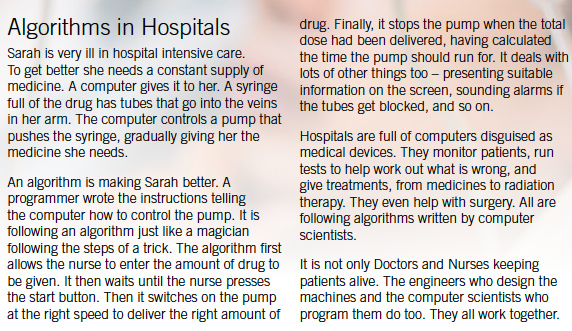
“The cs4fn magic books are collections of easy to do magic tricks (mainly simple card tricks). The twist is that every trick comes with a link to some computer science too. That means that as you learn the tricks, you will learn something about what computer scientists get up to too.

Magic is a combination of a secret method and a presentation. A computer scientist would call the method an algorithm, and that is all a computer program is too. The presentation corresponds to the interaction design of a program. For a magic trick to delight, you must get both the algorithm and presentation right. The same is true for programs.”

Screen Shot 2015-03-25 at 17.22.36

This comes from page 9 of the booklet.

This booklet is published by cs4fn (Computer Science for Fun) in partnership with Teaching London Computing (TLC) and CHI+MED. CHI+MED is funded by the EPSRC and Teaching London Computing by the Mayor of London and the Department for Education.

Download the Magic books

New Easter CPD courses for Computing teachers in London: GCSE courses, at King’s College London

I’m delighted to announce that we have TWO new GCSE courses running soon and they will be held at King’s College London, Waterloo Campus and led by Margaret Derrington. These courses are aimed at experienced ICT teachers who would like to develop their subject knowledge in order to teach the new Computing Curriculum and the new Computing GCSEs.

Tickets are on sale now. The courses cost £300 but thanks to funding from the Mayor of London we can offer a 50% discount to London schools (get in touch if you’re not sure if your school qualifies).

More information and a guide syllabus is available from the links below and from our GCSE Computing page.

Course One

The first course is split into five sessions running over two weeks from the end of March to the second week of April:

Computing CPD GCSE Easter Holidays March 30 – April 10
Teaching London Computing
Monday, 30 March 2015 at 10:00 to Friday, 10 April 2015 at 16:00

5 sessions over two weeks, each class runs from 10am to 4pm.

  • Monday, March 30
  • Wednesday, April 1
  • Wednesday, April 8
  • Thursday, April 9
  • Friday, April 10

Eventbrite - Computing CPD GCSE Easter Holidays March 30 - April 10


Course Two

The second course is a one-week intensive in the third week of April:

Computing CPD GCSE Easter Holidays (1-week intensive) April 13 -17
Teaching London Computing
Monday, 13 April 2015 at 10:00 to Friday, 17 April 2015 at 16:00

Eventbrite - Computing CPD GCSE Easter Holidays (1-week intensive) April 13 -17

Paul Curzon’s doing two free workshops next Friday afternoon (20th) for Computing teachers in London cc @cs4fn

Paul Curzon’s free workshops, held at Queen Mary University of London’s Mile End campus, are fun and informal and support teachers who want to introduce programming concepts and computational thinking into the classroom in an engaging way. Each workshop is accompanied by downloadable classroom activities (also free) – these can be downloaded from the links below.

Next week’s (Friday 20th February) is a double session but you can choose to come to one workshop, or both.

The first workshop is at 2pm then there will be a half hour break with the second starting at 4pm, we aim to finish at 5.30pm.

Do I have to be a London computing teacher to attend?
The workshops are aimed at those who are currently (or who are about to begin) teaching the Computing curricula (particularly GCSE and A-level, though the information in the workshops has been used with younger children). As we’re funded by the Mayor of London we prioritise those who are currently teaching in London schools. The workshops are not suitable for school pupils though as the events are about how to introduce computing concepts into the classroom. Contact Jo Brodie (j.brodie@qmul.ac.uk) for further information.

Biography
Paul Curzon is a Professor of Computer Science at Queen Mary, University of London. He runs the cs4fn ‘Computer Science for Fun’ (cs4fn) project, www.cs4fn.org. It aims to inspire school students about computer science through a series of free magazines, website and school shows. He regularly gives such shows around the UK as well as continuous professional development talks to teachers about the cs4fn approach to teaching. He is Director of the Teaching London Computing Project. He was made a UK National Teaching Fellow in 2010 in recognition of his excellence in teaching and outreach, was a finalist in the 2009 Times Higher Education Innovative Teacher of the year award and has twice won the student nominated Queen Mary award for excellence in teaching.

Workshop A:
Programming unplugged: learning programming without computers

2.00-3.30pm (free Eventbrite tickets)

Overview
It’s easy to assume that programming is something you have to learn at a computer but if you want your students to deeply understand programming concepts, rather than blindly getting programs to work then unplugged techniques can work really well to get students started. We will see how to program a robot face that is made of students, look at a simple way to give a deep understanding of how variables work by making them physical, and see how to compile programs onto your class instead of onto a computer.

Session material This session will cover:

  • Inspiring ways to introduce programming away from computers.
  • What is a variable?
  • How does assignment work?
  • Programming simple objects
  • Introducing flow of control and if statements

Workshop B:
Computational thinking: it’s about people too

4pm-5.30pm (free Eventbrite tickets)

Overview
Computing is not just about technology, it is about understanding people too. When we solve computing problems we are solving them for people. Computational thinking is the general group of problem solving skills that students learn as a result of studying computing. Often this is equated with algorithmic thinking – a direct result of learning to program. However it just as important to make programs usable by people – or they won’t be used. We will see how magic gives a fun way to introduce these ideas and how a simple game demonstrates why graphical user interfaces are effective.

This session is in collaboration with CHI+MED: an EPSRC-funded project about making medical devices safer.

Session material This session will cover:

  • computational thinking: understanding people
  • human computer interaction
  • why GUIs are better than text-based interfaces
  • The importance of data structures

What are London teachers’ needs for the new Computing curricula? We have a survey…

Teaching London Computing is a project that is run jointly from Queen Mary University of London (QMUL) and King’s College London (KCL). We’re funded by the Mayor of London and Department for Education to provide support to teachers in London who are delivering the new Computing curricula (GCSE and A-level).

This includes computing subject knowledge and pedagogical support through a range of continuing professional development courses, free workshops (with fun unplugged-style activities) and free printable resources for use in the classroom.


***London Computing teachers*** – please fill in our short survey
We would like to understand more about the training needs that Computing teachers in London have and we’ve developed a short survey to help us find out more. If you are a Computing teacher based in London your participation will be very helpful. There’s an opportunity to sign up for class sets of free booklets once you’ve completed the survey which should take no more than five minutes to complete.

Please visit http://bit.ly/TLCsurvey2015a to take part in our survey and pass this link on to colleagues.


About us
The Teaching London project developed from cs4fn (Computer Science for Fun, a popular outreach project from QMUL to enthuse schoolchildren about computer science) and, in partnership with the Education department at KCL, we are providing resources for teachers who are introducing programming concepts and computational thinking into the classroom. We aim to nurture an inspiring Computing education for pupils across London.

Next courses
We’ve two new courses starting in the New Year.

Research
We’ve published a number of research articles about computer science education, selected examples below.

Black J, Brodie J, Curzon P, Myketiak C, McOwan PW and Meagher LR (2013). Making computing interesting to school students: teachers’ perspectives. Proceedings of the 2013 Conference on Innovation and Technology in Computer
Science Education (ITiCSE 2013), 255–260. New York: ACM.

Myketiak C, Curzon P, Black J, McOwan PW and Meagher LR (2012) cs4fn: a flexible model for computer science outreach. In Proceedings of ITiCSE ’12 Proceedings of the 17th ACM annual conference on Innovation and technology in computer science education, Pages 297-302, ACM New York. DOI: 10.1145/2325296.2325366

Bell T, Curzon P, Cutts Q et al. (2011) . Introducing Students to Computer Science With Programmes That Don’t Emphasise Programming. Proceedings of ITiCSE 2011, The 16th Annual Conference on Innovation and Technology in Computer Science Education ACM SIGCSE. 391-391.
10.1145/1999747.1999904


Website: http://teachinglondoncomputing.org Twitter: http://twitter.com/TeachingLDNComp

*New course date* Computer Science Education: Theory & Practice (Spring 2015) @ King’s

Teaching London Computing has a new course for Computing teachers, at King’s College London. The short course is a standalone module on an MA course in Education, and is suitable for those who will be teaching Computing up to A-level.

For more details and to apply for a place please visit the course information page.

Computing

COURSE OVERVIEW

KEY FACTS
Course start date – 17 January 2015
Course duration – 11 weeks part time
Course type – Online course
Course times – Saturdays 10am-4pm on campus and online Tuesdays 7-8pm
Course recurrence – Saturday then five Tuesday evenings online, another Saturday and five more Tuesday evenings online.
Location – Waterloo Campus
Entry requirements – Qualified Teacher Status in ICT or experience of teaching ICT in a secondary school.
Credit value – 30 credits at Master’s level
Academic Lead – Sue Sentance

COURSE STRUCTURE

Saturday 1: Curriculum and Computing

Seminar 1 – Communications Unplugged
Seminar 2 – Gender and Computing
Seminar 3 – Teaching early Programming
Seminar 4 – Programming Teaching Methods
Seminar 5 – Teaching by Modelling

Saturday 2: Hardware and Assignment Workshop

Seminar 6 – Flow and Learning through Games
Seminar 7 – Motivation, Uptake and Careers in Computing
Seminar 8 – Collaboration and Group Work in Computing
Seminar 9 – Programming and Mathematics, Computational Thinking
Seminar 10 – Assignment Plans and Feedback

COURSE DESCRIPTION
The course is aimed at experienced ICT teachers and new PGCE graduates who do not have a computing background but would like to develop the capacity for teaching Computing/Computer Science up to A level.

Students on this course have access to online materials to enhance their subject knowledge and learn programming (Python 3). They can also attend workshops on the Subject Knowledge Enhancement course in order to improve their knowledge of the course content of current GCSE and A level specifications.

HOW IS THE COURSE TAUGHT?
Module teaching includes two Saturday workshops one at the beginning and one in the middle of the module together with weekly tasks, readings and discussions in ten on-line sessions. A task related to the week’s theme usually including the study of a specific aspect of programming or computing education with each student posting their reactions, comments and reflections to an on-line asynchronous discussion board for others to view and respond. Online synchronous (chat) seminars in small groups to discuss the week’s theme. These happen on the same evening (Tuesday) each week.

OTHER RELATED COURSES
The 30 credits from this Short Course could be transferred in to an MA Education programme.

We hope that course participants will be interested in the MA Computing in Education

WHAT WILL I GET OUT OF IT?
The intended outcomes are that students will develop a critical understanding of the Pedagogy of Computer Science at secondary level enabling them to make critical, informed judgements in

  • managing the introduction of computing to the curriculum from years 7 to 13
  • developing strategies for selecting appropriate public examinations for their students, at KS4&5
  • writing schemes of work and devising assessment in line with research into the learning of computer science and programming
  • selecting and designing and developing their own resources and teaching materials to enhance the understanding of key concepts

for the teaching of computer science, including programming from 11-18.

This course is offered BOTH as a 30 credit module on the Modular Education MA and here as a standalone Short Course. Students successfully completing this course will gain 30 credits towards an Education Masters.

WHO IS IT FOR?
Trained and practising teachers of secondary ICT who wish to teach Computer Science.

ADDITIONAL MATERIALS
Guide to Teaching Computer Science: an Activity-Based Approach by Lapidot and Ragonis (available from FWB library in hard copy and electronic versions).

ADDITIONAL MATERIALS PURCHASE INFORMATION
GCSE and A level text books for Computing and Computer Science.
Specifications for current GCSE and A level examinations (available online on Exam Board websites).

FEES & OTHER INFORMATION
This course is partly funded through the Teaching London Computing project run by Queen Mary University of London in collaboration with King’s College London.
A number of teachers in London schools will benefit by receiving a 50% discount on the cost of the course through funding received by the TLC project from the London Schools Excellence Fund.
Course cost £1000, less discount £500 (for London Teachers), net cost £500.

COURSE TIMES
Saturdays 10am-4pm on campus and online Tuesdays 7-8pm

COURSE LEVEL
Masters

For more details and to apply for a place please visit the course information page.

A new CPD course for A-level Computing teachers – 18-22 August @QMUL

Teaching London Computing will be running a new one-week intensive course for A-level Computing teachers, from Monday to Friday (10-4pm) 18-22 August 2014. The teaching will take place at Queen Mary University of London (QMUL) and will be led by Dr William Marsh.

Eligibility
The course will follow on from our GCSE Computing courses and those attending will need to be familiar with Python.

More information
There will be more details about the course on our dedicated A-level Computing CPD course page and places can be booked at Eventbrite (see button below).

Fees
Thanks to funding from the Mayor of London we are able to offer London teachers a 50% reduction in fees (£150), for teachers outside London the full fee is £300. Please see our Fees and Fundingpage for more information.

Book a place for the next “A-level Computing CPD for teachers” course which runs during 18-22 August 2014, (10am-4pm) Monday – Friday, at QMUL
Eventbrite - Teaching London Computing - A-level Computing CPD course

Coming up in July & August from Teaching London Computing: two free workshops, GCSE CPD course, A-level CPD course

What: “Teaching Computing Unplugged to Young Children”
Where: Goldsmiths, London
When: 8 July 2014
Audience: Primary school computing teachers
Find out more

What: Programming unplugged: learning programming without computers
Where: Cardinal Pole School, Hackney
When: 9 July 2014
Audience: GCSE Computing teachers
Find out more

What: Computing CPD GCSE Summer Holiday
Where: KCL (King’s College London, Waterloo Campus)
When: 4 – 8 August 2014
Audience: GCSE Computing teachers
Find out more

What: CPD A-level Computing (one week intensive)
Where: QMUL (Queen Mary University of London, Mile End Campus)
When: 18 – 22 August 2014
Audience: People teaching the A-level Computing curriculum
Find out more – more details will be posted here soon.

Two new free computing workshops with Paul Curzon – 4pm, 25 Jun & 9 July in Hackney

We’re delighted to announce that Paul Curzon will be running another two free workshops for Computing teachers in London. These will take place in a school in Hackney on Wednesday 25 June (A) and Wednesday 9 July 2014 (B).

Workshop A – Invisible Palming! Intelligent paper? So what is an algorithm?
4pm, Wednesday 25 June 2014
Cardinal Pole School, 205 Morning Ln, Hackney, London E9 6LG

Workshop BProgramming Unplugged: Learning programming without computers
4pm, Wednesday 9 July 2014
Cardinal Pole School, 205 Morning Ln, Hackney, London E9 6LG
Eventbrite - FREE workshop with Teaching London Computing - programming unplugged for a free place.

Our other events and courses
FREE: Paul is also presenting a talk “Teaching Computing Unplugged to Young Children” for primary school computing teachers, on 8 July 2014 at a two-day workshop event at Goldsmiths in London. Please note that registration for this event is via Goldsmiths (given in link).

NOT FREE: We also have a new short course for GCSE Computing teachers which will take place at KCL from 4-8 August (Mon-Fri) 2014. “Computing CPD GCSE Summer Holiday (1-week intensive)” costs £150 for London teachers and £300 for those outside London (if space is available)