Paul Curzon from @QMUL and @cs4fn has been making faces at #casneconf :)

Paul Curzon gave a talk at the Computing At School North East conference this morning and judging from the tweets (see below) it seems that people enjoyed themselves. Paul uses magic and audience participation to demonstrate fun and easy ways of introducing programming topics into the classroom and delivers a series of free workshops for London teachers.

(More tweets from the #casneconf below)

If you’re enjoying his talk and wondering about the resources then the links below should help. We’re posting out printed copies to our subscribers but anyone can download free PDFs of our booklets.

The Magic of Computer Science 3: magic meets mistakes, machines and medicine
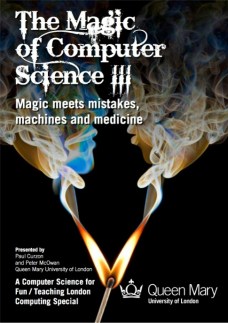
magicbookcover3This book is published by cs4fn (Computer Science for Fun) in partnership with Teaching London Computing (TLC) and CHI+MED. TLC is funded by the Mayor of London and additional funding from the Department for Education has enabled us to send copies to schools of this booklet beyond London. It is also supported by Computing At School. Click on the picture for more information.

“The cs4fn magic books are collections of easy to do magic tricks (mainly simple card tricks). The twist is that every trick comes with a link to some computer science too. That means that as you learn the tricks, you will learn something about what computer scientists get up to too.

Magic is a combination of a secret method and a presentation. A computer scientist would call the method an algorithm, and that is all a computer program is too. The presentation corresponds to the interaction design of a program. For a magic trick to delight, you must get both the algorithm and presentation right. The same is true for programs”

Computational thinking: searching to speak
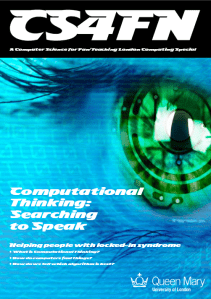
Searching to Speak A5 blueThis booklet was produced as part of the Teaching London Computing activities and has been used in one of our free workshops. It highlights how computational thinking can help people, for example in speeding up tasks, but also focuses on remembering when it’s appropriate to use technological solutions and when it isn’t.

“Computational Thinking: Searching To Speak is a glossy booklet that shows computational thinking in action embedded in a story about helping people with disability, even without technology. It shows how the separate elements of computational thinking combine in interdisciplinary problem solving. Along the way it teaches some core search algorithms. It is written by Paul Curzon of Queen Mary University of London based on the cs4fn approach.”

Click on the picture to download a copy of the PDF, or read more about it and also see how it’s used in the workshop.

The Create-A-Face activity
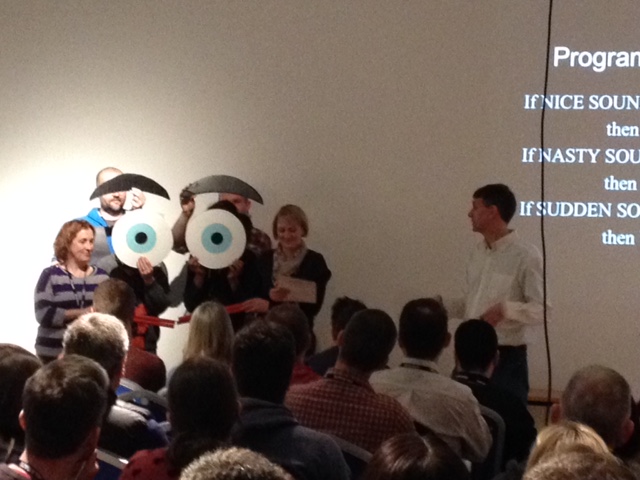
IMG_0942 - Paul Curzon at CASneconfIn the picture on the left (taken by Sue Sentance at the CAS NE Conference) Paul Curzon is instructing members of the audience to create a face whose expression can be programmed with simple instructions.

“Explore programming by making an affective (relating to moods and emotions) robot face out of card, tubes and students. Program it to react to different kinds of sounds (nasty, nice or sudden) and show different emotions (sad, happy, surprised). Then think up some other facial expressions and program rules to make the face respond to sounds with the new expressions.”

Download everything you need (apart from the cardboard tubes!) to recreate this in your classroom, from our Create-A-Face Activity page.


Tweets from the Computing At School North East Conference about Paul Curzon’s talk

The tweets above refer to the Searching to Speak booklet and the one below to the latest magic book. Most of the final tweets refer to the Create A Face activity.

Paul Curzon’s doing two free workshops next Friday afternoon (20th) for Computing teachers in London cc @cs4fn

Paul Curzon’s free workshops, held at Queen Mary University of London’s Mile End campus, are fun and informal and support teachers who want to introduce programming concepts and computational thinking into the classroom in an engaging way. Each workshop is accompanied by downloadable classroom activities (also free) – these can be downloaded from the links below.

Next week’s (Friday 20th February) is a double session but you can choose to come to one workshop, or both.

The first workshop is at 2pm then there will be a half hour break with the second starting at 4pm, we aim to finish at 5.30pm.

Do I have to be a London computing teacher to attend?
The workshops are aimed at those who are currently (or who are about to begin) teaching the Computing curricula (particularly GCSE and A-level, though the information in the workshops has been used with younger children). As we’re funded by the Mayor of London we prioritise those who are currently teaching in London schools. The workshops are not suitable for school pupils though as the events are about how to introduce computing concepts into the classroom. Contact Jo Brodie (j.brodie@qmul.ac.uk) for further information.

Biography
Paul Curzon is a Professor of Computer Science at Queen Mary, University of London. He runs the cs4fn ‘Computer Science for Fun’ (cs4fn) project, www.cs4fn.org. It aims to inspire school students about computer science through a series of free magazines, website and school shows. He regularly gives such shows around the UK as well as continuous professional development talks to teachers about the cs4fn approach to teaching. He is Director of the Teaching London Computing Project. He was made a UK National Teaching Fellow in 2010 in recognition of his excellence in teaching and outreach, was a finalist in the 2009 Times Higher Education Innovative Teacher of the year award and has twice won the student nominated Queen Mary award for excellence in teaching.

Workshop A:
Programming unplugged: learning programming without computers

2.00-3.30pm (free Eventbrite tickets)

Overview
It’s easy to assume that programming is something you have to learn at a computer but if you want your students to deeply understand programming concepts, rather than blindly getting programs to work then unplugged techniques can work really well to get students started. We will see how to program a robot face that is made of students, look at a simple way to give a deep understanding of how variables work by making them physical, and see how to compile programs onto your class instead of onto a computer.

Session material This session will cover:

  • Inspiring ways to introduce programming away from computers.
  • What is a variable?
  • How does assignment work?
  • Programming simple objects
  • Introducing flow of control and if statements

Workshop B:
Computational thinking: it’s about people too

4pm-5.30pm (free Eventbrite tickets)

Overview
Computing is not just about technology, it is about understanding people too. When we solve computing problems we are solving them for people. Computational thinking is the general group of problem solving skills that students learn as a result of studying computing. Often this is equated with algorithmic thinking – a direct result of learning to program. However it just as important to make programs usable by people – or they won’t be used. We will see how magic gives a fun way to introduce these ideas and how a simple game demonstrates why graphical user interfaces are effective.

This session is in collaboration with CHI+MED: an EPSRC-funded project about making medical devices safer.

Session material This session will cover:

  • computational thinking: understanding people
  • human computer interaction
  • why GUIs are better than text-based interfaces
  • The importance of data structures

Friday 20 February 2015 @QMUL – two free workshops for computing teachers, with Paul Curzon

On Friday 20 February we have a double workshop session for computing teachers in London*. These demonstrate ways of introducing programming and computational thinking topics to the classroom in a fun way, without the need to use computers. You are welcome to attend either or both sessions, which are FREE. These will be held at Queen Mary University of London (Mile End Campus).

Next workshops
• Friday 20 February 2015, 2.00-3.30pm – Programming unplugged: learning programming without computers (click to see more information)
Eventbrite - Paul Curzon's free workshop for computing teachers (A): Programming unplugged: learning programming without computers for the first workshop ‘Programming unplugged: learning programming with computers’ at 2pm on 20 February.

• Friday 20 February 2015, 4.00-5.30pm – Computational thinking: it’s about people too (click to see more information)
Eventbrite - Paul Curzon's free workshop for computing teachers (B): Computational Thinking: it’s about people too for the second workshop ‘Computational thinking: it’s about people too’ at 4pm on 20 February.

Sign-up to hear about our workshops as they are advertised.


*Do I have to be a London computing teacher to attend?
The workshops are aimed at those who are currently (or who are about to begin) teaching the Computing curricula (particularly GCSE and A-level, though the information in the workshops has been used with younger children). As we’re funded by the Mayor of London we prioritise those who are currently teaching in London schools. The workshops are not suitable for school pupils though as the events are about how to introduce computing concepts into the classroom. Contact Jo Brodie (j.brodie@qmul.ac.uk) for further information.


2nd FREE workshop with Paul Curzon – NEW: Interdisciplinary Computational Thinking through Modelling (26 Jan)

Our second free workshop of the year with Prof Paul Curzon will also be a brand new one. “Interdisciplinary Computational Thinking through Modelling” takes place on Monday 26 January from 5.30pm at Queen Mary University of London.

These workshops are aimed at Computing teachers in London and demonstrate a number of ways that teachers might introduce computational thinking and computer programming topics into the classroom, as such a workshop is not a ‘show’ (not suitable for pupils for example) and there will probably be some audience participation.

There is also another workshop, Computational Thinking: Searching to Speak, running the week before on Monday 19 January at 5.30 to 7pm at QMUL.


Next workshop: Interdisciplinary Computational Thinking through Modelling
Monday 26 January 2015, 5.30pm, at QMUL
Eventbrite - Free workshop for Computing teachers in London, with Paul Curzon - Interdisciplinary Computational Thinking through Modelling


Interdisciplinary Computational Thinking through Modelling

Monday 26 January 2015, 5.30pm to 7pm
QMUL
Eventbrite tickets
Nearest tube: Stepney Green, Mile End also close by
Buses: 25 and 205 to ‘Ocean Estate

For full details of the workshop and to download some accompanying free classroom resources please take a look at the workshop’s page: Interdisciplinary Computational Thinking through Modelling

Overview
Is computational thinking just for computer scientists? Actually no. It has already revolutionised the way scientists, mathematicians and many others do their jobs.

Computing has changed the way science is done not just because of the availability of more powerful computers, but because it has given scientists a whole new toolset for thinking. In particular algorithmic thinking gives a new way of doing science. We will use  cs4fn activities, games and magic tricks to illustrate how computational modelling can be used both to do and learn about other subjects. We will also use a magic trick to show how algebra plays an important role in logical thinking for computer scientists.

Session material
This session will cover:

  • How Computational Thinking supports other subjects.
  • What is computational modelling and how does it link to algorithmic thinking?
  • How interdisciplinary Computational Thinking can be used to teach topics in Biology, Physics and Mathematics in a powerful and fun way.

Activities are suitable for all age groups and can be adapted to fit your teaching needs.

Biography
Paul Curzon is a Professor of Computer Science at Queen Mary, University of London. He runs the cs4fn ‘Computer Science for Fun’ (cs4fn) project, www.cs4fn.org. It aims to inspire school students about computer science through a series of free magazines, website and school shows. He regularly gives such shows around the UK as well as continuous professional development talks to teachers about the cs4fn approach to teaching. He is Director of the Teaching London Computing Project. He was made a UK National Teaching Fellow in 2010 in recognition of his excellence in teaching and outreach, was a finalist in the 2009 Times Higher Education Innovative Teacher of the year award and has twice won the student nominated Queen Mary award for excellence in teaching.


FREE: Paul Curzon ‘Computational Thinking’ workshop @QMUL for Computing teachers, 19 January

Our first free workshop of the year will be Paul’s exploration of ‘Searching to Speak’. This uses the example of a case of locked-in syndrome to explore the use of computational thinking in solving human problems (human-computer interaction) as well as considering when a technological approach might not actually be the most appropriate solution.

The workshop will take place on Monday 19 January from 5.30pm to 7pm at Queen Mary University of London (QMUL, Mile End Campus) and is free.

These workshops are aimed at Computing teachers in London and demonstrate a number of ways that teachers might introduce computational thinking and computer programming topics into the classroom, as such a workshop is not a ‘show’ (not suitable for pupils for example) and there will probably be some audience participation. There will also be a second workshop, with details to be confirmed, which will take place on Monday 26 January also at 5.30 to 7pm at the same venue.

Computational thinking: searching to speak

Monday 19 January 2015, 5.30pm to 7pm
QMUL
Eventbrite tickets
Nearest tube: Stepney Green, Mile End also close by
Buses: 25 and 205 to ‘Ocean Estate

For full details of the workshop and to download some accompanying free classroom resources please take a look at the workshop’s page: Computational thinking: searching to speak

Two CPD Computing courses starting next week and another two free workshops with Paul Curzon

Happy New Year to all our readers :)

I’m delighted to announce that Paul Curzon will be running another two workshops in January and free tickets (via Eventbrite) will go live soon, but in the meantime please make a note of these dates.

Workshops (free)
The first will be on Monday 19 January from 5.30pm to 7pm, on Computational thinking: searching to speak. The second will be on Monday 26 January at the same time with the workshop title to be confirmed.

Edited
Tickets for the first workshop are now live.

CPD Computing courses (not free)
We’ve two different short courses beginning next week.

The first course is £300 (or £150 for London teachers thanks to subsidised funding from the Mayor of London). The second is £1,000 (£500 for London teachers).

And… while we have your attention – we’re keen to find out more about what people want from training courses, please could you help by answering our survey? Thank you.

***London Computing teachers*** – please fill in our short survey
We would like to understand more about the training needs that Computing teachers in London have and we’ve developed a short survey to help us find out more. If you are a Computing teacher based in London your participation will be very helpful. There’s an opportunity to sign up for class sets of free booklets once you’ve completed the survey which should take no more than five minutes to complete.

Please visit http://bit.ly/TLCsurvey2015a to take part in our survey and pass this link on to colleagues.

Paul Curzon gave a keynote at the Keycit2014 conference in Potsdam today

Prof Paul Curzon of Teaching London Computing, cs4fn (Computer Science for Fun) and chi+med* gave the keynote talk at the IFIP KEYCIT (Key Competences in Informatics and ICT) conference earlier today in Potsdam, Germany.

His talk / workshop “Unplugged computational thinking for fun” covered some of the ideas we encourage teachers to use when introducing computational thinking into the classroom. Paul included the Locked In activity, Invisible Palming (magic, with a computer-human interaction angle) and the Create-a-face activity – all of which are free to download, easy to use and highlight that computational thinking isn’t just about computers but about people too.

They are also part of wider thematic workshops, more information below:

The talk was recorded and we’ll share the video when we have it. Meanwhile others have been kind enough to share short video snippets of the free workshops for teachers that Paul does, and here’s a photo from his talk today.


*chi+med means Computer-Human Interaction for Medical Devices and is a project looking at ways in which interactive medical devices can be made safer.

Coming up in July & August from Teaching London Computing: two free workshops, GCSE CPD course, A-level CPD course

What: “Teaching Computing Unplugged to Young Children”
Where: Goldsmiths, London
When: 8 July 2014
Audience: Primary school computing teachers
Find out more

What: Programming unplugged: learning programming without computers
Where: Cardinal Pole School, Hackney
When: 9 July 2014
Audience: GCSE Computing teachers
Find out more

What: Computing CPD GCSE Summer Holiday
Where: KCL (King’s College London, Waterloo Campus)
When: 4 – 8 August 2014
Audience: GCSE Computing teachers
Find out more

What: CPD A-level Computing (one week intensive)
Where: QMUL (Queen Mary University of London, Mile End Campus)
When: 18 – 22 August 2014
Audience: People teaching the A-level Computing curriculum
Find out more – more details will be posted here soon.

Paul Curzon’s workshop at #CASconf2014 (Computing At School conference)

A couple of people have shared YouTube videos and photos of Paul’s workshop at the Birmingham CAS conference this weekend – thank you very much, we’re glad you enjoyed it and here’s a collection of the tweets below.

All the free resources that Paul mentioned in his workshop can be downloaded from our section on Inspiring unplugged classroom resources.

Paul has a few free workshops coming up in London:


Round-up of Teaching London Computing’s free workshops, courses – and a CAS hub event

I’ve just emailed this to people who’ve signed up to receive info about our events and thought I’d post it here too.

We’re on Twitter @TeachingLDNComp.


Free workshops
25 June 2014, Hackney
Invisible Palming! Intelligent paper? So what is an algorithm?
4pm, Wednesday 25 June 2014
Cardinal Pole School, 205 Morning Ln, Hackney, London E9 6LG

8 July 2014, New Cross
Prof Paul Curzon will be giving a talk, “Teaching Computing Unplugged to Young Children” for primary school computing teachers on 8 July 2014 at a two-day workshop event at Goldsmiths in London. Please note that registration for this event is via Goldsmiths (given in link).

9 July 2014, Hackney
Programming Unplugged: Learning programming without computers
4pm, Wednesday 9 July 2014
Cardinal Pole School, 205 Morning Ln, Hackney, London E9 6LG

Courses
We have a new short CPD course for GCSE Computing teachers which will take place at KCL from 4-8 August (Mon-Fri) 2014. “Computing CPD GCSE Summer Holiday (1-week intensive)” costs £150 for London teachers (thanks to funding from the Mayor of London) and £300 for those outside London (if space is available).

Other events
Computing At School (CAS) – East London hub meeting, 8 July 2014, 4.30 to 6pm.
This event will take place in Islington at the City & Islington 6th Form College and is free to attend. As well as being a networking event for computing teachers the event will also plan ‘a practical using the Arduino Uno’ and discuss the new CAS document ‘Computing in the National Curriculum – A guide for secondary teachers‘.