[FREE] BBC micro:bit training for teachers at CAS East London Hub meeting

CAS East London Hub Meeting: BBC micro:bit training [tickets]

Thursday 19 November 2015 from 4:45- 6:15pm, Free.
East London Hub
City & Islington Sixth Form College

BBC micro:bit Training. Hands-on session teachers of year 7’s to find out about using the micro:bit. For further information: Ceinwen Hilton (ceinwen.hilton@candi.ac.uk)

PROGRAMME

Time Topic
16:45 Registration and Refreshments
17:00 Introduction
17:15 Practical
18:00 Feedback

Tickets for this event (free)

Our next events: [teachers] free workshop, not-free ‘Intro to Arduino’ miniCPD, [kids] free magic show

Our diary of events is as follows, everything is taking place at QMUL (Mile End Campus). Details and tickets below.

  • Saturday 21 November (1-5pm) £30/60
    Introduction to Arduino, with Nicola Plant – a ‘miniCPD’ session on programming using an Arduino with simple electronics
  • Wednesday 25 November (5-6.30pm) FREE
    Sorting Unplugged, a free workshop with Paul Curzon
  • Saturday 28 November (1-5pm) £30/60
    Introduction to Arduino, with Nicola Plant – a ‘miniCPD’ session on programming using an Arduino with simple electronics – note that this session is identical to the one on the 21st, we’re running it twice
  • Wednesday 2 December (5-7pm) FREE
    The IET Christmas Children’s Lecture on ‘The Magic of Christmas Computer Science‘ with Paul Curzon and Peter McOwan

More details and tickets
Events for Computing teachers in London

Introduction to Arduino – Aimed at teachers of pupils at KS3 and above our miniCPD session will introduce you to programming using an Arduino with simple electronics. There are two identical sessions on Saturday 21 and Saturday 28 November, from 1-5pm, both capped at 15 guests.
[Tickets for 21 Nov session] [Tickets for 28 Nov session] £30 (London teachers) / £60 for teachers outside London

Sorting Unplugged‘ – demonstrating some practical and powerful ways to teach basic sort algorithms using unplugged methods, Wednesday 25 November 2015, from 5pm.
[Get a free ticket for this workshop]

Aimed at secondary school children and young people

The Magic of Christmas Computer Science‘ – a magic show powered by hidden computer science. Profs Paul Curzon and Peter McOwan present the IET’s Christmas children’s lecture
[Get a free ticket for this magic show]

Launch event for the new CAS London Regional Centre (Computing At School) – Fri 10th July

Queen Mary University of London and King’s College London will be involved in running the new CAS London Regional Centre (this is separate from Teaching London Computing project but many of the same people are involved). There will be a launch event [free] from 4.30pm on Friday 10 July and the invitation and details are below. [Eventbrite link for the meeting]

Find out more about CAS London @cas_london_crc.

Here is a map of the CAS regional hubs and Computing at School‘s website, and they’re @CompAtSch on Twitter.


We would like to invite you to the first CAS London Meeting. This is a regional collaboration bringing together primary and secondary teachers, Computing At School master teachers, hub leaders, lead schools, universities, boroughs and other training groups and interested parties to promote and support computing education in London. The meeting aims to start a discussion of how we can best mutually support each other, further developing our London education computing community.

The twilight event is on Friday 10th July 2015, at King’s College London.

Here is the link to eventbrite invitation.

Outline:

  • 4:30 Networking tasks & refreshments
  • 5:30 Keynote speaker Simon Humphreys
  • 5:45 Contributed presentations: What’s happening in London?
  • 6:30 Working together: Tasks
  • 7:00 Finish – more refreshments and networking

We aim to explore three questions about computing CPD and teaching computing in London schools: What is working well? What help do you need? What can you offer others?

If possible, can you create 1 or 2 slides with your answers to the above questions and send them to us. We will share your slides on a rolling display during the networking sessions and ask a number of contributors to talk through their slides in the contributed presentations session (maximum of 4 minutes per presentation).

Join us to celebrate the work done by our fantastic community of computing educators (that’s you) and to find out how we can further grow and develop the network of support and computing CPD provision across London.

For more information and to share your slides please contact Jane (jane.waite@computingatschool.org.uk) or Trevor (trevor.bragg@computingatschool.org.uk)

Many thanks
Paul Curzon, William Marsh, Jane Waite, Trevor Bragg, Sue Sentance

The CAS London meeting is supported by ‘Computing at School’ and ‘Teaching London Computing’, which is funded by the Mayor of London and Department for Education. The meeting is being organised by London’s CAS Regional Centre (CRC) a collaboration between Queen Mary University of London and King’s College London.’

miniCPD – one day Controlled Assessment and Programming skills (Sat 2 May)

One of the things we try and do is vary the format of our courses so that we can offer something to suit as many teachers as possible. Some prefer weekly classes, others prefer intensive week-long, some are able to take a day from work for study, others aren’t. One thing teachers have asked us for is help with controlled assessments and so we’re trying out new ‘miniCPD’ one-day sessions.

The first will be on Saturday 2 May and will be held at King’s College London (Waterloo Campus). The cost for the day will be £30 for London teachers thanks to funding from the Mayor of London (£60 for non-London teachers). The miniCPD course will run from 10-4pm.

The new one day course ‘Preparing Pupils for Controlled Assessment‘ uses Python to program solutions to problems of a similar type to those set in GCSE Controlled Assessments. The aim is to make teachers feel confident about tackling these problems and programming solutions themselves, so that they can pass their knowledge, experience and confidence on to their pupils. Teachers should already have some knowledge of the basics of Python; strings, arithmetic, ‘if statements’ and loops. This is not a course for complete beginners.

Eventbrite - KCL: miniCPD - Preparing Pupils for Controlled Assessment (Python) - Saturday short course at King's

About us

Teaching London Computing, is a successful partnership between Queen Mary University of London’s Computer Science Department and King’s College London’s Computing Education team which has been running courses and workshops for the past two years helping Computing and ICT teachers to deliver the new Computing Curricula at GCSE and A-level.

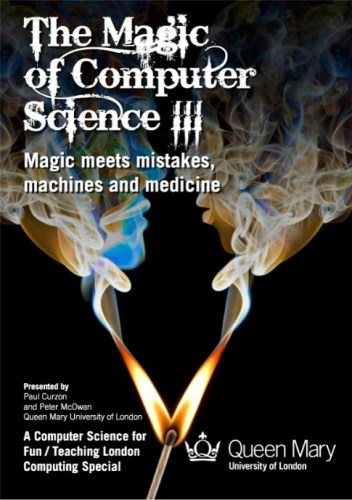
Introducing: free booklet “The magic of computer science: magic meets mistakes, machines and medicine”

Blogpost crossposted on both CHI+MED and Teaching London Computing sites.

We have a new booklet out which you can download as a PDF (click on the picture below to visit the book’s microsite) and find out more about where “magic meets mistakes, machines and medicine”.

The Magic of Computer Science 3: magic meets mistakes, machines and medicine
magicbookcover3cs4fn (Computer Science for Fun) is an outreach project from Queen Mary University of London (QMUL) which aims to enthuse school-aged children about computer science. There’s a website and a magazine (usually two issues a year) with special issues and booklets – this is the latest magic booklet.

Paul Curzon and Peter McOwan who set up cs4fn at QMUL are both magicians and also both work on the CHI+MED project and Teaching London Computing. Previous blog posts have referred to to CHI+MED’s use of magic in our public engagement work.

“The cs4fn magic books are collections of easy to do magic tricks (mainly simple card tricks). The twist is that every trick comes with a link to some computer science too. That means that as you learn the tricks, you will learn something about what computer scientists get up to too.

Magic is a combination of a secret method and a presentation. A computer scientist would call the method an algorithm, and that is all a computer program is too. The presentation corresponds to the interaction design of a program. For a magic trick to delight, you must get both the algorithm and presentation right. The same is true for programs.”

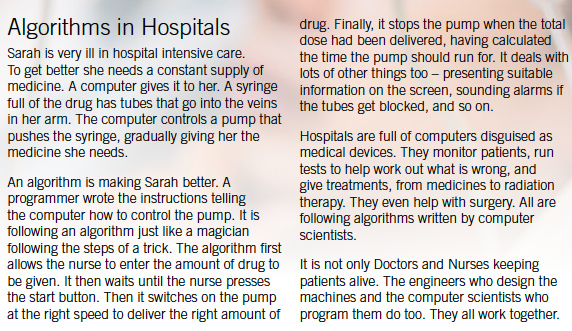
Screen Shot 2015-03-25 at 17.22.36

This comes from page 9 of the booklet.

This booklet is published by cs4fn (Computer Science for Fun) in partnership with Teaching London Computing (TLC) and CHI+MED. CHI+MED is funded by the EPSRC and Teaching London Computing by the Mayor of London and the Department for Education.

Download the Magic books

Teachers: Help your students build their own apps in the #AppsforGood course. Apply to deliver in 2015/16

AppsForGood are looking for Education Partners – here’s some information about them (and there’s a printable / shareable flyer at the end).

Print“Apps for Good is an education programme where students learn to build and pitch their own apps – helping students to become real-life entrepreneurs and digital creators.

The course meets the demands of the new curriculum in an engaging way and builds skills in teamwork, communication and problem solving.

Apps for Good provide their course framework, training and connections to tech Expert volunteers, and then let you do what you are best at – inspiring and guiding young people. Join 500 schools across the UK and apply to become an Education Partner: http://www.appsforgood.org/public/teach-apps-for-good – it’s free for non-fee paying schools.”

Follow them on Twitter  Screen Shot 2015-02-25 at 17.23.02  @appsforgoodcdi

Apps for Good – Info Flyer

Secondary computing teachers eligible for Teacher Industrial Partners’ Scheme (TIPS) from @ntlstemcentre

Teachers may be interested in TIPS (the Teacher Industrial Partners’ Scheme) which gives STEM teachers an authentic experience of what takes place in modern engineering and technology organisations. The aim is to enable teachers to link their subject to the range of careers open to their students.

The National Science Learning Network, which runs the scheme, has arranged work placements with BP during the spring term.

Become a BP Partner School – 3 places available
BP is looking for three secondary teachers of science, technology, engineering, mathematics or computing to undertake a two-week work placement during the spring term 2015.

The placement is part of the Teacher Industrial Partners’ Scheme (TIPS), linking engineering and technology employers with local schools. By giving you an authentic experience of what takes place in modern engineering and technology organisations, you can help your students understand how your subject links to a diverse range of career opportunities at all levels.

The main base will be at the International Centre for Business & Technology at Sunbury with visits to the oil trading headquarters at Canary Wharf, a supply depot on the south coast and a fuel development centre near Reading.

What will it cost and are there any bursaries?
The fee to take part in TIPS is £360.

Teachers from state-funded schools, academies and colleges can receive an ENTHUSE Award bursary of £1400 to help with supply cover and other costs.

How to apply
To participate, you must be available to leave the classroom from the 6 to 23 of February 2015.

For information on how to apply, visit the website below to register:
www.sciencelearningcentres.org.uk/consortia/national/teacher-industrial-partners-scheme

About the NSLN
The National Science Learning Network is the UK’s largest provider of subject-specific CPD. It comprises the National Science Learning Centre in York, and a wider network of 50 Science Learning Partnerships across England.


What are London teachers’ needs for the new Computing curricula? We have a survey…

Teaching London Computing is a project that is run jointly from Queen Mary University of London (QMUL) and King’s College London (KCL). We’re funded by the Mayor of London and Department for Education to provide support to teachers in London who are delivering the new Computing curricula (GCSE and A-level).

This includes computing subject knowledge and pedagogical support through a range of continuing professional development courses, free workshops (with fun unplugged-style activities) and free printable resources for use in the classroom.


***London Computing teachers*** – please fill in our short survey
We would like to understand more about the training needs that Computing teachers in London have and we’ve developed a short survey to help us find out more. If you are a Computing teacher based in London your participation will be very helpful. There’s an opportunity to sign up for class sets of free booklets once you’ve completed the survey which should take no more than five minutes to complete.

Please visit http://bit.ly/TLCsurvey2015a to take part in our survey and pass this link on to colleagues.


About us
The Teaching London project developed from cs4fn (Computer Science for Fun, a popular outreach project from QMUL to enthuse schoolchildren about computer science) and, in partnership with the Education department at KCL, we are providing resources for teachers who are introducing programming concepts and computational thinking into the classroom. We aim to nurture an inspiring Computing education for pupils across London.

Next courses
We’ve two new courses starting in the New Year.

Research
We’ve published a number of research articles about computer science education, selected examples below.

Black J, Brodie J, Curzon P, Myketiak C, McOwan PW and Meagher LR (2013). Making computing interesting to school students: teachers’ perspectives. Proceedings of the 2013 Conference on Innovation and Technology in Computer
Science Education (ITiCSE 2013), 255–260. New York: ACM.

Myketiak C, Curzon P, Black J, McOwan PW and Meagher LR (2012) cs4fn: a flexible model for computer science outreach. In Proceedings of ITiCSE ’12 Proceedings of the 17th ACM annual conference on Innovation and technology in computer science education, Pages 297-302, ACM New York. DOI: 10.1145/2325296.2325366

Bell T, Curzon P, Cutts Q et al. (2011) . Introducing Students to Computer Science With Programmes That Don’t Emphasise Programming. Proceedings of ITiCSE 2011, The 16th Annual Conference on Innovation and Technology in Computer Science Education ACM SIGCSE. 391-391.
10.1145/1999747.1999904


Website: http://teachinglondoncomputing.org Twitter: http://twitter.com/TeachingLDNComp

New dates: GCSE & A-level Computing CPD courses for London teachers from @TeachingLDNComp #LondonEd

We’ll be running two 10-week CPD courses for London Computing teachers. Thanks to funding from the Mayor of London and Department for Education we are able to offer each course at the reduced price of £150 for London teachers (£300 for teachers at schools outside London).

The GCSE CPD courses will run on Tuesday evenings, starting Tuesday 7 October, at KCL (King’s College University) and the A-level CPD courses will be held on Wednesday evenings, starting Wednesday 8 October, at QMUL (Queen Mary University of London in the ITL building*).

We’re also looking at dates for more of our popular (and free!) unplugged-style workshops.

Please note: one of the things we’ll be asking for when you sign up for a course is your school’s ‘URN’, which you can copy from Edubase.

Next GCSE CPD course will run on the following TUESDAYS
7 October -2014 (Week 1)
14 October (Wk2)
21 October (Wk3)
28 October (Wk4)
4 November (Wk5)
11 November (Wk6)
18 November (Wk7)
25 November (Wk8)
2 December (Wk9)
9 December (Wk10) – note that we will run the course through half-term.

Booking details will be added to the GCSE Course page soon.

Next A-level CPD course will run on the following WEDNESDAYS
8 October 2014 (Week 1)
15 October (Wk2)
22 October (Wk3)
29 October (Wk4)
5 November (Wk5)
12 November (Wk6)
19 November (Wk7)
26 November (Wk8)
3 Decmember (Wk9)
10 December (Wk10) – note that we will run the course through half-term.

Booking details will be added to the A-level Course page soon.

*In the ITL or Informatics Teaching Laboratory which is in Godward Square at QMUL. Nearest tube stations are Stepney Green (a short walk) and Mile End (slightly longer walk) and the 25 and 205 buses will drop you off very close to the entrance to the square. We’ll have tea / coffee and biscuits but more substantial fare is available from a Co-op just by Stepney Green or a small Sainsburys very close to Godward Square.


Computer animation competition for schools – Animation15 has launched!

We thought our readers might like to know about this event. It’s not a Teaching London Computing event but our sister project, cs4fn, is involved.

—–

Animation15 – the 8th Annual UK Schools Computer Animation Competition run by the School of Computer
Science at The University of Manchester, has launched!

It’s open now, for teacher registration, at http://animation.cs.manchester.ac.uk

The competition is open to all UK schoolchildren aged 7-19.

Teacher registration is FREE and carries no obligation to submit any
entries. All registered teachers will receive FREE colour A2-sized
Animation15 posters for their school, to be sent out in early-October.

To get your free posters — while stocks last! — register at the
website or log in using your existing credentials.

Entrants can create their animations (maximum duration: 1 minute)
using any of the following programs: Scratch, Adobe Flash, Alice,
Serif: Draw Plus, KoolMoves, SWiSH Max4, and Blender.

They can also use 3DS Max, and Maya — free from Autodesk to all
Schools: see http://www.autodesk.co.uk/campaigns/design-the-future-uk/curriculum

There are great prizes for the winners, and trophies for
schools. Winners will be announced in early-Summer 2015.

Last year’s Animation14 competition was bigger than ever, with over
1,330 entries from 183 schools across the UK, from 1,768 students.

We awarded prizes to 41 students (working as individuals, or in groups)
from 24 schools. You can see all the winning entries, and photos from
our Awards and Inspirational Computer Science Day at
http://animation14.cs.manchester.ac.uk.

Key date
* 20 March 2015: Deadline for submitting entries.

Key contacts
* Website: http://animation.cs.manchester.ac.uk
* Enquiries: animation@cs.man.ac.uk

Animation15 is funded by Electronic Arts, Autodesk, Microsoft, RM
Education, and in association with cs4fn.