Storytelling provides a powerful memorable way to teach concepts in Computer Science. As the Ofsted report says (quoting one of our publications amongst others):
Storytelling is one of the oldest methods of sharing and communicating knowledge. Psychologists refer to stories as ‘psychologically privileged’.[footnote 138] This means that they are organised differently in memory than other types of content. The story of the ‘Cat in the hat!’ by Dr Seuss, for example, is a memorable way of helping pupils understand the computing concept of recursion, with increasingly smaller cats appearing to clean a bath tub.[footnote 139]
The structure of stories is important. Willingham highlights that curriculum content can be organised within the lesson using the structure of stories, for example, using causality, conflict, complications and character as a framework for sequencing lessons.[footnote 140] Curzon and others highlight that in computing ‘the links from the story to the technical concepts, again, have to be made clear – travelling the semantic wave’.[footnote 141] This means that, if stories or analogies are used, they should be linked back to the specific computing concept they represent. The teacher should make clear the differences and similarities between the representation and the concept.
Research review series, Computing, Ofsted, 2022,
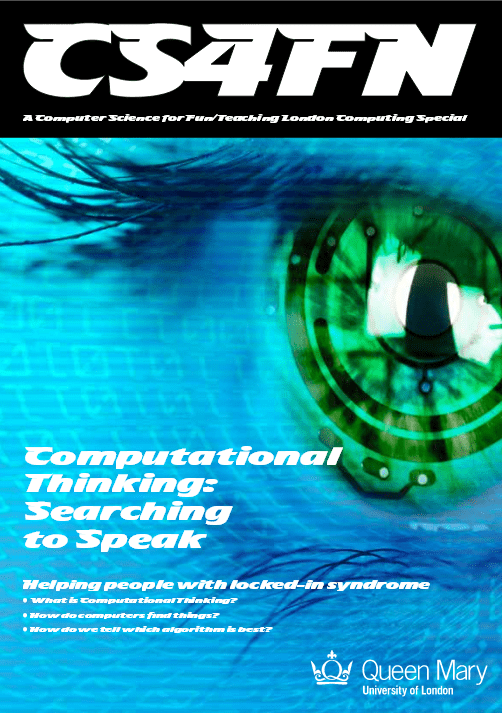
We have used storytelling a lot as part of the Computer Science for Fun project, such as in our “Searching to Speak” talk and booklet.
Publications
Paul Curzon, Peter McOwan, James Donohue, Seymour Wright and William Marsh (2018) Teaching of concepts, Chapter 6 of Computer Science Education: Perspectives on Teaching and Learning in School, edited by Sue Sentance, Erik Barendsen, Carsten Schulte, Bloomsbury Academic.
Curzon, P., McOwan, P. W., Plant, N., & Meagher, L. R. (2014). Introducing teachers to computational thinking using unplugged storytelling. In Proceedings of the 9th Workshop in Primary and Secondary Computing Education In Proceedings of the 9th Workshop in Primary and Secondary Computing Education. ACM. November 2014.

 Teaching London Computing: A RESOURCE HUB from CAS LONDON & CS4FN