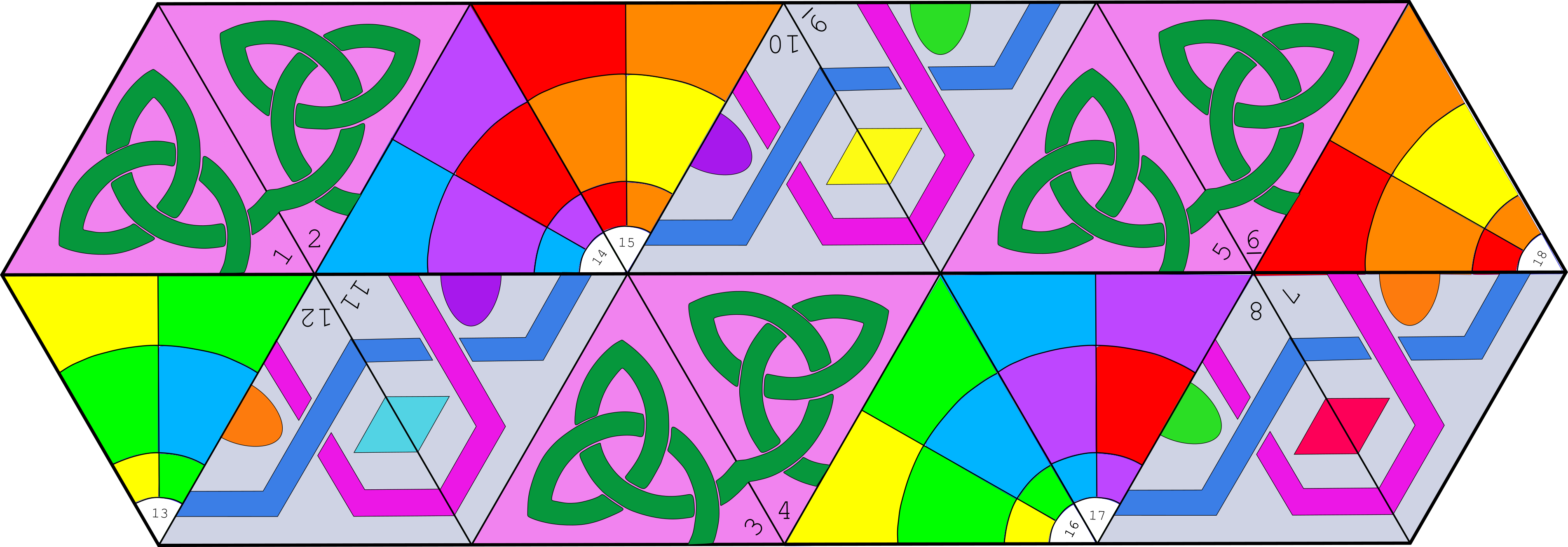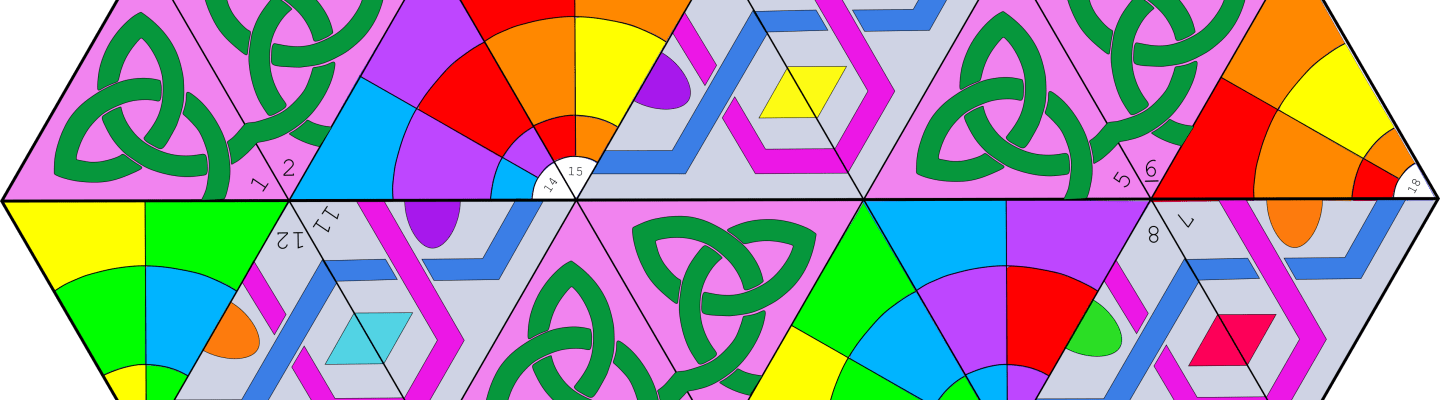
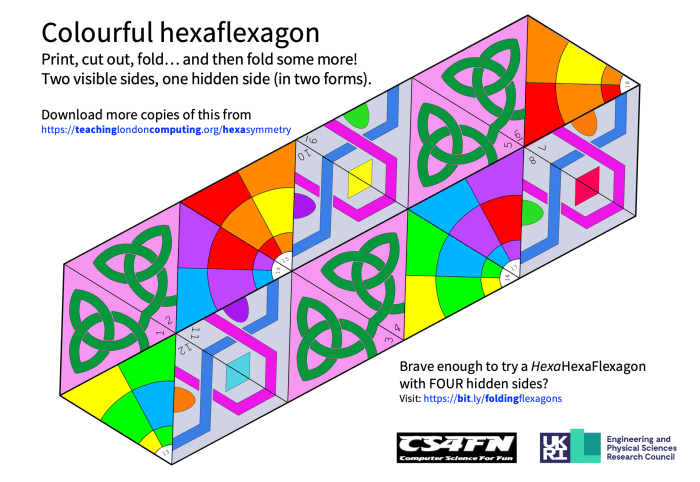
This is a simple three-faced hexaflexagon which, when assembled, has two visible sides. The flexagon can be pinched and folded revealing a third side, in two formats (depending on the starting point).
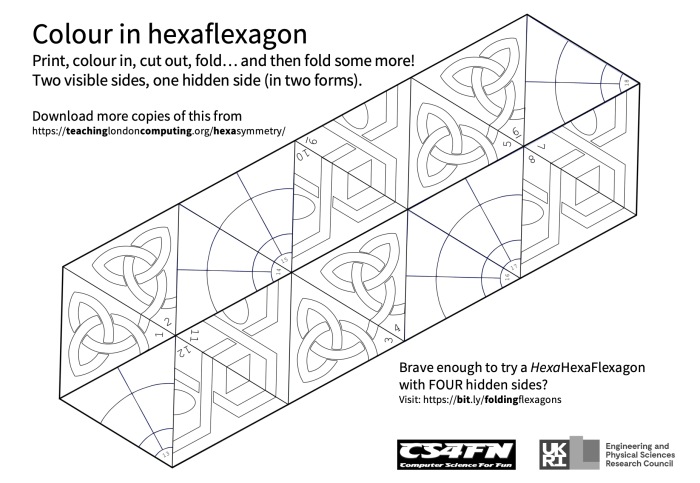
Both a full-colour version and a colour-in version are available. Either can be printed, cut out and assembled. Full instructions below.
This was designed using Inkscape, a free open-source program for drawing SVGs (scalable vector graphics).
If the folds are made cleanly the flexagon also spins quite nicely…
Downloads
A. Colourful hexaflexagon
Download and print a PDF, or incorporate this PNG into your own worksheets.
B. Black and white, colour-in hexaflexagon
Download and print a PDF, or incorporate this PNG into your own worksheets.
Instructions and next steps
C. Assembly instructions
1. Print and cut out the hexaflexagon shape so it looks like the first picture. Fold on the long middle black line so that the pictures are on the outside.

It is helpful to then fold (in both directions) all of the triangles to loosen them up a bit for flexing later.
2. Hold the folded flexagon shape in front of you so that it looks like it does in the picture below with triangles #1 and #2 on the left with the numbers at the bottom.
3. To start the assembly process, fold triangle #15 forwards onto #14 at the fold marked with a thick black line.
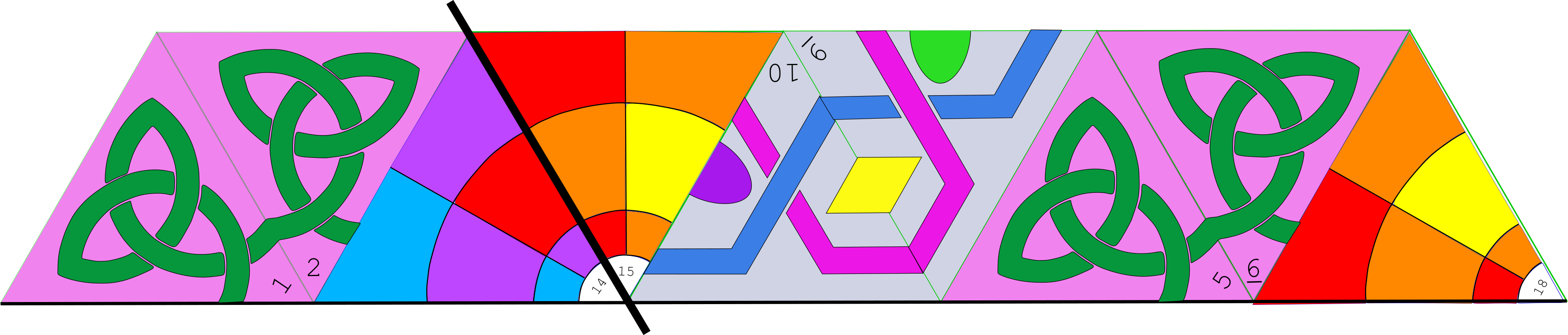
It will now look like the picture below, with trianlges #1 – #4 lining up.
4. Fold triangle #17 upwards onto triangle #16.

The hexaflexagon will now look like this.
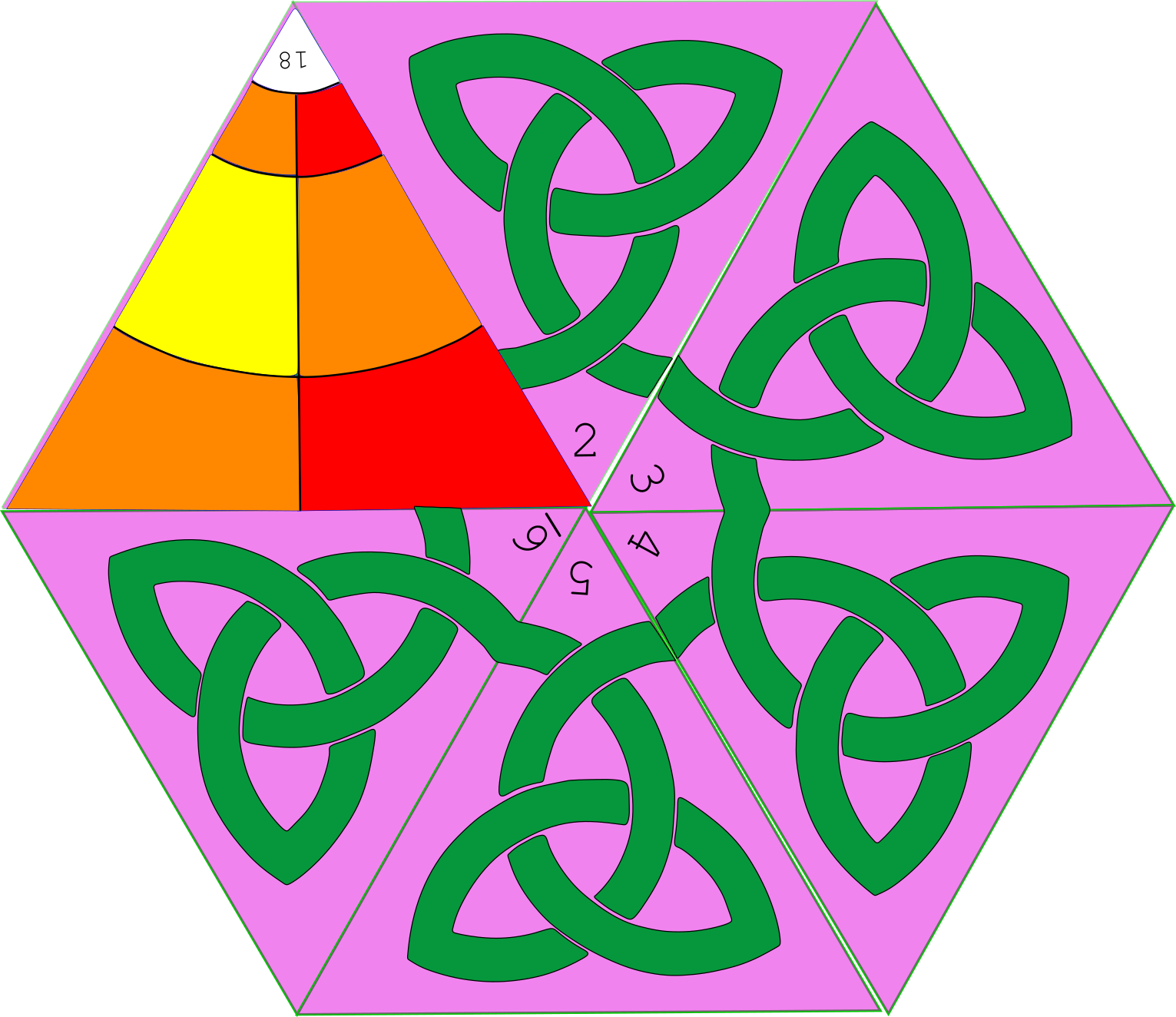
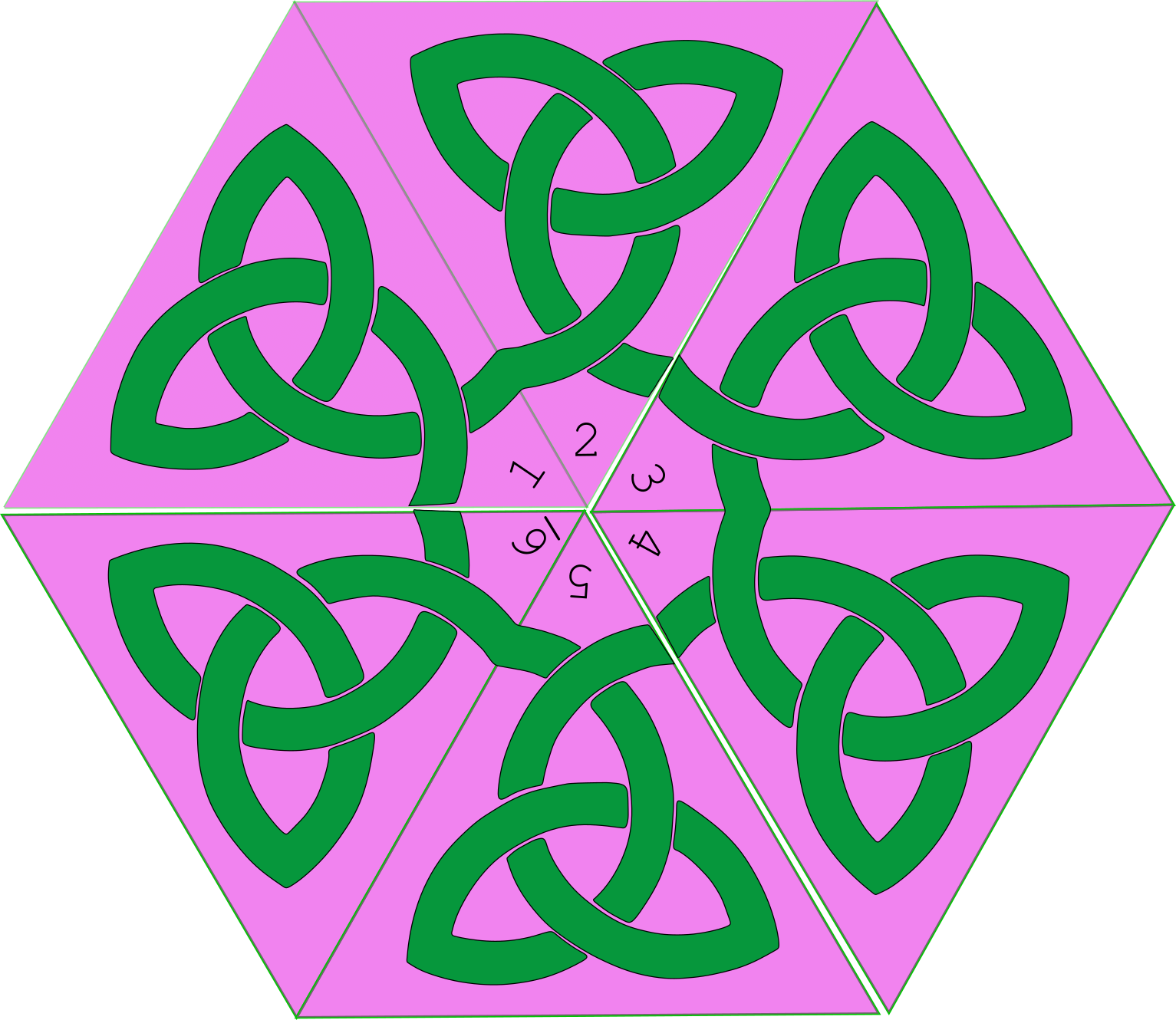
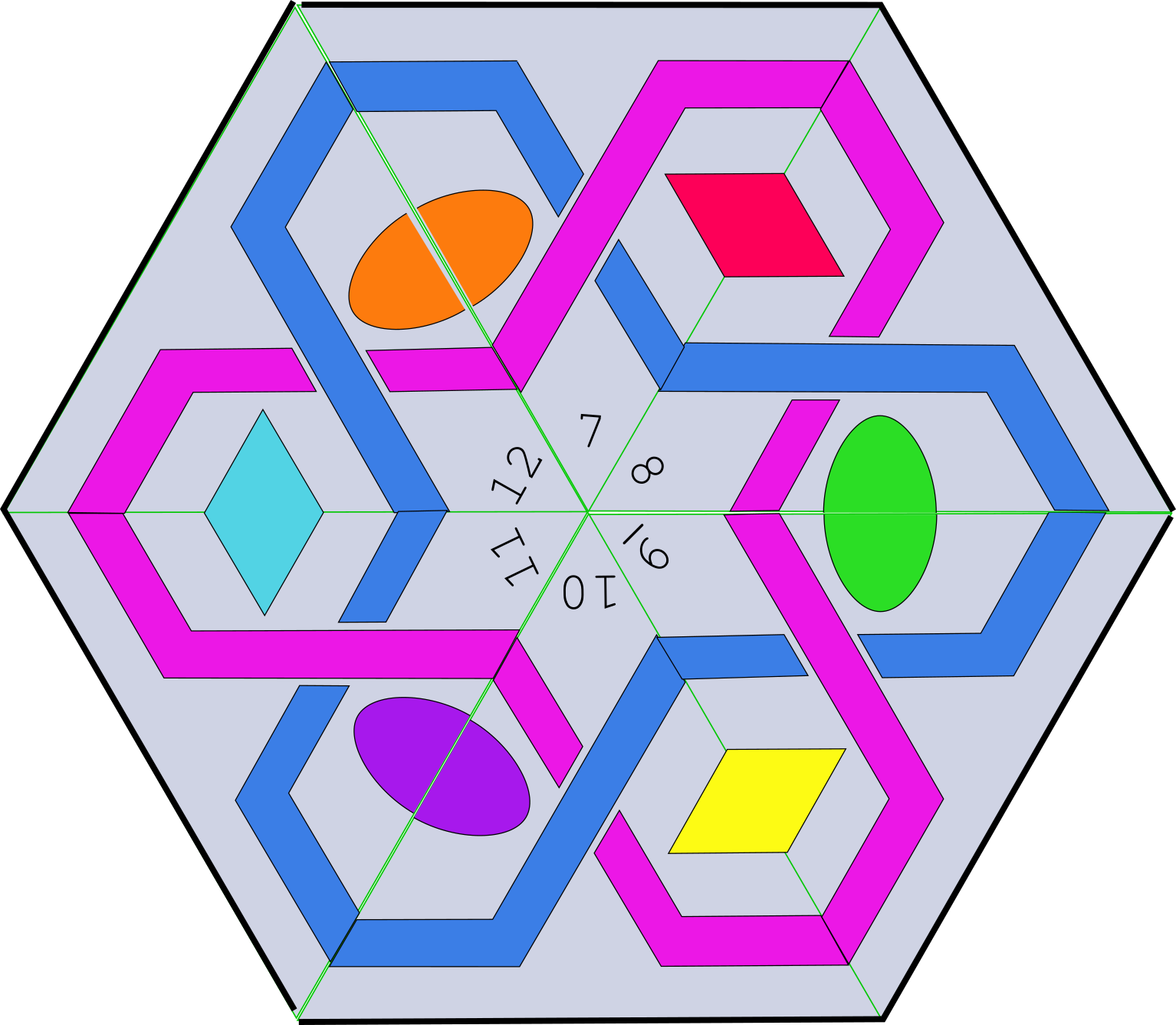
5. To complete the hexaflexagon tuck triangle #18 behind triangle #1 and add a small piece of sellotape over the outer edge (this lets the hexaflexagon fold without becoming undone). Below is what both visible sides look like. Your task is to find the two forms of the third side which is currently hidden.
D. Flexing instructions
On each of the sides you can pinch some, but not all, of the triangles together then fold them to reveal the third side.
The folding points on side one (the pink side) are at 1&6 or 2&3 or 4&5. If you pinch and fold here you’ll reveal Side Three as a series of concentric circles (but turn back over and see what side one looks like now). To reset pinch one of the side one folding points and fold and you’ll be back to seeing Sides One and Two again.
The folding points on side two (the grey side) are at 8&9 or 10&11 or 12&7. Holding side 2 in front of you pinch and fold at any one of these points and you’ll see Side 3 emerge ‘upside down’ with the numbers pointing outwards. Side 2 will also look ‘reversed’. To reset pinch and fold one of the folding points on Side 2 and you’ll be back to seeing Sides One and Two again.
You can keep folding forever if you keep pinching and folding at one of the folding points. It’s an infinite loop!
Here are the two views of Side 3 (but remember that Sides 1 and 2 reverse like this too).

E. Next steps
Are you brave enough to tackle a hexahexaflexagon which has two visible sides and four hidden sides? Visit Computational Thinking: HexaHexaFlexagon Automata for more, if you dare. Assembly and folding instructions are quite similar to above and there is a map (‘graph’) showing how you can navigate from one side to the others without getting lost among the folds.

This blog is supported through EPSRC grant EP/W033615/1.
 Teaching London Computing: A RESOURCE HUB from CAS LONDON & CS4FN