
Full list of Royal Institution Holiday Workshops (in various topics, not just computing, electronics or robotics).
Support to attend holiday workshops
The Potential Trust may be able to offer financial assistance to enable children to participate in Ri events and activities if this would otherwise be financially difficult. Please contact Anna Comino-James preferably via telephone on +44 (0)1844 351666, or at their new email address potentialtrust@gmail.com. Once a bursary is agreed, you will make your workshop bookings directly with the Ri.
- 1. The magic of computer science: Monday 7th April
- 2. Artificial Intelligence, but where is the intelligence? Tuesday 8th April
- 3. Coding with LEGO WeDo: Tuesday 8th April
- 4. Electronic and Electrical Control: Wednesday 9 April 2025
- 5. LEGO robotic explorers: Wednesday 9th April
- 6. Card tricks and computing: Thursday 10th April
1. The magic of computer science: Monday 7th April

• Holiday workshops (7 April): 🎩 The magic of computer science (ages 7–8)
11am to 1.15pm, £40 (£32) – in person – this morning workshop is strictly for ages 7-8 only.
• Holiday workshops (7 April): 🎩 The magic of computer science (ages 9–11)
2.15 to 4.30pm, £40 (£32) – in person – this afternoon workshop is strictly for ages 9-11 only.
About the workshop
In this workshop, Paul Curzon will demonstrate real magic tricks, showing the group how they are done so they can do the tricks themselves.
When you learn to be a magician, it turns out you are also learning the skills needed to be a great computer scientist: computational thinking.
Students will then use the magic to learn the linked basics of computer science. They’ll see what computational thinking is all about and how both magicians and computer scientists rely on it.
About Paul Curzon
Paul Curzon is a Professor of Computer Science at Queen Mary University of London and a National Teaching Fellow. He runs Computer Science for Fun a magazine about the fun side of computing, and has been giving linked Computing Magic Shows for 10 years.
Paul also runs Teaching London Computing creating inspiring activities for teachers to use in class.
2. Artificial Intelligence, but where is the intelligence? Tuesday 8th April
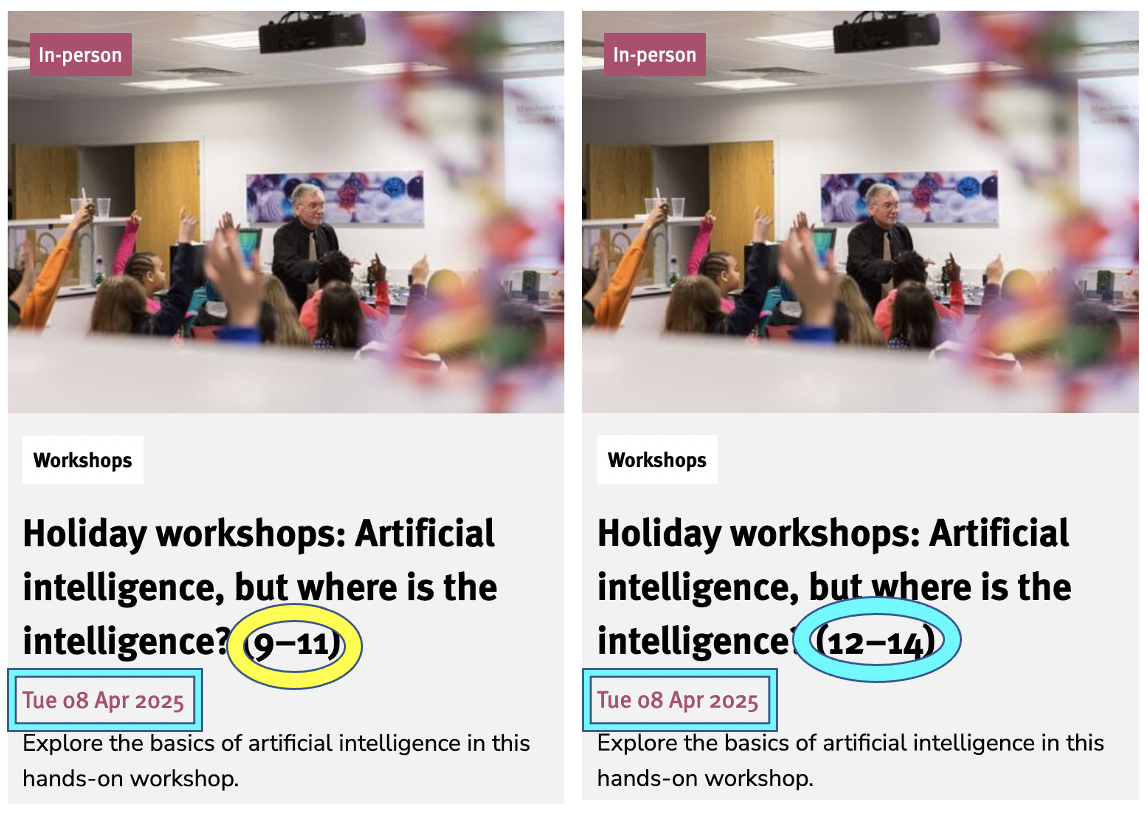
• Holiday workshops (8 April): ✨ Artificial intelligence, but where is the intelligence? (9–11)
11am to 1.15pm, £40 (£32) – in person – this morning workshop is strictly for ages 9-11 only
• Holiday workshops (8 April): ✨ Artificial intelligence, but where is the intelligence? (12-14)
2.15 to 4.30pm, £40 (£32) – in person – this afternoon workshop is strictly for ages 12-14 only
About the workshop
We all know the movie plots where evil robots and computers take over the world, but what is the reality? This workshop explores artificial intelligence, the field of science that tries to build ‘thinking machines’.
How are they built? Are they really intelligent? And what is intelligence anyway? We will also ask some interesting questions about a well-known ‘thinking machine’, you! Along the way we will play some games including building a working brain out of rope, tubes, and you, and playing snap with it.
3. Coding with LEGO WeDo: Tuesday 8th April
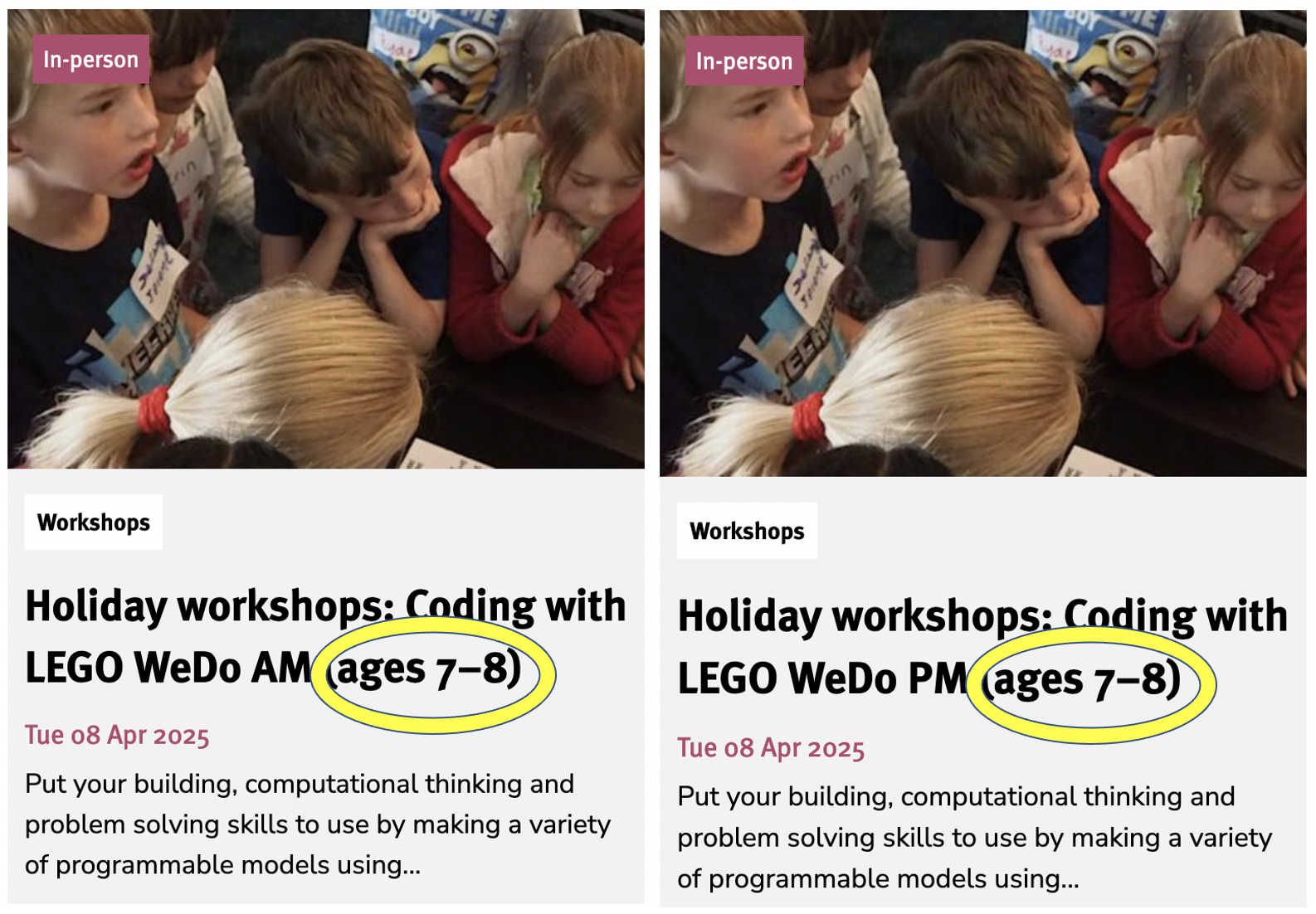
• Holiday workshops (8 April): Coding with LEGO WeDo AM (ages 7–8)
11am to 1.15pm, £40 (£32) – in person – this morning workshop is trictly for ages 7–8 only
• Holiday workshops (8 April): Coding with LEGO WeDo PM (ages 7–8)
2.15 to 4.30pm, £40 (£32) – in person – this afternoon workshop is also strictly for ages 7–8 only
Note that both the morning and afternoon sessions are aimed at the same 7-8 year old age-group.
About the workshop
In this session with Brian Egles, you will work in pairs to build a variety of models using motors and sensors based on the LEGO WeDo kit. Models include wild animals, amazing mechanisms, adventure stories and football themes. You will code your LEGO models and see them come to life and respond to the world around them.
4. Electronic and Electrical Control: Wednesday 9 April 2025
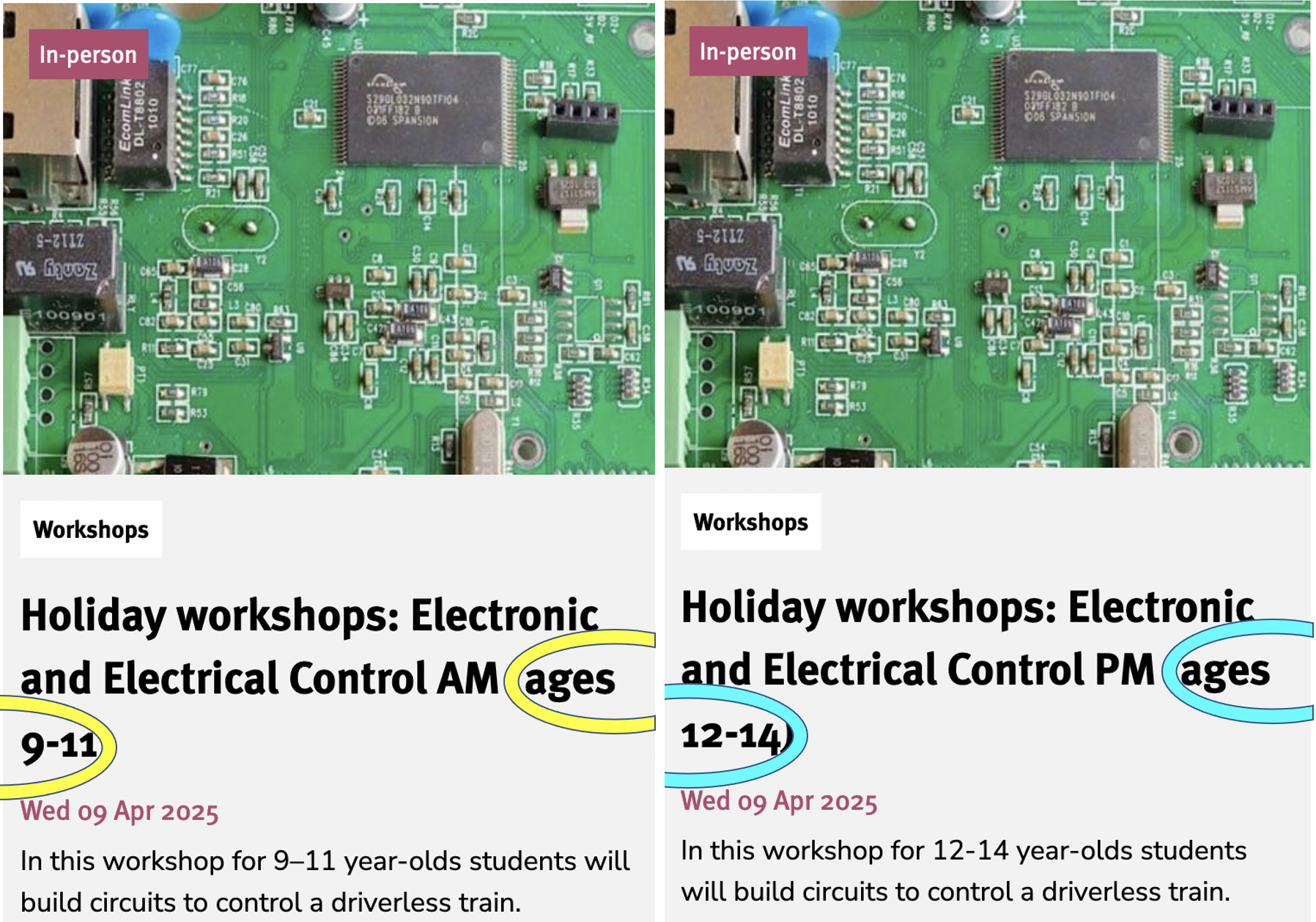
• Holiday workshops (9 April): ⚡️Electronic and Electrical Control AM (ages 9-11)
11am to 1.15pm, £40 (£32) – in person – this morning workshop is strictly for ages 9-11 only.
• Holiday workshops (9 April): ⚡️Electronic and Electrical Control PM (ages 12-14)
2.15pm to 4.30pm, £40 (£32) – in person – this morning workshop is strictly for ages 12-14 only.
With Jeremy King.
About the workshop
Participants will be working as Electronic and Electrical Engineers with some Mechanical Engineering aspects. They will design and build an increasingly complex electrical and electronic control system. Working in pairs they start by making a pressure switch and use this to control a pre-made electrical buggy to perform four tasks. Using a slide switch there are then three more tasks of increasing complexity. After the last task the buggy should be traveling backwards and forwards between two fixed objects automatically.
Using an on-board computer there are a further four tasks where a programme is built up on the computer to control the buggy to start and stop at specific places. For the twelfth challenge three ‘stations’ are laid out, the buggy needs to be programmed to start at station A, stop at station B briefly, go on to C then return to B & A, all automatically. This activity is modelled on the driverless underground Tracked Transit at Heathrow that transports passengers from Terminal 5A, to 5B to 5C, stopping on its return.
Other switches and tasks are available to those who would like to solve additional challenges.
5. LEGO robotic explorers: Wednesday 9th April
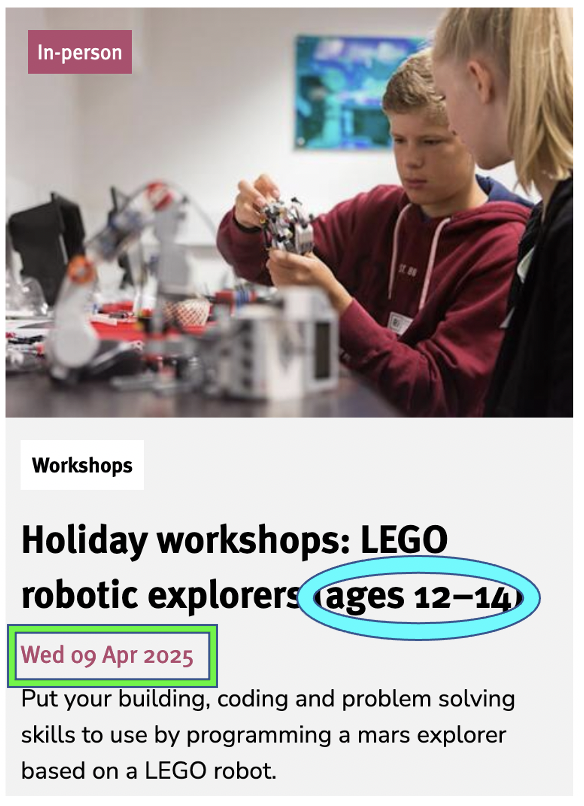
• Holiday workshops (9 April): 🤖 LEGO robotic explorers (ages 12–14)
11am to 3pm, £55 (£44) – in person – this morning workshop is trictly for ages 12–14 only
About the workshop
In this session with Brian Egles, you will work in pairs to program a small LEGO mars rover. You will first learn how your robot can be programmed to move around and to behave autonomously to avoid obstacles using sensors.
You will then solve a number of problems based on life on the international space station and on mars exploration. These are taken from the UK and international “First LEGO League” challenge run annually by the IET and other global partners.
This workshop is strictly for 12–14 year-olds and will include a 30 minute lunch break. Students should bring lunch and a drink.
6. Card tricks and computing: Thursday 10th April
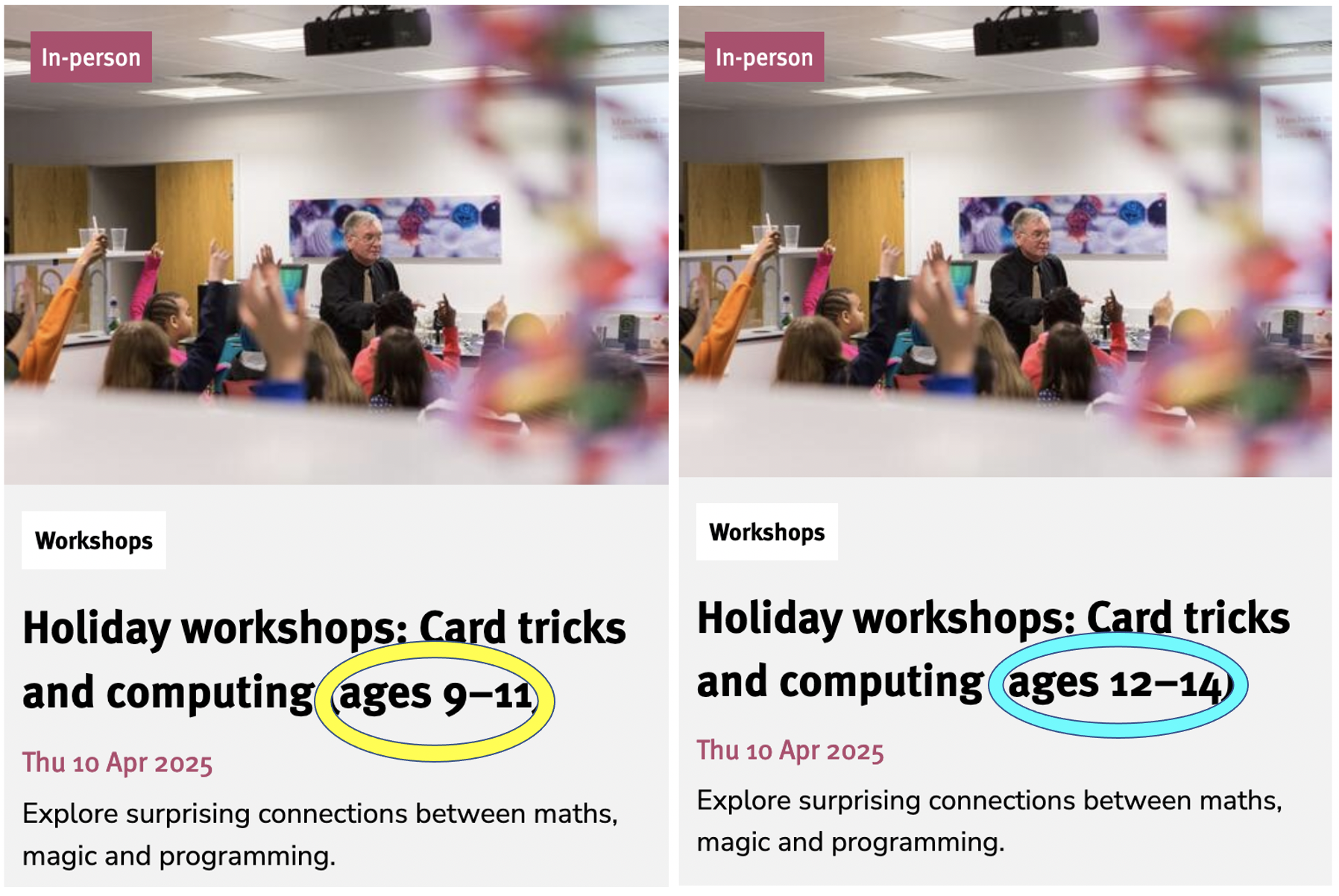
• Holiday workshops (10 April): Card tricks and computing (ages 9-11)
11am to 1.15pm, £40 (£32) – in person – this morning workshop is trictly for ages 9-11 only
• Holiday workshops (10 April): Card tricks and computing (ages 12-14)
2.15pm to 4.30pm, £40 (£32) – in person – this morning workshop is strictly for ages 12-14 only.
About the workshop
Join us for an exciting workshop with Barbara Pellegrino where math meets magic! In this hands-on session, you’ll dive into the fascinating world of binary and ternary number systems, all while learning card tricks that bring these concepts to life. Whether you’re a beginner or a maths enthusiast, this workshop will make abstract concepts like binary and ternary systems both fun and memorable!
Subscribe to be notified whenever we publish a new post to the Teaching London Computing blog.
This blog and post is funded by EPSRC on research agreement EP/W033615/1.













 Teaching London Computing: A RESOURCE HUB from CAS LONDON & CS4FN