Paul Curzon gave a keynote at the Keycit2014 conference in Potsdam today

Prof Paul Curzon of Teaching London Computing, cs4fn (Computer Science for Fun) and chi+med* gave the keynote talk at the IFIP KEYCIT (Key Competences in Informatics and ICT) conference earlier today in Potsdam, Germany.

His talk / workshop “Unplugged computational thinking for fun” covered some of the ideas we encourage teachers to use when introducing computational thinking into the classroom. Paul included the Locked In activity, Invisible Palming (magic, with a computer-human interaction angle) and the Create-a-face activity – all of which are free to download, easy to use and highlight that computational thinking isn’t just about computers but about people too.

They are also part of wider thematic workshops, more information below:

The talk was recorded and we’ll share the video when we have it. Meanwhile others have been kind enough to share short video snippets of the free workshops for teachers that Paul does, and here’s a photo from his talk today.


*chi+med means Computer-Human Interaction for Medical Devices and is a project looking at ways in which interactive medical devices can be made safer.

Coming up in July & August from Teaching London Computing: two free workshops, GCSE CPD course, A-level CPD course

What: “Teaching Computing Unplugged to Young Children”
Where: Goldsmiths, London
When: 8 July 2014
Audience: Primary school computing teachers
Find out more

What: Programming unplugged: learning programming without computers
Where: Cardinal Pole School, Hackney
When: 9 July 2014
Audience: GCSE Computing teachers
Find out more

What: Computing CPD GCSE Summer Holiday
Where: KCL (King’s College London, Waterloo Campus)
When: 4 – 8 August 2014
Audience: GCSE Computing teachers
Find out more

What: CPD A-level Computing (one week intensive)
Where: QMUL (Queen Mary University of London, Mile End Campus)
When: 18 – 22 August 2014
Audience: People teaching the A-level Computing curriculum
Find out more – more details will be posted here soon.

Paul Curzon’s workshop at #CASconf2014 (Computing At School conference)

A couple of people have shared YouTube videos and photos of Paul’s workshop at the Birmingham CAS conference this weekend – thank you very much, we’re glad you enjoyed it and here’s a collection of the tweets below.

All the free resources that Paul mentioned in his workshop can be downloaded from our section on Inspiring unplugged classroom resources.

Paul has a few free workshops coming up in London:


Round-up of Teaching London Computing’s free workshops, courses – and a CAS hub event

I’ve just emailed this to people who’ve signed up to receive info about our events and thought I’d post it here too.

We’re on Twitter @TeachingLDNComp.


Free workshops
25 June 2014, Hackney
Invisible Palming! Intelligent paper? So what is an algorithm?
4pm, Wednesday 25 June 2014
Cardinal Pole School, 205 Morning Ln, Hackney, London E9 6LG

8 July 2014, New Cross
Prof Paul Curzon will be giving a talk, “Teaching Computing Unplugged to Young Children” for primary school computing teachers on 8 July 2014 at a two-day workshop event at Goldsmiths in London. Please note that registration for this event is via Goldsmiths (given in link).

9 July 2014, Hackney
Programming Unplugged: Learning programming without computers
4pm, Wednesday 9 July 2014
Cardinal Pole School, 205 Morning Ln, Hackney, London E9 6LG

Courses
We have a new short CPD course for GCSE Computing teachers which will take place at KCL from 4-8 August (Mon-Fri) 2014. “Computing CPD GCSE Summer Holiday (1-week intensive)” costs £150 for London teachers (thanks to funding from the Mayor of London) and £300 for those outside London (if space is available).

Other events
Computing At School (CAS) – East London hub meeting, 8 July 2014, 4.30 to 6pm.
This event will take place in Islington at the City & Islington 6th Form College and is free to attend. As well as being a networking event for computing teachers the event will also plan ‘a practical using the Arduino Uno’ and discuss the new CAS document ‘Computing in the National Curriculum – A guide for secondary teachers‘.


Two new free computing workshops with Paul Curzon – 4pm, 25 Jun & 9 July in Hackney

We’re delighted to announce that Paul Curzon will be running another two free workshops for Computing teachers in London. These will take place in a school in Hackney on Wednesday 25 June (A) and Wednesday 9 July 2014 (B).

Workshop A – Invisible Palming! Intelligent paper? So what is an algorithm?
4pm, Wednesday 25 June 2014
Cardinal Pole School, 205 Morning Ln, Hackney, London E9 6LG

Workshop BProgramming Unplugged: Learning programming without computers
4pm, Wednesday 9 July 2014
Cardinal Pole School, 205 Morning Ln, Hackney, London E9 6LG
Eventbrite - FREE workshop with Teaching London Computing - programming unplugged for a free place.

Our other events and courses
FREE: Paul is also presenting a talk “Teaching Computing Unplugged to Young Children” for primary school computing teachers, on 8 July 2014 at a two-day workshop event at Goldsmiths in London. Please note that registration for this event is via Goldsmiths (given in link).

NOT FREE: We also have a new short course for GCSE Computing teachers which will take place at KCL from 4-8 August (Mon-Fri) 2014. “Computing CPD GCSE Summer Holiday (1-week intensive)” costs £150 for London teachers and £300 for those outside London (if space is available)


Free computing workshop, Goldsmiths 8-9 July, for KS2 & Y7 teachers, w Paul Curzon

How to use Scratch and unplugged activities to teach programming concepts


Screen Shot 2014-06-16 at 13.11.05
The text below is taken from the accompanying PDF flyer:  8-9July ScratchWorkshopNew

The National Curriculum for Computing involves a large amount of new content, namely programming that will be particularly challenging for KS2 –KS4 teachers. It is acknowledged that teachers will need support to acquire the necessary subject knowledge and skills to deliver this discipline.

This workshop aims to equip you with a good understanding of programming concepts and computational thinking, offering practical ways to teach the related KS2 programmes of study. It is suitable for teachers new to Scratch.

The workshop is part of the ‘Programming 4 Teachers’ project, funded by the Mayor’s Office to trial a CPD model for teaching KS1-3 teachers computer programming concepts, knowledge and skills as well as the trial of teaching resources and pedagogy. Zali Collymore-Hussein is one of the lead trainers on the project.

The ‘Programming 4 Teachers’ resource pack will be available free to delegates attending the workshop.

Complete the attached booking form and email to: TEACHERSCENTRE@GOLD.AC.UK

PLEASE BRING YOUR OWN LAPTOP TO THE WORKSHOP with Scratch 2 installed.

The workshop will take place at Goldsmiths University of London, Education Building, New Cross, London SE14 6NW
Map details: http://www.gold.ac.uk/find-us/

Course Outline

8th July 2014

•  Teaching Computing Unplugged to Young Children – Professor Paul Curzon
Computational thinking is a fundamental skill set that students learn by studying computing. We will demonstrate a range of activities that show how core ideas and concepts can be introduced using fun unplugged activities, games and magic tricks. We will show that computing can be fun for everyone and that it doesn’t have to be taught at a computer. Supporting resources are available at www.teachinglondoncomputing.org.

Introducing programming fundamentals through interactive games made in Scratch – Zali Collymore-Hussein
Suitable for years 4-5. Create programs that implement algorithms to achieve given goals that contains loops, comparative operators, randomized values, variables and if selections. Makey Makey can be used to interact with a game to add a mix of fun and science.

9th July 2014

• Deepen understanding of programming concepts through interactive quizzes made in Scratch – Zali Collymore-Hussein
Suitable for years 5-6. Create programs using procedural abstraction, post tested loops, multiple variables, arithmetic operators and ‘if, else’ selections.

• Tackling Control Projects using Scratch and Raspberry Pi – Zali Collymore-Hussein

Paul Curzon’s biography
Paul Curzon is a Professor of Computer Science at Queen Mary University of London. He runs cs4fn / Computer Science for Fun (www.cs4fn.org) through which he has been enthusing school students about interdisciplinary computer science worldwide for over 10 years. He is also co-Director of ‘Teaching London Computing’ (www.teachinglondoncomputing.org) developing inspiring activities for computing teachers to use in class. He is a UK National Teaching Fellow in recognition of his excellence in teaching and outreach. He also leads research in the area of human computer interaction and verification focussing on making medical devices safer.

Screen Shot 2014-06-16 at 13.43.28


FREE workshops next week at QMUL, for GCSE Computing teachers

TLC robot fauxgo title and URL

Prof Paul Curzon will be delivering four FREE workshops during half-term next week at QMUL (Queen Mary University of London) on Monday . These are fun, inspiring ‘unplugged’-style sessions which look at some creative ways of getting students to think about computing and programming concepts, without relying on computers, and are aimed at GCSE Computing teachers who’ll be delivering the new Computing curriculum.

Each session is accompanied by lots of free classroom resources and activity sheets to download, and of course an opportunity to share ideas with other workshop attendees.

We’ve arranged things so that there’s an hour between the morning and afternoon sessions (to make it easier for those who’d like to attend two in a day) but you’re welcome to come to as many of the workshops as you like.

The workshops are

A. Computational thinking: Searching to Speak (Website) (Eventbrite tickets)
Tuesday 27 May, 11.30am to 1pm

B. Computational Thinking: it’s about people too (Website) (Eventbrite tickets)
Tuesday 27 May, 2pm-3.30pm

C. Invisible palming! Intelligent paper? So what is an algorithm? (Website) (Eventbrite tickets)
Wednesday 28 May, 11.30am to 1pm

D. Programming unplugged: learning programming without computers (Website) (Eventbrite tickets)
Wednesday 28 May, 2pm-3.30pm

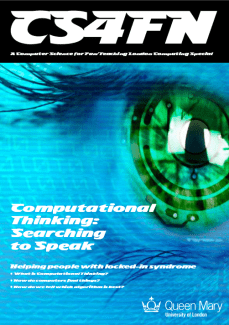
Cover of the Searching to Speak A5 booklet, click to open the PDF← Download a free copy of our latest booklet ‘Searching to Speak’ (which accompanies the first workshop in the series, on Tuesday morning) – click to open the PDF or right-click / save as to save a copy.


The admin bit:
All the workshops are free and will take place in Room 1.02 in the Law Building on Mile End Road. For those attending both morning and afternoon sessions (there’s an hour between the workshops) there are lunch options on campus (Mucci or Curve as well as snack shops) and plenty of food places on Mile End Road including a Sainsbury’s. You can attend as many workshops as you like.

Please contact me (Jo, j.brodie@qmul.ac.uk) if you have any queries.

Follow us on @TeachingLDNComp


New free workshop for Computing teachers – ‘Searching to Speak’ 22 May 2014, London

Cover of the Searching to Speak A5 booklet, click to open the PDF
Prof Paul Curzon will be running his FREE ‘Computational thinking: Searching to Speak‘ workshop for GCSE Computing teachers next Thursday afternoon at a school in London.

Eventbrite - Computational thinking: searching to speak - free workshop for teachers
When: Thursday 22 May 2014, 4pm-5.30pm
Where: Stormont House School, Downs Park Road, London, E5 8NP
Audience: GCSE Computing teachers
Cost: FREE

More info: Contact Jo Brodie (j.brodie@qmul.ac.uk) and see our workshop page for more details and downloadable resources.

Printed copies of the booklet, and other magazines from cs4fn (Computer Science For Fun) will be available for each delegate and you can sign up to receive free copies of our future magazines at the cs4fn website, and hear about our new courses and workshops.

Dates for your diary: Paul Curzon will also be delivering all four of his free workshops for GCSE Computing teachers on 27 and 28 May, at QMUL. More to follow…

Overview
One of the worst medical conditions I can imagine is locked-in syndrome. It leaves you totally paralyzed except perhaps for the blink of an eye. Your intelligent mind is locked inside a useless body, able to sense everything but unable to communicate. How could a computer scientist help? We will use this problem to illustrate a way to introduce computational thinking skills, as well as core computing topics such as search algorithms and how to compare them. More generally we will demonstrate how computational thinking ideas can be introduced in an integrated way using cs4fn ‘unplugged’ activities, games and magic tricks, getting students out of their seats and away from their computers.

Session material
This session will cover:

  • What is Computational Thinking?
  • Inspiring ways to teach Computational Thinking.
  • How do computers find things? Search algorithms.
  • How do we tell which algorithm is best? Efficiency Analysis.
  • An introduction to using magic tricks to teach computing concepts

Activities are suitable for all age groups and can be adapted to fit your teaching needs.


Free 1-day taster course for Y12 school students interested in electronics & computing, in June

Teachers of Y12 students might be interested in this free taster course on computer science and electronic engineering, to be held at Queen Mary University of London (QMUL). This is part of the University of London’s series of short taster courses for school students which QMUL participates in.

Please note that this is not a Teaching London Computing course.

IMG_0023[1]

Taster Course – Electronics and Computing for the Digital Age
Course Date: 26 Jun 2013
Duration: One day (10am – 4.15pm)
Cost: FREE, booking required

“This 1-day course will provide an excellent opportunity for students to experience some of the exciting things that our degrees in Electronic Engineering and/or Computer Science have to offer.

You will be shown just some of the choices that are open to you in terms of specialist skills you can learn and the outstanding career opportunities they afford. During the day you will get “hands-on” experience with various activities. You will also meet staff and some of our existing undergraduate students to get a feel for life with us.”

Subject area/s: Audio Systems Engineering, Computer Science, Electronic Engineering, Engineering (Audio Systems), Engineering (Electronic), Information and Communication Technologies, Information Technology (IT), Multimedia and Arts Technology, Technology, Telecommunications

Course Requirements: This taster course is open to year 12 students and anyone who is planning on starting their undergraduates studies in September 2014. Students should be studying either AS Maths or Physics (or equivalent).

Students can apply here, and will be asked to write 150 words on why they’re interested in studying computer science / electronic engineering.

Know someone aged 15-18 interested in 3D animation? FREE 3Dami summer school in July/Aug

For UK students aged 15-18 there’s an opportunity to participate in a week-long summer school learning about 3D animation techniques. 3Dami are the people behind the event, which will take place at UCL Engineering in London, and here’s their ‘blurb’:

“3Dami is a 7 day summer school where groups of students run their own studio and create their own animated short film from scratch. It operates at the intersection of art and technology (computer science), and is well suited to students with an interest in both. Students get to experience a semi-realistic studio setup, and create their film as a real studio would – it requires teamwork, thinking on their feet and hard work. The skills taught are directly related to the film effects and computer game industries, both of which are booming in the UK. There will be an industry visit and talks given by experts. The event is completely free for UK students aged 15-18 (includes free food!) and runs at UCL (London) from July 24th to August 1st. Please visit the website (3dami.org) to watch last year’s films and for further details, including how to apply.”

“3Dami London are looking for 24 students to make up 3 film studios.  Students are welcome to apply from all over the UK as long as they can sort out their own transportation and accommodation (hopefully there will be some bursaries available).”

You can also download the PDF poster to advertise in schools, click the picture below to open or right-click save as to save, and there’s a YouTube video below that.

The event will run Thursday 24th July – Friday 1st August (inclusive), most days start at 9am and finish at 5:00pm.  On the final Friday there will be a première of the films to parents, friends and other dignitaries at UCL, this event is likely to finish around 8:30pm.

More information from 3Dami London 2014.

3Dami pdf poster

Click to open / save PDF poster