Live in London? Have or care for children? Do they like magic, & free talks @QMUL abt computer science? Abracadabra!

Peter McOwan and Paul Curzon, both of QMUL and cs4fn fame, will be delivering the IET’s Christmas children’s lecture in The Great Hall of the People’s Palace at Queen Mary University of London on Wednesday 2 December. It’s completely free and doors will open at 5pm with the lecture starting at 5.30pm. There will be mince pies too.
magic of christmas computer science

FREE tickets for the ‘The Magic of Christmas Computer Science’, a magic show powered by hidden computer science, are available from Eventbrite and you can find out more information about the event and the speakers below. Please share this event flyer with others who might be interested.

About this event

Experience some amazing magic tricks and sneak behind the scenes to explore the maths and computing behind them.

Mathematics and computer science are behind today’s technological wizardry… Let Professors Peter McOwan & Paul Curzon, both scientists and magicians, be your guides to the secret world where science meets conjuring…

This special one-off Christmas event – co-hosted by the School of Electronic Engineering and Computer Science at Queen Mary, and The Institution of Engineering and Technology (IET) – will be a fun-filled evening full of surprises.

The evening is aimed at secondary school aged students, but with surprises to be unveiled for both adults and young people alike. All are welcome so if you have a curious mind, book your (free) tickets below quickly as places are vanishing fast!

About the Speakers

Professor Peter McOwan QMUL Vice-Principal (Public Engagement and Student Enterprise) and Professor Paul Curzon.

Peter McOwan and Paul Curzon are Professors of Computer Science in the School of Electronic Engineering and Computer Science at Queen Mary College University of london. As researchers and academics they apply their ‘magic’ to everything from robotics and artificial intelligence to the software of medical devices. Their infectious enthusiasm for exploring the endless possibilities of computer science has led them both to be elected as National Teaching Fellows. They work closely with the ‘Computing at Schools’ network, Peter was a founding member.  Paul also runs ‘Teaching London Computing’, which creates inspiring activities for teachers to use in class.

The speakers also run ‘Computer Science for Fun’, a magazine about the fun side of computing. They have been giving linked computing magic shows for over 10 years.
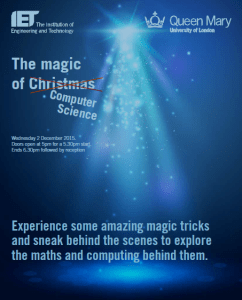
magic of christmas pdf front cover
Programme

17:00     Registration
17:15     Seating
17:30     Start of Lecture
18:30     Reception
19:15     Close

Reasons to attend

Bring your children, grandchildren, nephews or nieces to show them what a career in Science and Engineering has to offer.

Additional information

There will be a reception and mince pies and some light refreshments for everyone after the lecture. All are welcome.

Information above adapted from IET and QMUL pages advertising the event
Paul Curzon from @QMUL and @cs4fn has been making faces at #casneconf :)

Paul Curzon gave a talk at the Computing At School North East conference this morning and judging from the tweets (see below) it seems that people enjoyed themselves. Paul uses magic and audience participation to demonstrate fun and easy ways of introducing programming topics into the classroom and delivers a series of free workshops for London teachers.

(More tweets from the #casneconf below)

If you’re enjoying his talk and wondering about the resources then the links below should help. We’re posting out printed copies to our subscribers but anyone can download free PDFs of our booklets.

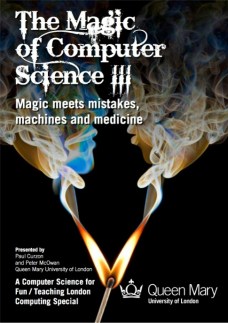
The Magic of Computer Science 3: magic meets mistakes, machines and medicine
magicbookcover3This book is published by cs4fn (Computer Science for Fun) in partnership with Teaching London Computing (TLC) and CHI+MED. TLC is funded by the Mayor of London and additional funding from the Department for Education has enabled us to send copies to schools of this booklet beyond London. It is also supported by Computing At School. Click on the picture for more information.

“The cs4fn magic books are collections of easy to do magic tricks (mainly simple card tricks). The twist is that every trick comes with a link to some computer science too. That means that as you learn the tricks, you will learn something about what computer scientists get up to too.

Magic is a combination of a secret method and a presentation. A computer scientist would call the method an algorithm, and that is all a computer program is too. The presentation corresponds to the interaction design of a program. For a magic trick to delight, you must get both the algorithm and presentation right. The same is true for programs”

Computational thinking: searching to speak
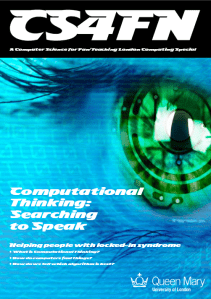
Searching to Speak A5 blueThis booklet was produced as part of the Teaching London Computing activities and has been used in one of our free workshops. It highlights how computational thinking can help people, for example in speeding up tasks, but also focuses on remembering when it’s appropriate to use technological solutions and when it isn’t.

Computational Thinking: Searching To Speak is a glossy booklet that shows computational thinking in action embedded in a story about helping people with disability, even without technology. It shows how the separate elements of computational thinking combine in interdisciplinary problem solving. Along the way it teaches some core search algorithms. It is written by Paul Curzon of Queen Mary University of London based on the cs4fn approach.”

Click on the picture to download a copy of the PDF, or read more about it and also see how it’s used in the workshop.

The Create-A-Face activity

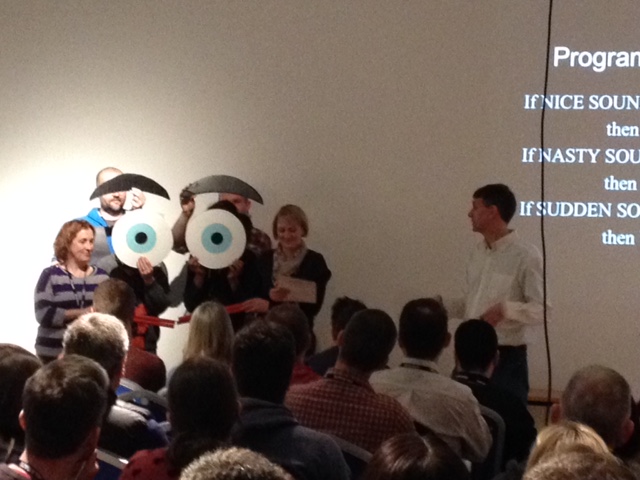
IMG_0942 - Paul Curzon at CASneconfIn the picture on the left (taken by Sue Sentance at the CAS NE Conference) Paul Curzon is instructing members of the audience to create a face whose expression can be programmed with simple instructions.

“Explore programming by making an affective (relating to moods and emotions) robot face out of card, tubes and students. Program it to react to different kinds of sounds (nasty, nice or sudden) and show different emotions (sad, happy, surprised). Then think up some other facial expressions and program rules to make the face respond to sounds with the new expressions.”

Download everything you need (apart from the cardboard tubes!) to recreate this in your classroom, from our Create-A-Face Activity page.


Tweets from the Computing At School North East Conference about Paul Curzon’s talk

The tweets above refer to the Searching to Speak booklet and the one below to the latest magic book. Most of the final tweets refer to the Create A Face activity.

Computer animation competition for schools – Animation15 has launched!

We thought our readers might like to know about this event. It’s not a Teaching London Computing event but our sister project, cs4fn, is involved.

—–

Animation15 – the 8th Annual UK Schools Computer Animation Competition run by the School of Computer
Science at The University of Manchester, has launched!

It’s open now, for teacher registration, at http://animation.cs.manchester.ac.uk

The competition is open to all UK schoolchildren aged 7-19.

Teacher registration is FREE and carries no obligation to submit any
entries. All registered teachers will receive FREE colour A2-sized
Animation15 posters for their school, to be sent out in early-October.

To get your free posters — while stocks last! — register at the
website or log in using your existing credentials.

Entrants can create their animations (maximum duration: 1 minute)
using any of the following programs: Scratch, Adobe Flash, Alice,
Serif: Draw Plus, KoolMoves, SWiSH Max4, and Blender.

They can also use 3DS Max, and Maya — free from Autodesk to all
Schools: see http://www.autodesk.co.uk/campaigns/design-the-future-uk/curriculum

There are great prizes for the winners, and trophies for
schools. Winners will be announced in early-Summer 2015.

Last year’s Animation14 competition was bigger than ever, with over
1,330 entries from 183 schools across the UK, from 1,768 students.

We awarded prizes to 41 students (working as individuals, or in groups)
from 24 schools. You can see all the winning entries, and photos from
our Awards and Inspirational Computer Science Day at
http://animation14.cs.manchester.ac.uk.

Key date
* 20 March 2015: Deadline for submitting entries.

Key contacts
* Website: http://animation.cs.manchester.ac.uk
* Enquiries: animation@cs.man.ac.uk

Animation15 is funded by Electronic Arts, Autodesk, Microsoft, RM
Education, and in association with cs4fn.


Paul Curzon gave a keynote at the Keycit2014 conference in Potsdam today

Prof Paul Curzon of Teaching London Computing, cs4fn (Computer Science for Fun) and chi+med* gave the keynote talk at the IFIP KEYCIT (Key Competences in Informatics and ICT) conference earlier today in Potsdam, Germany.

His talk / workshop “Unplugged computational thinking for fun” covered some of the ideas we encourage teachers to use when introducing computational thinking into the classroom. Paul included the Locked In activity, Invisible Palming (magic, with a computer-human interaction angle) and the Create-a-face activity – all of which are free to download, easy to use and highlight that computational thinking isn’t just about computers but about people too.

They are also part of wider thematic workshops, more information below:

The talk was recorded and we’ll share the video when we have it. Meanwhile others have been kind enough to share short video snippets of the free workshops for teachers that Paul does, and here’s a photo from his talk today.


*chi+med means Computer-Human Interaction for Medical Devices and is a project looking at ways in which interactive medical devices can be made safer.

CAS: 2014 Teacher Conference 21 June 2014 & Teaching Computing CPD Day on 20th, from @CompAtSch

The CAS (Computing At School) Teacher Conference will take place in Birmingham on Friday 20 and Saturday 21 June 2014. The conference itself takes place on the Saturday 21st with a day of teaching CPD happening on Friday 20th.

Tickets and information available from 2014 CAS – Conferences for Teachers of Computing.

2014 CAS – Conference for Teachers of Computing
Computing At School (CAS)
Saturday, June 21, 2014 from 9:00 AM to 5:00 PM (BST)
Birmingham, United Kingdom