OCR exam board apparently removes Controlled Assessments from GCSE Computing, via @tonyparkin

Updated 1 July 2014 2.30pm – the OCR has agreed to let students continue with their controlled assessments. More information available at http://www.ocr.org.uk/i-want-to/subject-information-updates/# (look for July 2014 » + GCSE Computing (from 2012) – UPDATE)

—–

Updated 30 June 2014 1.30pm – the OCR will contact centres tomorrow to give their final decision.


— Original post below —

A few excerpts from the post OCR assessment shock hits GCSE Computing students are included below; there is a lot of Twitter discussion on the #withdrawnCA hashtag.

“In a major blow to thousands of students taking the OCR’s Computing GCSE, the exam board has withdrawn the controlled assessment task for June 2015 that many of them have already completed – and in some cases have already submitted.”

“In a surprise twist just after 9am this morning (Monday June 30), the notification letter was suddenly taken down from the OCR website, without any explanation. Whether this marks a shift in thinking at OCR, or merely means that the letter was posted too early online, as indicated by its curious July dateline, will no doubt emerge shortly.”

“As news of the letter reached the teachers involved, a storm broke online as they took to social media and web forums to discuss their reactions over the weekend. Prominent among them was Drew Buddie, well-known as @digitalmaverick on Twitter, who has started the #withdrawnCA hashtag to bring together the online discussion, and offer support from NAACE. Drew is currently Naace senior vice chair on its board of management.”

Further reading
Computing assessment scrapped amid fears of cheating (30 June 2014) tesconnect.


Round-up of Teaching London Computing’s free workshops, courses – and a CAS hub event

I’ve just emailed this to people who’ve signed up to receive info about our events and thought I’d post it here too.

We’re on Twitter @TeachingLDNComp.


Free workshops
25 June 2014, Hackney
Invisible Palming! Intelligent paper? So what is an algorithm?
4pm, Wednesday 25 June 2014
Cardinal Pole School, 205 Morning Ln, Hackney, London E9 6LG

8 July 2014, New Cross
Prof Paul Curzon will be giving a talk, “Teaching Computing Unplugged to Young Children” for primary school computing teachers on 8 July 2014 at a two-day workshop event at Goldsmiths in London. Please note that registration for this event is via Goldsmiths (given in link).

9 July 2014, Hackney
Programming Unplugged: Learning programming without computers
4pm, Wednesday 9 July 2014
Cardinal Pole School, 205 Morning Ln, Hackney, London E9 6LG

Courses
We have a new short CPD course for GCSE Computing teachers which will take place at KCL from 4-8 August (Mon-Fri) 2014. “Computing CPD GCSE Summer Holiday (1-week intensive)” costs £150 for London teachers (thanks to funding from the Mayor of London) and £300 for those outside London (if space is available).

Other events
Computing At School (CAS) – East London hub meeting, 8 July 2014, 4.30 to 6pm.
This event will take place in Islington at the City & Islington 6th Form College and is free to attend. As well as being a networking event for computing teachers the event will also plan ‘a practical using the Arduino Uno’ and discuss the new CAS document ‘Computing in the National Curriculum – A guide for secondary teachers‘.


*New course* Computing CPD GCSE Summer Holiday (1-week intensive)

Teaching London Computing will be hosting a week-long intensive CPD course in GCSE Computing at its KCL site in the week beginning 4th August 2014.

You will need to book directly through King’s website (look for the ‘Apply’ tab).
https://www.kcl.ac.uk/prospectus/shortcourses/index/name/tlc-gcse-summer-holiday/

Computing CPD GCSE Summer Holiday

4 August 2014 to 8 August 2014
One week: 5 days full time
10am – 4pm for 5 days

Location
King’s College London, Waterloo Campus

This course has been developed in collaboration with the Computer Science Department at Queen Mary University of London

Academic Lead
Margaret Derrington (KCL)

Tutors
William Marsh (QMUL)
Tricia Lockhart (KCL)

Entry requirements
Qualified Teacher Status in ICT or experience of teaching ICT in a secondary school. It will help to have some experience of a ‘drag and drop’ programming language such as Scratch and perhaps turtle drawing programs like LOGO. Teachers who have absolutely no experience of programming and prefer a slower start may prefer to do the Primary to KS3 course which looks at ‘drag and drop’ programming in Scratch and LOGO rather than Python and ‘unplugged’ activities for understanding how computers work.

The course is aimed at experienced ICT teachers who would like to develop their subject knowledge in order to teach the new Compting Curriculum and the new Computing GCSEs.

Course overview
The aim of this course is to prepare ICT teachers for the new Computing Curriculum and to give them the subject knowledge to teach Computing/Computer Science up to GCSE level and to give them the confidence to set up Computer Science courses in their schools. The programming language used is Python3 and we assume that participants will be ICT teachers and that they will have at least tried out Scratch. Python 3 and Scratch are free downloads.

How is the course taught?
Online materials in KEATS include recorded lectures, forums and online tests. Face to face workshops will focus on practical programming work. To get the best out of the course, participants should expect to do additional study using the VLE and continue to practice programming between classes. It will help to have some knowledge of a ‘drag and drop’ programming language such as Scratch.

What will I get out of it?
The intended outcomes are that students will learn and understand the subject knowledge to begin teaching computing and programming at KS3 and KS4 ie from Year 7 up to GCSE

Fees & other information
This course is partly funded through the Teaching London Computing project run by Queen Mary University of London in collaboration with King’s College London.

A number of teachers in London schools will benefit by receiving a 50% discount on the cost of the course through funding received by the Teaching London Computing (TLC) project from the London Schools Excellence Fund.

So for London Teachers the course costs £150
and for teachers from outside London £300.


Free computing workshop, Goldsmiths 8-9 July, for KS2 & Y7 teachers, w Paul Curzon

How to use Scratch and unplugged activities to teach programming concepts


Screen Shot 2014-06-16 at 13.11.05
The text below is taken from the accompanying PDF flyer:  8-9July ScratchWorkshopNew

The National Curriculum for Computing involves a large amount of new content, namely programming that will be particularly challenging for KS2 –KS4 teachers. It is acknowledged that teachers will need support to acquire the necessary subject knowledge and skills to deliver this discipline.

This workshop aims to equip you with a good understanding of programming concepts and computational thinking, offering practical ways to teach the related KS2 programmes of study. It is suitable for teachers new to Scratch.

The workshop is part of the ‘Programming 4 Teachers’ project, funded by the Mayor’s Office to trial a CPD model for teaching KS1-3 teachers computer programming concepts, knowledge and skills as well as the trial of teaching resources and pedagogy. Zali Collymore-Hussein is one of the lead trainers on the project.

The ‘Programming 4 Teachers’ resource pack will be available free to delegates attending the workshop.

Complete the attached booking form and email to: TEACHERSCENTRE@GOLD.AC.UK

PLEASE BRING YOUR OWN LAPTOP TO THE WORKSHOP with Scratch 2 installed.

The workshop will take place at Goldsmiths University of London, Education Building, New Cross, London SE14 6NW
Map details: http://www.gold.ac.uk/find-us/

Course Outline

8th July 2014

•  Teaching Computing Unplugged to Young Children – Professor Paul Curzon
Computational thinking is a fundamental skill set that students learn by studying computing. We will demonstrate a range of activities that show how core ideas and concepts can be introduced using fun unplugged activities, games and magic tricks. We will show that computing can be fun for everyone and that it doesn’t have to be taught at a computer. Supporting resources are available at www.teachinglondoncomputing.org.

Introducing programming fundamentals through interactive games made in Scratch – Zali Collymore-Hussein
Suitable for years 4-5. Create programs that implement algorithms to achieve given goals that contains loops, comparative operators, randomized values, variables and if selections. Makey Makey can be used to interact with a game to add a mix of fun and science.

9th July 2014

• Deepen understanding of programming concepts through interactive quizzes made in Scratch – Zali Collymore-Hussein
Suitable for years 5-6. Create programs using procedural abstraction, post tested loops, multiple variables, arithmetic operators and ‘if, else’ selections.

• Tackling Control Projects using Scratch and Raspberry Pi – Zali Collymore-Hussein

Paul Curzon’s biography
Paul Curzon is a Professor of Computer Science at Queen Mary University of London. He runs cs4fn / Computer Science for Fun (www.cs4fn.org) through which he has been enthusing school students about interdisciplinary computer science worldwide for over 10 years. He is also co-Director of ‘Teaching London Computing’ (www.teachinglondoncomputing.org) developing inspiring activities for computing teachers to use in class. He is a UK National Teaching Fellow in recognition of his excellence in teaching and outreach. He also leads research in the area of human computer interaction and verification focussing on making medical devices safer.

Screen Shot 2014-06-16 at 13.43.28


For primary school computing teachers: Barefoot Computing website now live & competition

From the Computing At School website’s news page:

Barefoot Computing CAS


“The Barefoot Computing project is about helping primary school teachers get ready for the computer science element of the new computing curriculum.”

 
The website is now live at http://barefootcas.org.uk/ and they’re running a competition “for primary school pupils to design a mascot for the Barefoot Computing Project. There are iPads to be won! The closing date is 23rd June and more information can be found here. ”


Calling UK teachers – free copies of cs4fn issue on computer science and medical devices

Free magazine for UK schools from cs4fn, about computer science, medical devices and patient safety.

cs4fn (Computer Science For Fun, based at Queen Mary University of London, QMUL) has been providing school students and teachers with inspiring resources, including magazines, magic books, puzzles and schools talks, about computer science for almost ten years.

Teaching London Computing is a spin-off project from cs4fn to explicitly support teachers. It is run jointly by QMUL and colleagues at King’s College London and provides courses and classroom resources for teachers who’ll be delivering the new KS3, GCSE and A-level Computing curricula. Primary school teachers are also finding many of the resources useful.

There’s also a bit of overlap with a third project, CHI+MED, which is adding a human dimension to cs4fn and TLC. It is funded by one of the UK’s research councils (EPSRC) to investigate how interactive medical devices could be made safer. That project runs over four universities (UCL, QMUL, Swansea University and City University) and the main investigator at QMUL, Prof Paul Curzon, is also one of the people behind cs4fn.

CHI+MED (computer-human interaction for medical devices) takes a very broad view of medical devices – how they’re designed, how they’re approved for use on the market, how people in hospitals decide which one(s) to buy and how they’re actually used in the real world by busy healthcare professionals. Computing is an important aspect of medical device design (software performs calculations and determines how the machine responds to keypresses when a nurse enters a drug dose) but it’s not the only one. It’s important to look at the people involved (the ‘human’ bit of ‘human-computer interaction) at every stage of device development and use too, for example when trying to reduce the harm that can arise when someone makes a slip in mistyping a drug dose.

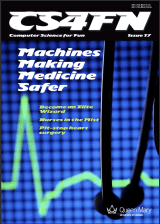
Magazine cover for cs4fn's special issue on medical devices and patient safetyIssue 17 of the cs4fn magazine series is about the research that people on the CHI+MED project are doing along with related work of other groups. It provides a good overview of some of the issues that researchers are thinking about when looking at patient safety in medical devices. It also shows how computer scientists and researchers work with other types of scientists (ergonomists, human-factors experts) in trying to understand and solve a real-world problem.

Sign up for free copies of the magazine
cs4fn already sends copies of the magazines to schools who subscribe. If you are a teacher or school librarian who would like to receive one or more copies (up to a class set of 30*) of this, and future magazines, please fill in your school’s address details (UK addresses only please) on this form and we’ll do the rest (while stocks last). The magazine is free due to support from EPSRC and Google.

*If you need a larger number of copies, eg for an event, please get in touch (cs4fn@eecs.qmul.ac.uk) and we’ll do our best to get more to you.

[This post cross-posted to both Teaching London Computing and CHI+MED blogs]


[New] *10 week course* Computing CPD GCSE – 7 May 2014 at KCL

Teaching London Computing runs several courses throughout the year, at different London locations, for computing teachers in London.

This is a ten week course beginning on Wednesday 7 May 2014 and you can also see details of all our other CPD courses.

Computing CPD (GCSE) Summer – ten weeks (KCL), 7 May 2014

Eventbrite - Teaching London Computing - Programming & more: CPD for GCSE computing

Course overview
The aim of this course is to prepare ICT teachers for the new Computing Curriculum and to give them the subject knowledge to teach Computing/Computer Science up to GCSE level and to give them the confidence to set up Computer Science courses in their schools. The programming language used is Python3 and we assume that participants will be ICT teachers and that they will have at least tried out Scratch.

More information on what’s taught on the courses can be found at our GCSE computing page.

Key facts
Course start date: Wednesday 7 May 2014 (ends on Wednesday 16 July 2014 with a half-term break on 28 May)
Course duration: Ten Wednesday evenings
Times: 5.00pm-8.00pm
Tutors: William Marsh and Margaret Derrington
Course code: Computing CPD (GCSE) Summer 10w

Entry requirements
Qualified Teacher Status in ICT or experience of teaching ICT in a secondary school. It will help to have some experience of a ‘drag and drop’ programming language such as Scratch and perhaps turtle drawing programs like LOGO.

Fees and other information
Cost of Course £300.
Less Discount   £150 (for London Teachers) – please see our information on Fees and Funding.

Eventbrite - Teaching London Computing - Programming & more: CPD for GCSE computing

*Short course* Computing CPD GCSE one week Easter 2014 (7-11 April) at KCL

Teaching London Computing runs several courses throughout the year, at different London locations, for computing teachers in London. Our next one will take place at King’s College London (Waterloo Campus) and is an intensive 5-day course running from Monday 7th to Friday 11th April 2014. You can register and pay for tickets at KCL’s website directly.

Computing CPD GCSE one week Easter 2014
(info below taken mostly from the ‘Overview’ tab, but see the other tabs on that site for full information)

Course overview
The aim of this course is to prepare ICT teachers for the new Computing Curriculum and to give them the subject knowledge to teach Computing/Computer Science up to GCSE level and to give them the confidence to set up Computer Science courses in their schools. The programming language used is Python3 and we assume that participants will be ICT teachers and that they will have at least tried out Scratch.

Key facts
Course start date: 7 April 2014, Monday to Friday 11 April 2014
Course duration: Five days full time
Times: 10:00am-16:00pm

Entry requirements
Qualified Teacher Status in ICT or experience of teaching ICT in a secondary school. It will help to have some experience of a ‘drag and drop’ programming language such as Scratch and perhaps turtle drawing programs like LOGO. Teachers who have absolutely no experience of programming and prefer a slower start may prefer to do the Primary to KS3 course which looks at ‘drag and drop’ programming in Scratch and LOGO rather than Python and ‘unplugged’ activities for understanding how computers work.

Academic Lead: Margaret Derrington

Fees and other information
This course is partly funded through the Teaching London Computing project run by Queen Mary University of London in collaboration with King’s College London.
A number of teachers in London schools will benefit by receiving a 50% discount on the cost of the course through funding received by the TLC project from the London Schools Excellence Fund.
Cost of Course £300.
Less Discount   £150   (for London Teachers)

The full price of £300 must be paid by students who are not ‘London Teachers’ covered by the LSEF funding, ie who do not live in London and do not work at schools in London LEAs.


From BBC News – ‘Master’ computing teachers recruited to train others

From BBC News, 22 January 2014
“A network of 400 “master” computer science teachers is being recruited to deliver a new computer science curriculum in schools across England.

These specialist teachers will train teachers in other schools and provide resources for teachers to use in class.

Funded by government, the scheme is run by the British Computer Society.”

This was announced at BETT 2014 and the full story can be read here http://www.bbc.co.uk/news/education-25842199