How to enjoy a career in computing: the power of networks – 22 May, free, 5.15pm via @bcsacademy

Professor Dame Wendy Hall FRS FREng will present the 4th Karen Spärck Jones Lecture (an annual event that honours women in computing research).

A Digital Library by Eric Hackathorn

The influence of her work has been significant in many areas including digital libraries, the development of the Semantic Web, and the emerging research discipline of Web Science”

“In 1987, I co-authored a paper on the lack of women in computer science called “Where have all the girls gone?”. Twenty-seven years later things have changed depressingly little despite much effort across many different projects and initiatives. During that time however, I have (mostly) enjoyed a wonderful career in computing. In this talk I will reflect on how the power of networks has affected my career both in terms of the work I do and in terms of surviving, indeed thriving, in what is still very much a man’s world. I will also reflect on the current state of affairs with regards to women in computer science and in the wider STEM community. What lessons have we learnt and what hope is there for the future? As Karen Spärck Jones famously said – computing is too important to be left to men. But it is only by working together that we will change the gender balance in our industry. It’s time for men to make sacrifices as well.”

Karen Spärck Jones Lecture 2014 – Dame Wendy Hall
5:15 PM to 9:00 PM
BCS, The Chartered Institute for IT, First Floor, The Davidson Building, 5 Southampton Street, London , WC2E 7HA
Organiser: BCS Academy of Computing
Price: Free to attend
Book a free ticket.

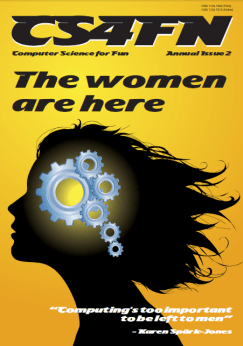
Our sister site, cs4fn (Computer Science For Fun) has a magazine called ‘The women are here‘ all about women in computing.

cs4fn's magazine celebrating women's contribution to computing


From around the web: #Eastbourne teachers: Introduction to Creative Computing Fri 9 May 1-4pm £30

From Connective Culture: Tech Resort & Towner Gallery via @aidandelaney

Eastbourne Pier

Friday 9 May 2014, 1pm – 4pm, £30, Towner Gallery, Eastbourne.

Introduction to Creative Computing
If you’re an Eastbourne based teacher, we want you to attend a half-day computing training to achieve two goals:
1. develop your technical skills in programming, and
2. give you some insight into the requirements in the new computer science curriculum.
We will provide a half-day supply cover and computing subject knowledge training for a small commitment fee of £30.

This is a joint project between the ArtsWork funded Creative Computing project, Eastbourne’s own TechResort and the Computing School at the University of Brighton.

We’re delivering training on the 9th of May at the Towner Gallery in Eastbourne on developing web and mobile applications using the JavaScript programming language. This will introduce the basics of JavaScript and creative problem solving.”

More information, and tickets: Introduction to Creative Computing

Please note: this is not a Teaching London Computing event, we just like sharing what other people are up to :)

[New] *10 week course* Computing CPD GCSE – 7 May 2014 at KCL

Teaching London Computing runs several courses throughout the year, at different London locations, for computing teachers in London.

This is a ten week course beginning on Wednesday 7 May 2014 and you can also see details of all our other CPD courses.

Computing CPD (GCSE) Summer – ten weeks (KCL), 7 May 2014

Eventbrite - Teaching London Computing - Programming & more: CPD for GCSE computing

Course overview
The aim of this course is to prepare ICT teachers for the new Computing Curriculum and to give them the subject knowledge to teach Computing/Computer Science up to GCSE level and to give them the confidence to set up Computer Science courses in their schools. The programming language used is Python3 and we assume that participants will be ICT teachers and that they will have at least tried out Scratch.

More information on what’s taught on the courses can be found at our GCSE computing page.

Key facts
Course start date: Wednesday 7 May 2014 (ends on Wednesday 16 July 2014 with a half-term break on 28 May)
Course duration: Ten Wednesday evenings
Times: 5.00pm-8.00pm
Tutors: William Marsh and Margaret Derrington
Course code: Computing CPD (GCSE) Summer 10w

Entry requirements
Qualified Teacher Status in ICT or experience of teaching ICT in a secondary school. It will help to have some experience of a ‘drag and drop’ programming language such as Scratch and perhaps turtle drawing programs like LOGO.

Fees and other information
Cost of Course £300.
Less Discount   £150 (for London Teachers) – please see our information on Fees and Funding.

Eventbrite - Teaching London Computing - Programming & more: CPD for GCSE computing

What do we get up to in our free programming workshops for computing teachers? Pics from @GTaylorSTEM

Paul Curzon from Queen Mary University of London has been running a series of free Monday evening workshops for computing teachers, on introducing programming concepts into the classroom in fun and creative ways. The next workshop (the last in this series, but they’ll be repeated) is on Monday 17 March at 5.30, more details and free tickets available from Computational Thinking: it’s about people too

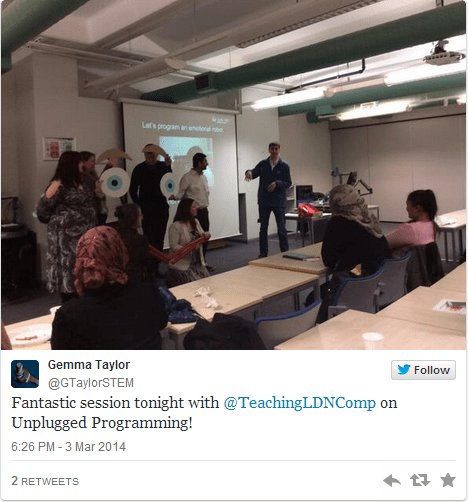
Gemma Taylor was kind enough to share a couple of pictures she took from the most recent workshop (Programming unplugged: learning programming without computers) on Monday 3 March, and she’s given us permission to share them here – thanks Gemma!

TLC audience pic01

Naturally you might be wondering what on earth is going on above – Paul has corralled audience volunteers into forming an ’emotional robot’ which can be programmed to react to certain sounds. You can find out the instructions for making your own in our PDF Create-a-face: programming an emotional robot which comes from our workshop page on Programming unplugged: learning programming without computers – an excerpt is below.

SUMMARY
The class make an affective (relating to moods and emotions) robot face out of card, tubes and themselves. It is programmed to react to different kinds of sounds (nasty, nice or sudden) and show different emotions (sad, happy, surprised). The class then think up some other facial expressions and program sets of rules to make the face respond to sounds with the new expressions.

AIMS
The aim of this activity is to demonstrate how apparently complicated behaviour can be programmed using some simple rules. It also shows how programs are just rules followed by computes and specifically introduces object-based programming. The activity shows how breaking a program into objects can be much easier to write than trying to write it in one go. The class get to write some simple programs to control the face they created.

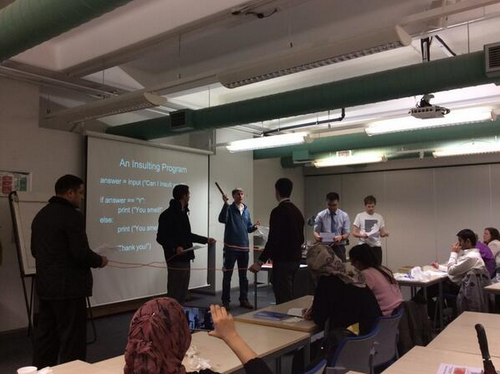
In the picture below the class have created an ‘insulting program’ which comes from the classroom activity ‘The Imp Computer‘ (PDF). That resource and all the other workshop resources can be downloaded from the Programming unplugged: learning programming without computers page.

TLC audience pic02


What’s happening at Teaching London Computing this week? – free workshop, job vacancy closing

1. Free workshop – Monday 3 March 2014
Prof Paul Curzon will be running the third in his four-part series of FREE workshops for computing teachers in London. The talk starts at 5.30pm, at Queen Mary University of London (nearest tubes Stepney Green and Mile End, or 25 and 205 buses).

Programming unplugged: learning programming without computers is an inspiring free unplugged session on introducing computing concepts into the classroom.

“It’s easy to assume that programming is something you have to learn at a computer but if you want your students to deeply understand programming concepts, rather than blindly getting programs to work then unplugged techniques can work really well to get students started. We will see how to program a robot face that is made of students, look at a simple way to give a deep understanding of how variables work by making them physical, and see how to compile programs onto your class instead of onto a computer.”

Paul’s next workshop, on Computational Thinking: it’s about people too, will be the last in this series, though the talks will be repeated. Free tickets for the event, on Monday 17 March 2014, are now available if you want to book a place.

2. Job vacancy closing – Tuesday 4 March 2014
We’re looking for a research assistant / postdoctoral research assistant to help us develop our teaching support resources and evaluate them. The job is based at Queen Mary University of London (Mile End campus).

3. Looking ahead to April – a new short CPD course
We’ll be running another CPD course for London computing teachers, at King’s College London. “Computing CPD GCSE one week Easter 2014” runs from Monday 7 to Friday 11 April 2014 and tickets are available from King’s website. They cost £150 for London teachers (who are eligible for a 50% discount thanks to our funding) and cost £300 for non-London teachers, if space is available.


*New free workshop* Computational Thinking: it’s about people too – 17 March 2014 @QMUL

Prof Paul Curzon is running a series of FREE workshops for London computing teachers on Monday evenings (every second Monday) at Queen Mary University of London (QML). The next one: Programming unplugged: learning programming without computers will take place on Monday 3 March 2014 (there are still tickets available).

The last in this series Computational Thinking: it’s about people too will take place on Monday 17 March at 5.30pm (registration from 5pm) in The Bancroft Building, Mile End campus.

Location: Room 1.13a, The Bancroft Building, Queen Mary University of London, Mile End Rd. E1 4NS

Eventbrite - Teaching London Computing FREE workshop - Computational Thinking: it's about people too for the session on Monday 17th March 2014, 17:30-19:00 (refreshments and registration from 5pm).
2014-02-15-12-45-58

Overview
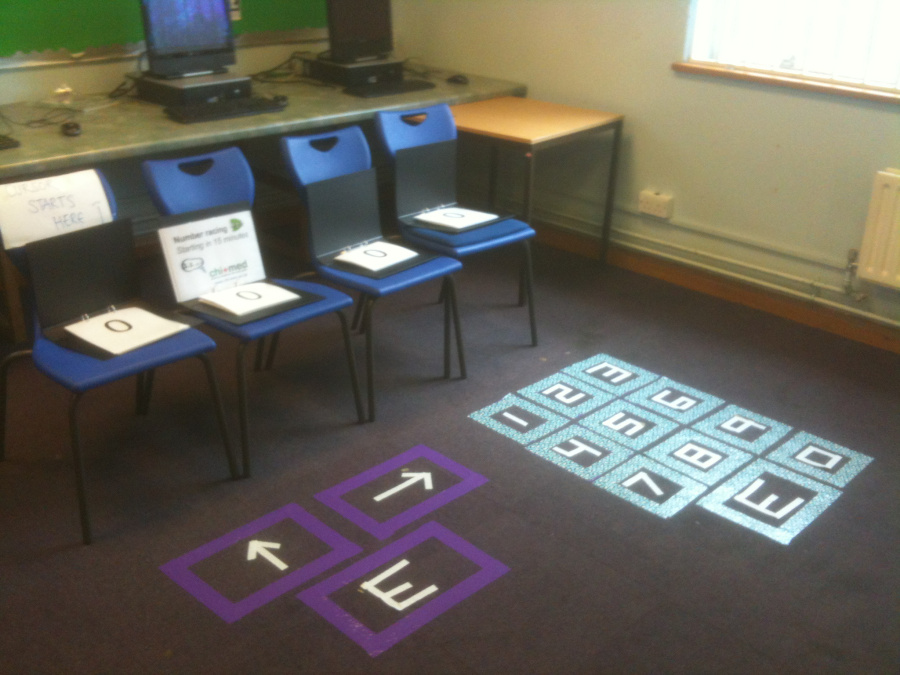
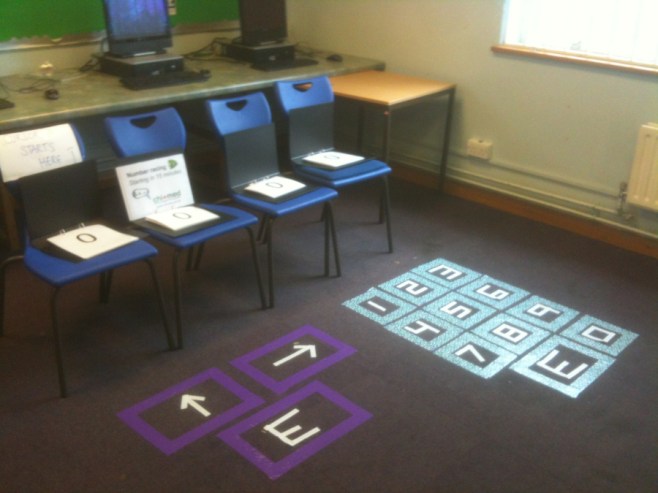
Computing is not just about technology, it is about understanding people too. When we solve computing problems we are solving them for people. Computational thinking is the general group of problem solving skills that students learn as a result of studying computing. Often this is equated with algorithmic thinking – a direct result of learning to program. However it just as important to make programs usable by people – or they won’t be used. We will see how magic gives a fun way to introduce these ideas, how a simple game demonstrates why graphical user interfaces are effective, ways of evaluating interface designs, and by creating an interface out of kids, see how something as simple as entering numbers can tax designers and lead to trade-offs between speed and accuracy.

Session material
This session will cover:

  • computational thinking: understanding people
  • human computer interaction
  • why GUIs are better than text-based interfaces
  • evaluating interfaces
  • number entry

Activities are suitable for all age groups and can be adapted to fit your teaching needs.

Resources
This session comes with linked activity sheets and ‘story’ write-ups that you’ll be able to download from the page for this event: Computational Thinking: it’s about people too

Format
This is a self-contained evening interactive seminar session. It will last 60-90 minutes plus time for networking. The event starts at 5pm with refreshments and a chance to network. The talk will start at 5.30. For our programme of longer courses for teachers please see CPD courses.

Biography
Paul Curzon is a Professor of Computer Science at Queen Mary, University of London. He runs the cs4fn ‘Computer Science for Fun’ (cs4fn) project, www.cs4fn.org. It aims to inspire school students about computer science through a series of free magazines, website and school shows. He regularly gives such shows around the UK as well as continuous professional development talks to teachers about the cs4fn approach to teaching. He is Director of the Teaching London Computing Project. He was made a UK National Teaching Fellow in 2010 in recognition of his excellence in teaching and outreach, was a finalist in the 2009 Times Higher Education Innovative Teacher of the year award and has twice won the student nominated Queen Mary award for excellence in teaching.

About us
Teaching London Computing is a joint project between QML and King’s College London (KCL), with support from Computing At School (CAS). We are supporting London computing teachers with a variety of classroom resources (free) and programming CPD courses for computing teachers (£150 for London teachers, £300 for others if space is available). We’re funded by the Mayor of London and Department for Education to provide this support.

*Short course* Computing CPD GCSE one week Easter 2014 (7-11 April) at KCL

Teaching London Computing runs several courses throughout the year, at different London locations, for computing teachers in London. Our next one will take place at King’s College London (Waterloo Campus) and is an intensive 5-day course running from Monday 7th to Friday 11th April 2014. You can register and pay for tickets at KCL’s website directly.

Computing CPD GCSE one week Easter 2014
(info below taken mostly from the ‘Overview’ tab, but see the other tabs on that site for full information)

Course overview
The aim of this course is to prepare ICT teachers for the new Computing Curriculum and to give them the subject knowledge to teach Computing/Computer Science up to GCSE level and to give them the confidence to set up Computer Science courses in their schools. The programming language used is Python3 and we assume that participants will be ICT teachers and that they will have at least tried out Scratch.

Key facts
Course start date: 7 April 2014, Monday to Friday 11 April 2014
Course duration: Five days full time
Times: 10:00am-16:00pm

Entry requirements
Qualified Teacher Status in ICT or experience of teaching ICT in a secondary school. It will help to have some experience of a ‘drag and drop’ programming language such as Scratch and perhaps turtle drawing programs like LOGO. Teachers who have absolutely no experience of programming and prefer a slower start may prefer to do the Primary to KS3 course which looks at ‘drag and drop’ programming in Scratch and LOGO rather than Python and ‘unplugged’ activities for understanding how computers work.

Academic Lead: Margaret Derrington

Fees and other information
This course is partly funded through the Teaching London Computing project run by Queen Mary University of London in collaboration with King’s College London.
A number of teachers in London schools will benefit by receiving a 50% discount on the cost of the course through funding received by the TLC project from the London Schools Excellence Fund.
Cost of Course £300.
Less Discount   £150   (for London Teachers)

The full price of £300 must be paid by students who are not ‘London Teachers’ covered by the LSEF funding, ie who do not live in London and do not work at schools in London LEAs.


Turing lecture – free livestream on Monday 24 February, 6.30pm GMT

“Beyond silicon: cognition and much, much more” Monday 24 February, 18:30 GMT

The IET / BCS Turing lecture 2014 is being given in four cities this year (London, Cardiff, Manchester, Edinburgh). The London talk (at the Royal Institution) is fully booked but the IET will be hosting a free livestream of the talk as it’s given on the Monday evening.

Visit the IET’s Turing Lecture webcast site to see if your computer setup will let you view the stream.

More information at the BCS’s website on Beyond silicon: cognition and much, much more, and on the speaker – Bernard S Meyerson. The Turing lecture is given in honour of Alan Turing, an important figure in the history of computer science.

Free resource from cs4fn
We have a free PDF / web-based version of ‘The Alan Turing Issue‘ of cs4fn magazine (issue 14) for schools.

“…2012, marks one hundred years since the birth of Alan Turing. You may not have heard of him before, but he is one of the most important scientists of the last century. He worked on maths, logic, code-breaking and most importantly, he came up with some of the fundamental ideas that make computers work. He was one of the very first computer scientists.

In this issue we’ll explore Turing’s world-changing life and ideas, and we’ll check out the latest research in subjects he cared about. You’ll read about computers made from chocolate, the best ways to keep a secret and an animal that can survive being chopped into almost 300 pieces. It’s a pretty amazing world out there, made all the more amazing by Alan Turing’s work.”


Head of Curriculum wanted by @CodeClub (closing 10 March 2014)

Code Club is after a Head of Curriculum. They’re based in London (Old Street) but are happy for remote workers to apply. They’re looking for someone with experience of designing and writing learning materials for children, with experience of Scratch and Python in addition to HTML and CSS.

Salary is £35-45k depending on experience, applications close on Monday 10 March 2014. More details at Code Club’s Head of Curriculum vacancy page.

Other jobs
We also have a job vacancy – we’re looking for Research / Postdoc Research Assistant for the Confidently Teaching Secondary Computing (“Teaching London Computing“) project (£31-34k, closing 4 March 2014), based in London.


New free workshop: Learning programming without computers

Prof Paul Curzon is currently running a series of free workshops for London computing teachers on Monday evenings (every second Monday) at Queen Mary University of London (QML). The next free session Learning programming without computers will take place on Monday 3 March at 5.30pm (registration from 5pm) in The Bancroft Building, Mile End campus.

Lego laptop

“It’s easy to assume that programming is something you have to learn at a computer but if you want your students to deeply understand programming concepts, rather than blindly getting programs to work then unplugged techniques can work really well to get students started. We will see how to program a robot face that is made of students, look at a simple way to give a deep understanding of how variables work by making them physical, and see how to compile programs onto your class instead of onto a computer.”

For more information please visit the workshop’s information page: Learning programming without computers, and you can register for a free ticket using the Eventbrite button below.

Eventbrite - [Free workshop] Learning programming without computing for the free session on Monday 3rd March 2014, 17:30-19:00 (registration and refreshments from 5pm).

About us
Teaching London Computing is a joint project between QML and King’s College London (KCL), with support from Computing At School (CAS). We are supporting London computing teachers with a variety of classroom resources (free) and programming CPD courses for computing teachers (£150 for London teachers, £300 for others if space is available). We’re funded by the Mayor of London and Department for Education to provide this support.