CAS: 2014 Teacher Conference 21 June 2014 & Teaching Computing CPD Day on 20th, from @CompAtSch

The CAS (Computing At School) Teacher Conference will take place in Birmingham on Friday 20 and Saturday 21 June 2014. The conference itself takes place on the Saturday 21st with a day of teaching CPD happening on Friday 20th.

Tickets and information available from 2014 CAS – Conferences for Teachers of Computing.

2014 CAS – Conference for Teachers of Computing
Computing At School (CAS)
Saturday, June 21, 2014 from 9:00 AM to 5:00 PM (BST)
Birmingham, United Kingdom

For primary school computing teachers: Barefoot Computing website now live & competition

From the Computing At School website’s news page:

Barefoot Computing CAS


“The Barefoot Computing project is about helping primary school teachers get ready for the computer science element of the new computing curriculum.”

 
The website is now live at http://barefootcas.org.uk/ and they’re running a competition “for primary school pupils to design a mascot for the Barefoot Computing Project. There are iPads to be won! The closing date is 23rd June and more information can be found here. ”


An example of a job that people who code might do (at Cancer Research UK)

We often talk about coding as a skill that’s useful in a variety of jobs (as well as just being an enjoyable challenge in itself). Here’s an example of a recently posted job advert from Cancer Research UK – they’re looking for someone with a knowledge of coding. The job description is saved on this blog so you’ll be able to look at it even after the job advert has closed, for example if you want to use it in giving your students an idea of some of the jobs available, and skills wanted by employers.


Information Designer or Coder

Permanent link to job description: Role Profile – Information Designer

Are you a creative and analytical individual who can create infographics and interactive web content to communicate science and statistics?

We’re looking for a driven and self-starting Information Designer or Coder to…

  • Create infographics and data visualisation tools, working with our Senior Information Designer
  • Support our Statistical Information Team with the delivery of visual and interactive content for the web and production of downloadable materials
  • Contribute to new ways of presenting information for a wide range of audiences

Here at Cancer Research UK, we work to inspire volunteers, unite the scientific community, educate the public about cancer prevention and tell our story to the government to bring about change. Every day we achieve extraordinary things by being innovative, imaginative and bold in our work. Now we need an Information Designer to support the Statistical Information Team to present and communicate complex information about cancer to a variety of audiences in a smart and engaging way.

Join our collective force and help us lead the way through your…

  • Knowledge
    • of infographics and data visualisation
    • of interactive web development, design software and content management systems
    • of numbers and statistics
  • Experience (either in the work-place or during relevant qualification)
    • of graphic design, and/or front-end web development (HTML, CSS, SVG, JavaScript)
    • of assimilating, analysing and presenting information to a variety of audiences
  • Skills and Competencies
    • Good understanding of design for web, print and social media
    • Creative and visual thinker with a keen attention to detail
    • Able to understand, interpret and communicate science or statistics
    • Able to find a story or a message in complex information and bring it to life
    • Strong verbal communication skills, organisational skills, initiative and flexibility

Our passion, determination and ambition leads us to set ourselves more and more challenging targets, which means you’ll need to translate concepts and creative briefs into demonstrable solutions, to communicate complex ideas and processes visually. You’ll also provide suggestions, promote best practice and engage with a variety of teams.

Whether your background is primarily in design, science communication or web development, this is a growing area for us with enough flexibility for the right person to find their balance between these three skill sets. If this describes you, you can enjoy a great career with us as, together, we bring forward the day when all cancers are cured.

Closing Date: 18th May 2014
Interviews: 5th and 6th June 2014

Job details
Salary: £23,000 – £28,000 p.a + excellent benefits
Location: Angel Building
Contract: Permanent
Contracted Hours (per week): Full Time (35 hours)
Business Area: Health & Patient Information, PR & Communications, Web and Digital
Closing Date: 18/05/2014 23:55

Visit Cancer Research UK’s website to apply for this job.


Calling UK teachers – free copies of cs4fn issue on computer science and medical devices

Free magazine for UK schools from cs4fn, about computer science, medical devices and patient safety.

cs4fn (Computer Science For Fun, based at Queen Mary University of London, QMUL) has been providing school students and teachers with inspiring resources, including magazines, magic books, puzzles and schools talks, about computer science for almost ten years.

Teaching London Computing is a spin-off project from cs4fn to explicitly support teachers. It is run jointly by QMUL and colleagues at King’s College London and provides courses and classroom resources for teachers who’ll be delivering the new KS3, GCSE and A-level Computing curricula. Primary school teachers are also finding many of the resources useful.

There’s also a bit of overlap with a third project, CHI+MED, which is adding a human dimension to cs4fn and TLC. It is funded by one of the UK’s research councils (EPSRC) to investigate how interactive medical devices could be made safer. That project runs over four universities (UCL, QMUL, Swansea University and City University) and the main investigator at QMUL, Prof Paul Curzon, is also one of the people behind cs4fn.

CHI+MED (computer-human interaction for medical devices) takes a very broad view of medical devices – how they’re designed, how they’re approved for use on the market, how people in hospitals decide which one(s) to buy and how they’re actually used in the real world by busy healthcare professionals. Computing is an important aspect of medical device design (software performs calculations and determines how the machine responds to keypresses when a nurse enters a drug dose) but it’s not the only one. It’s important to look at the people involved (the ‘human’ bit of ‘human-computer interaction) at every stage of device development and use too, for example when trying to reduce the harm that can arise when someone makes a slip in mistyping a drug dose.
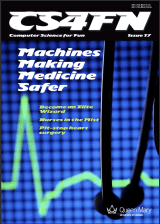
Magazine cover for cs4fn's special issue on medical devices and patient safetyIssue 17 of the cs4fn magazine series is about the research that people on the CHI+MED project are doing along with related work of other groups. It provides a good overview of some of the issues that researchers are thinking about when looking at patient safety in medical devices. It also shows how computer scientists and researchers work with other types of scientists (ergonomists, human-factors experts) in trying to understand and solve a real-world problem.

Sign up for free copies of the magazine
cs4fn already sends copies of the magazines to schools who subscribe. If you are a teacher or school librarian who would like to receive one or more copies (up to a class set of 30*) of this, and future magazines, please fill in your school’s address details (UK addresses only please) on this form and we’ll do the rest (while stocks last). The magazine is free due to support from EPSRC and Google.

*If you need a larger number of copies, eg for an event, please get in touch (cs4fn@eecs.qmul.ac.uk) and we’ll do our best to get more to you.

[This post cross-posted to both Teaching London Computing and CHI+MED blogs]



How to enjoy a career in computing: the power of networks – 22 May, free, 5.15pm via @bcsacademy

Professor Dame Wendy Hall FRS FREng will present the 4th Karen Spärck Jones Lecture (an annual event that honours women in computing research).

A Digital Library by Eric Hackathorn

The influence of her work has been significant in many areas including digital libraries, the development of the Semantic Web, and the emerging research discipline of Web Science”

“In 1987, I co-authored a paper on the lack of women in computer science called “Where have all the girls gone?”. Twenty-seven years later things have changed depressingly little despite much effort across many different projects and initiatives. During that time however, I have (mostly) enjoyed a wonderful career in computing. In this talk I will reflect on how the power of networks has affected my career both in terms of the work I do and in terms of surviving, indeed thriving, in what is still very much a man’s world. I will also reflect on the current state of affairs with regards to women in computer science and in the wider STEM community. What lessons have we learnt and what hope is there for the future? As Karen Spärck Jones famously said – computing is too important to be left to men. But it is only by working together that we will change the gender balance in our industry. It’s time for men to make sacrifices as well.”

Karen Spärck Jones Lecture 2014 – Dame Wendy Hall
5:15 PM to 9:00 PM
BCS, The Chartered Institute for IT, First Floor, The Davidson Building, 5 Southampton Street, London , WC2E 7HA
Organiser: BCS Academy of Computing
Price: Free to attend
Book a free ticket.

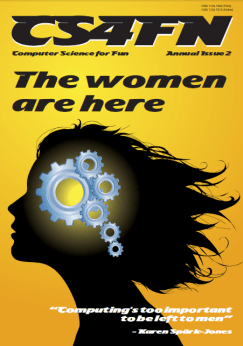
Our sister site, cs4fn (Computer Science For Fun) has a magazine called ‘The women are here‘ all about women in computing.

cs4fn's magazine celebrating women's contribution to computing


From around the web: #Eastbourne teachers: Introduction to Creative Computing Fri 9 May 1-4pm £30

From Connective Culture: Tech Resort & Towner Gallery via @aidandelaney

Eastbourne Pier

Friday 9 May 2014, 1pm – 4pm, £30, Towner Gallery, Eastbourne.

Introduction to Creative Computing
If you’re an Eastbourne based teacher, we want you to attend a half-day computing training to achieve two goals:
1. develop your technical skills in programming, and
2. give you some insight into the requirements in the new computer science curriculum.
We will provide a half-day supply cover and computing subject knowledge training for a small commitment fee of £30.

This is a joint project between the ArtsWork funded Creative Computing project, Eastbourne’s own TechResort and the Computing School at the University of Brighton.

We’re delivering training on the 9th of May at the Towner Gallery in Eastbourne on developing web and mobile applications using the JavaScript programming language. This will introduce the basics of JavaScript and creative problem solving.”

More information, and tickets: Introduction to Creative Computing

Please note: this is not a Teaching London Computing event, we just like sharing what other people are up to :)

[New] *10 week course* Computing CPD GCSE – 7 May 2014 at KCL

Teaching London Computing runs several courses throughout the year, at different London locations, for computing teachers in London.

This is a ten week course beginning on Wednesday 7 May 2014 and you can also see details of all our other CPD courses.

Computing CPD (GCSE) Summer – ten weeks (KCL), 7 May 2014

Eventbrite - Teaching London Computing - Programming & more: CPD for GCSE computing

Course overview
The aim of this course is to prepare ICT teachers for the new Computing Curriculum and to give them the subject knowledge to teach Computing/Computer Science up to GCSE level and to give them the confidence to set up Computer Science courses in their schools. The programming language used is Python3 and we assume that participants will be ICT teachers and that they will have at least tried out Scratch.

More information on what’s taught on the courses can be found at our GCSE computing page.

Key facts
Course start date: Wednesday 7 May 2014 (ends on Wednesday 16 July 2014 with a half-term break on 28 May)
Course duration: Ten Wednesday evenings
Times: 5.00pm-8.00pm
Tutors: William Marsh and Margaret Derrington
Course code: Computing CPD (GCSE) Summer 10w

Entry requirements
Qualified Teacher Status in ICT or experience of teaching ICT in a secondary school. It will help to have some experience of a ‘drag and drop’ programming language such as Scratch and perhaps turtle drawing programs like LOGO.

Fees and other information
Cost of Course £300.
Less Discount   £150 (for London Teachers) – please see our information on Fees and Funding.

Eventbrite - Teaching London Computing - Programming & more: CPD for GCSE computing

What do we get up to in our free programming workshops for computing teachers? Pics from @GTaylorSTEM

Paul Curzon from Queen Mary University of London has been running a series of free Monday evening workshops for computing teachers, on introducing programming concepts into the classroom in fun and creative ways. The next workshop (the last in this series, but they’ll be repeated) is on Monday 17 March at 5.30, more details and free tickets available from Computational Thinking: it’s about people too

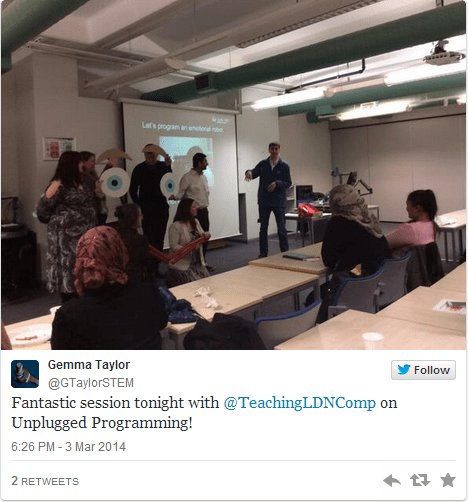
Gemma Taylor was kind enough to share a couple of pictures she took from the most recent workshop (Programming unplugged: learning programming without computers) on Monday 3 March, and she’s given us permission to share them here – thanks Gemma!

TLC audience pic01

Naturally you might be wondering what on earth is going on above – Paul has corralled audience volunteers into forming an ’emotional robot’ which can be programmed to react to certain sounds. You can find out the instructions for making your own in our PDF Create-a-face: programming an emotional robot which comes from our workshop page on Programming unplugged: learning programming without computers – an excerpt is below.

SUMMARY
The class make an affective (relating to moods and emotions) robot face out of card, tubes and themselves. It is programmed to react to different kinds of sounds (nasty, nice or sudden) and show different emotions (sad, happy, surprised). The class then think up some other facial expressions and program sets of rules to make the face respond to sounds with the new expressions.

AIMS
The aim of this activity is to demonstrate how apparently complicated behaviour can be programmed using some simple rules. It also shows how programs are just rules followed by computes and specifically introduces object-based programming. The activity shows how breaking a program into objects can be much easier to write than trying to write it in one go. The class get to write some simple programs to control the face they created.

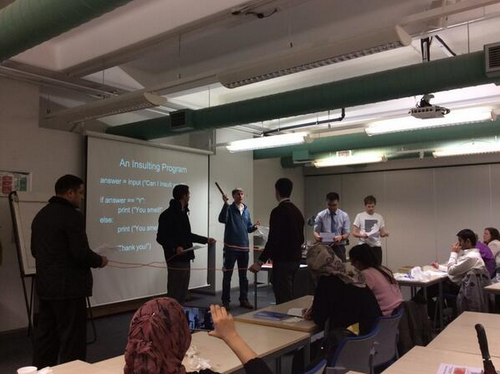
In the picture below the class have created an ‘insulting program’ which comes from the classroom activity ‘The Imp Computer‘ (PDF). That resource and all the other workshop resources can be downloaded from the Programming unplugged: learning programming without computers page.

TLC audience pic02


What’s happening at Teaching London Computing this week? – free workshop, job vacancy closing

1. Free workshop – Monday 3 March 2014
Prof Paul Curzon will be running the third in his four-part series of FREE workshops for computing teachers in London. The talk starts at 5.30pm, at Queen Mary University of London (nearest tubes Stepney Green and Mile End, or 25 and 205 buses).

Programming unplugged: learning programming without computers is an inspiring free unplugged session on introducing computing concepts into the classroom.

“It’s easy to assume that programming is something you have to learn at a computer but if you want your students to deeply understand programming concepts, rather than blindly getting programs to work then unplugged techniques can work really well to get students started. We will see how to program a robot face that is made of students, look at a simple way to give a deep understanding of how variables work by making them physical, and see how to compile programs onto your class instead of onto a computer.”

Paul’s next workshop, on Computational Thinking: it’s about people too, will be the last in this series, though the talks will be repeated. Free tickets for the event, on Monday 17 March 2014, are now available if you want to book a place.

2. Job vacancy closing – Tuesday 4 March 2014
We’re looking for a research assistant / postdoctoral research assistant to help us develop our teaching support resources and evaluate them. The job is based at Queen Mary University of London (Mile End campus).

3. Looking ahead to April – a new short CPD course
We’ll be running another CPD course for London computing teachers, at King’s College London. “Computing CPD GCSE one week Easter 2014” runs from Monday 7 to Friday 11 April 2014 and tickets are available from King’s website. They cost £150 for London teachers (who are eligible for a 50% discount thanks to our funding) and cost £300 for non-London teachers, if space is available.


*New free workshop* Computational Thinking: it’s about people too – 17 March 2014 @QMUL

Prof Paul Curzon is running a series of FREE workshops for London computing teachers on Monday evenings (every second Monday) at Queen Mary University of London (QML). The next one: Programming unplugged: learning programming without computers will take place on Monday 3 March 2014 (there are still tickets available).

The last in this series Computational Thinking: it’s about people too will take place on Monday 17 March at 5.30pm (registration from 5pm) in The Bancroft Building, Mile End campus.

Location: Room 1.13a, The Bancroft Building, Queen Mary University of London, Mile End Rd. E1 4NS

Eventbrite - Teaching London Computing FREE workshop - Computational Thinking: it's about people too for the session on Monday 17th March 2014, 17:30-19:00 (refreshments and registration from 5pm).

2014-02-15-12-45-58

Overview
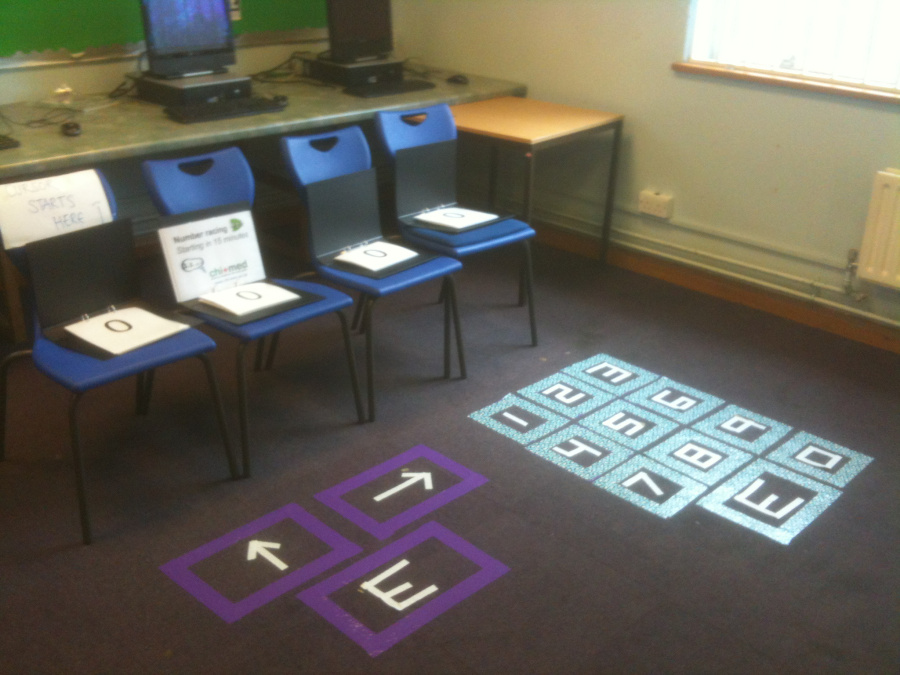
Computing is not just about technology, it is about understanding people too. When we solve computing problems we are solving them for people. Computational thinking is the general group of problem solving skills that students learn as a result of studying computing. Often this is equated with algorithmic thinking – a direct result of learning to program. However it just as important to make programs usable by people – or they won’t be used. We will see how magic gives a fun way to introduce these ideas, how a simple game demonstrates why graphical user interfaces are effective, ways of evaluating interface designs, and by creating an interface out of kids, see how something as simple as entering numbers can tax designers and lead to trade-offs between speed and accuracy.

Session material
This session will cover:

  • computational thinking: understanding people
  • human computer interaction
  • why GUIs are better than text-based interfaces
  • evaluating interfaces
  • number entry

Activities are suitable for all age groups and can be adapted to fit your teaching needs.

Resources
This session comes with linked activity sheets and ‘story’ write-ups that you’ll be able to download from the page for this event: Computational Thinking: it’s about people too

Format
This is a self-contained evening interactive seminar session. It will last 60-90 minutes plus time for networking. The event starts at 5pm with refreshments and a chance to network. The talk will start at 5.30. For our programme of longer courses for teachers please see CPD courses.

Biography
Paul Curzon is a Professor of Computer Science at Queen Mary, University of London. He runs the cs4fn ‘Computer Science for Fun’ (cs4fn) project, www.cs4fn.org. It aims to inspire school students about computer science through a series of free magazines, website and school shows. He regularly gives such shows around the UK as well as continuous professional development talks to teachers about the cs4fn approach to teaching. He is Director of the Teaching London Computing Project. He was made a UK National Teaching Fellow in 2010 in recognition of his excellence in teaching and outreach, was a finalist in the 2009 Times Higher Education Innovative Teacher of the year award and has twice won the student nominated Queen Mary award for excellence in teaching.

About us
Teaching London Computing is a joint project between QML and King’s College London (KCL), with support from Computing At School (CAS). We are supporting London computing teachers with a variety of classroom resources (free) and programming CPD courses for computing teachers (£150 for London teachers, £300 for others if space is available). We’re funded by the Mayor of London and Department for Education to provide this support.