


This is the full text of the latest newsletter which I (Jo B) email to all the UK teachers on our Teaching London Computing subscription list. Despite the name we support teachers and home educators across the UK and our resources can be freely downloaded by anyone anywhere in the world (though we only post within the UK).

If you would like to sign up to received emailed copies of future newsletters please use the orange form here.
Previous newsletters can be found here.
Table of Contents for Newsletter #17
- 1. Technology Books for Children
- 2. Classroom resources, free posters (print & PDF)
- 3. Courses
- 4. Events
- 5. Careers and Gatsby Foundation Benchmarks
- 6. Portals – CS4FN articles arranged by theme
1. Technology Books for Children

You and / or your librarian might enjoy this useful site which reviews technology books (written for children aged 4 to 14) that cover a wide range of topics. October sees the launch of a new book ‘The Tech Career Coach for Teens’.
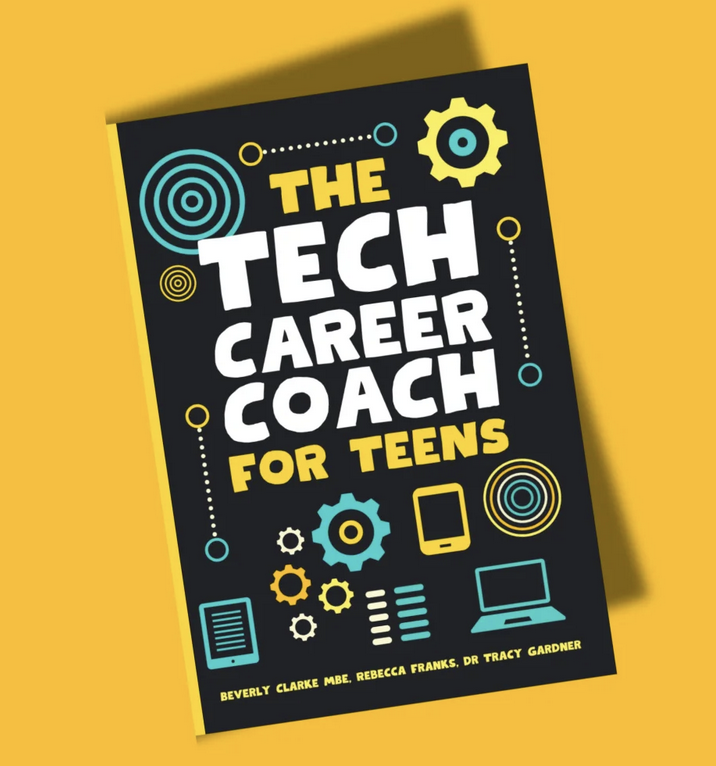
Find out more (and sign up to their mailing list) https://www.technologybooksforchildren.org/books/
2. Classroom resources, free posters (print & PDF)
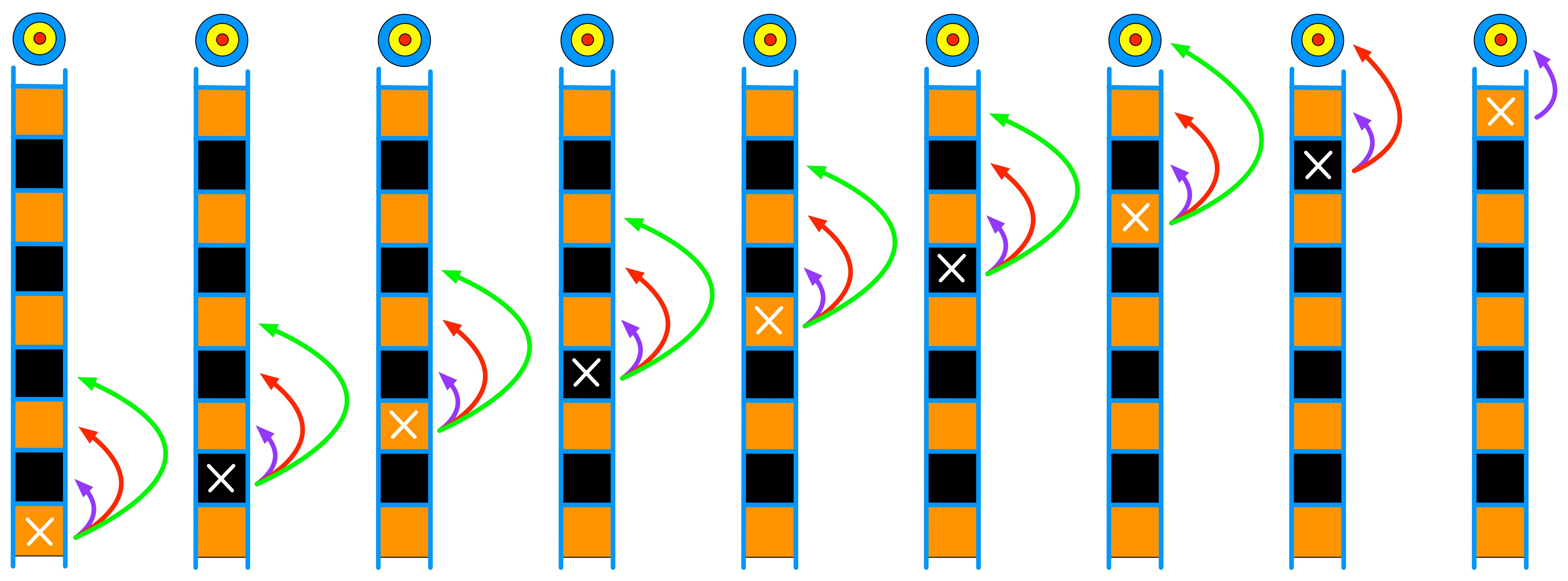
2a. Simplified ‘Sweet Learning Computer’
Paul Curzon has developed Ladders, a more compact ‘travel version’ of The Sweet Learning Computer based on the game Chocolate Chilli, but played with Starburst sweets. You can download some resources to help you play it with your class. More information and instructions.

2b. A new issue of ‘A Bit of CS4FN’ on AI and music
We’re delighted to announce that a colleague in our department, Dr Iran Roman, has been given some funding from an EPSRC ‘AI pipeline’ grant awarded to Queen Mary. He’ll be developing a schools’ project on using Artificial Intelligence to analyse non-Western music. There’ll be a hackathon event for some local secondary school students, plus online resources that will be widely available, and a new issue of A Bit of CS4FN (for primary pupils) on the links between AI, computing and music. As this is a Small Grant the print run will be very limited but we plan to get one copy each to all those who are subscribed (UK only) to receive A Bit of CS4FN (aimed at ~8-12 year olds).
Please use the green form if you’d like to sign up https://teachinglondoncomputing.org/sign-up/
2c. FREE Posters: Computer Science Heroes – what does a computer scientist look like?

We have A3-sized (folded to A4) packs of these five cartoon-style posters which we will post free to school teachers, librarians and home educators in the UK. The “What does a computer scientist look like?” range of posters was created by our former computer science colleague (now illustrator) Richard Butterworth and celebrate a range of computer scientists (we tend to take a fairly broad view of what a computer scientist is!) that we hope will inspire your class and look colourful on your walls.
If you’re not in the UK we have them as PDF form (also available as a rolling PowerPoint presentation). Find out more about the people on the posters and order your free set: https://cs4fn.blog/heroes/
2d. Humanoid robots
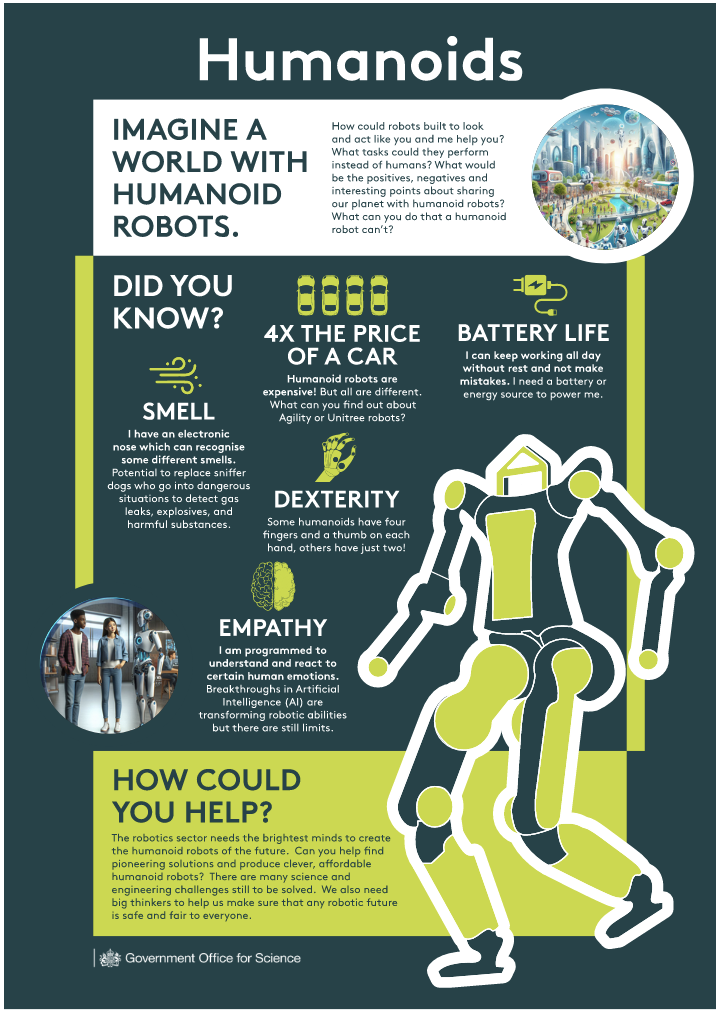
The UK Government is keen to encourage more young people into technological careers and the Government Office for Science team created this free-to-download PDF poster on humanoid robots. “Schools can use this poster to teach about humanoid robots. It includes use cases and features, as well as questions prompting discussion.” The poster, aimed at primary audiences, “…invites pupils to get involved in tackling the science and engineering challenges of our times.” See also our robots 🤖 portal below.
2e. NCCE – Teach Computing
Plenty of resources (and CPD courses) for primary and secondary computing teachers, as well as a selection of Careers videos showing people who do different roles. NCCE are also running an online careers event for KS3 students ‘I Belong in Computing’ and sponsoring I’m A Computer Scientist, Get Me Out Of Here, both of which you can sign up for below.

2f. Digital Schoolhouse resources, workshops and TV spot
Digital Schoolhouse aims “to bridge the gap between education and the games industry by providing accessible, engaging, and high-quality computing education.” They have a number of computing and immersive careers education resources as well as workshops through their Schoolhouse network.
They were recently featured on BBC News as part of a segment on children learning video gaming skills at school and are calling for the creation of a new GCSE in Digital Creativity.
See also: Children learn video gaming skills at school (13 September 2025) BBC News
3. Courses

3a. Unlocking AI & Computer Science – King’s College London
King’s College London is running a FREE, ONLINE 8-week evening class for Y12/Y13 girls starting on 2nd October – need to apply by 28th September 2025.
“This online programme for girls runs online over eight weeks. Each week, researchers from King’s College London lead webinars, joined by hundreds of students from around the country. Through this eight-week online programme, participants meet other people interested in computer science and discover cutting-edge research in AI and tech, from Natural Language Processing – the backbone of tools like ChatGPT – to Human Computer Interaction, which studies communication between people and machines.
Computer science is a predominantly male field – what’s it like to be a woman in this area? Students hear first-hand from researchers and students and have the opportunity to think about where computer science can take you, while also developing a strong sense of community with the other people on the programme. This programme is for female students currently in Year 12 or Year 13 who are considering applying for a degree in Computer Science or something related. Keen students in Year 10 or Year 11 may want to sign up too, but we might not be able to give you a place if the programme is oversubscribed.”
Find out more: https://www.kcl.ac.uk/unlocking-aics
3b. Isaac Computer Science – GCSE and A-level student events
Courses coming up this week and next are in Object-Oriented Programming (A level), Careers in esports (both), Programming – inputs and outputs (GCSE) with Assembly Language (A level) coming up in October.
Booster events are for GCSE or A level students who either want to revise computer science, or are less familiar with the material and want a primer. Each session focuses on a different computer science topic, and gives you the understanding and confidence to use the concepts involved during your studies.
Discovery events are large-scale sessions for GCSE and A level students, inspiring you about the career possibilities that computer science opens up for you. Highlights include expert speakers from industry and academia; panel discussions around studying at university; creative, hands-on workshops; and poster sessions from potential employers. Teachers are welcome to attend too!
See also 2e. NCCE – Teach Computing above.
4. Events
4a. Techy Talks for non-techy people, online / in-person (various)
This is an occasional round-up of computing-related talks / workshops / events that are aimed at people who are interested in the subject but who aren’t researchers or in industry (so I don’t include academic or industry seminars). There are some for children and families, some for interested adults. Many are online so less tied to a particular city, and you may like to share them with your class. The full list is in the panel but below that are a few that may be particularly relevant for teachers and educators.
- The National Museum of Computing at Bletchley Park will have its next Home Educators Day in January 2026 (in person)
- Data-related concepts and practices for AI education in K–12 from Raspberry Pi, free, online on 14 October 2025
- Support Students into Tech Careers from Computing At School / BCS, free, online, 24 November 2025
- Smartphone Free Childhoods? from UCL’s Lunchtime Lectures, free, online, 9 December 2025 – “In this lecture, Professor Jessica Ringrose reports on a research project on teachers, parents and young people’s views on smartphone restrictions.”
4b. I Belong in Computing, online
NCCE’s free, online computing careers event aimed at KS3 (aged 11-14) students and teachers. Friday 26 September 2025, 9-9.45am.
“In this live online panel event, we’ll meet three inspirational role models working in a range of computing-related roles. We’ll find out what their day-to-day role looks like, and why skills such as programming, data and algorithms, might be more widely applicable than you think. Our role models will also share their tips for navigating your education and career next steps.
Mandi is an Information Rights Specialist at National Highways
Hannah is a Scrum Master at CGI
Molly is an Industry Process Consultant at Dassault Systemes”
Register for a place: https://www.eventbrite.co.uk/e/i-belong-in-computing-webinar-ks311-14-tickets-1635682021959
(See also KCL’s Short Course – Unlocking & AI and Computer Science, more details in 3a above)
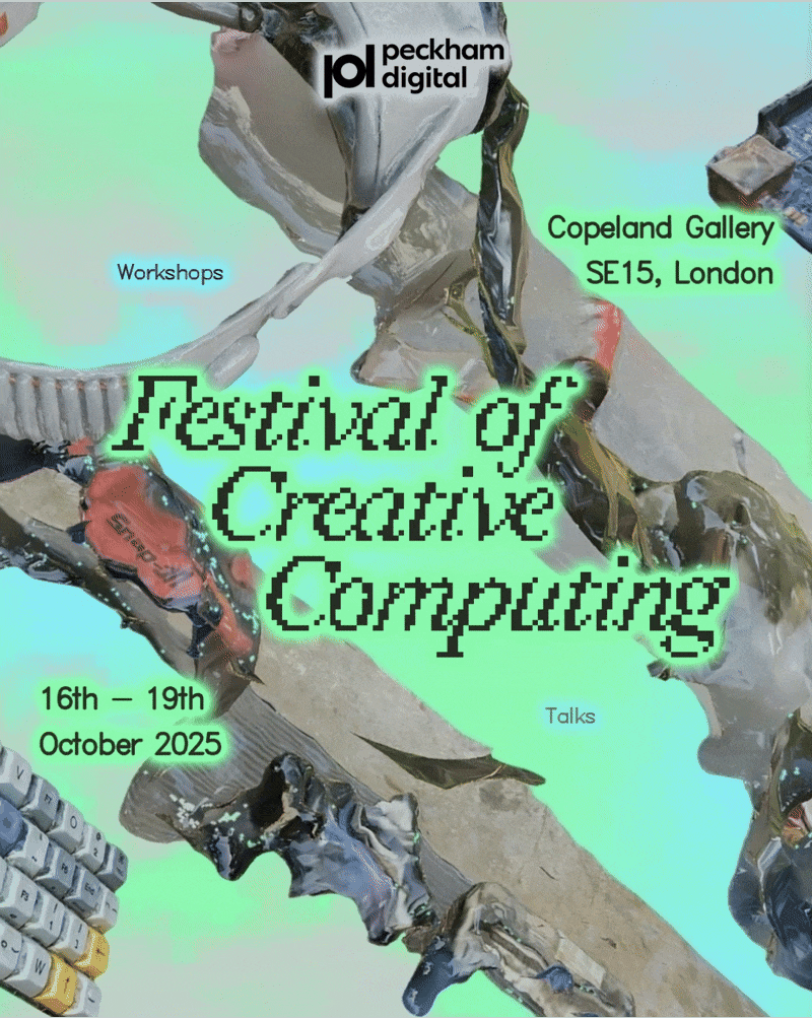
4c. Festival of Creative Computing, Peckham (in-person)
“Peckham Digital is a chance to experience some exciting and interactive artwork, create your own, learn from great artists, meet like-minded people, soak up some good vibes and make the world that little bit more creative.“
Four days of artworks, workshops, talks, meetups, demos, audio/visual performances and algorave, 16-19 October 2025. Tickets.
4d. I’m A Computer Scientist, Get Me Out Of Here, online
Connect your students with computer scientists, free. “IACSGMOOH” is a fun fast-paced event for your class. It’s an online text-based chat where students can type their questions about computer science and careers and the computer scientists in the chat try and answer them. No audio, no video, just quick typing. Find out more: https://imacomputerscientist.uk/signup/t/ (see also Gatsby Benchmarks below).
4e. ICT for Education conferences (in-person)
Their events programme “was launched to help teachers and others responsible for IT and computing in UK schools to get the most out of technology in the face of ever-changing curriculum demands and constantly evolving classroom technology” and they have events in different cities around the UK. A couple of years ago one of their conferences was held at Queen Mary University of London.
Find out more: https://www.ictforeducation.co.uk and sign up (at the bottom of the link above) to their Sapientia newsletter.
- Salford Conference – 9 October 2025
- Solihull Conference – 7 November 2025
- Newcastle Conference – 5 December 2025
5. Careers and Gatsby Foundation Benchmarks

One of our aims is to help in giving school students, teachers, parents and careers advisors a better idea of career choices.
Find out how CS4FN (Computer Science For Fun) and Teaching London Computing help schools in fulfilling three of the Gatsby Foundation’s careers benchmarks.
- Benchmark 2. Learning from career and labour market information
- Benchmark 4. Linking curriculum learning to careers
- Benchmark 7. Encounters with further and higher education
6. Portals – CS4FN articles arranged by theme
Having recently celebrated CS4FN’s 20th birthday anniversary (there was cake and magic) it will come as no surprise that we’ve amassed rather a lot of articles over the years! From these we’ve produced 29 issues of CS4FN (plus special issues), 5 issues of the primary version (A Bit of CS4FN) and 3 puzzle books. We’re gradually adding our articles to these “portals”, thematic collections to help teachers and readers find CS4FN stories about particular topics – we now have over fifty of them. Career-related ones are in bold if you’ve clicked here from the Gatsby Foundation benchmarks section above. We think you might also like our ‘Computing and...’ resource page, for teaching interdisciplinary computing.
Bookmark our main portals page: https://cs4fn.blog/portals/
A CS4FN look at Computer Science PhDs | Alan Turing | Ancient Egyptian Computer Science | Animals and Computing 🐋 🦓 | Art 🎨 | Artificial Intelligence (AI) | Asian Computer Science Stars | Aviation and aerospace – computing and flight ✈️ | Bias | Black History, Present and Future | Career paths in computing | Christopher Strachey | Computer Science and 3D | Computer science and research | Computer Science at the Movies 🎬🍿 | Computer science in space 🚀 | Computing in the Americas | Coordinate Conundrums | CS4FN Christmas Computing Advent Calendar | Cunning Computational Contraptions (CS4FN magazine, issue 28) | Cyber Security (CS4FN magazine, issue 24) | Data Visualisation and Sonification | Disability in Computer Science | Diversity Day By Day | Diversity in Computer Science | Doodle Algorithms | Egyptian Survey Puzzles | Emotion | Internet of Things | Jewish Computer Scientists | Lego computer science | LGBTQ+ Computer Science Greats | Logic and Deduction | Materials Science | Medicine / Healthcare 💊 | Mini beasts and computer science 🐞 | Muslim, Middle Eastern and North African Heritage | Natural language processing | Networks and Telecommunications 🕸 ☎️| Neurodiversity and Computer Science | Pixel Puzzles | Puzzles | Quantum Computing ⚛️ | Quirks and oddities | Robotics 🤖 | Sound, acoustics, audio, music 🔈 | Tech Entrepreneurs | The Computer Science of Star Wars ⭐️⚔️| The human computers | The women are still here | Time | Victorian computer science | Wearable computing and fashion ⌚️ | Word search
Follow us everywhere :-)
CS4FN is on BlueSky and Paul Curzon is on LinkedIn. Our website full of free resources for teachers is Teaching London Computing (this site); our website for young people, full of articles about computer science, is the CS4FN blog.
Teaching London Computing and CS4FN (Computer Science For Fun) produce an irregular newsletter for computing teachers and educators with a focus on UK / London. Read previous newsletters and sign up to receive the next issue by filling in the orange form.
Subscribe to be notified whenever we publish a new post to the Teaching London Computing blog.
 Teaching London Computing: A RESOURCE HUB from CAS LONDON & CS4FN