


This is the full text of the latest newsletter which I (Jo B) email to all the UK teachers on our Teaching London Computing subscription list. Despite the name we support teachers and home educators across the UK and our resources can be freely downloaded by anyone anywhere in the world (though we only post within the UK).
If you would like to sign up to received emailed copies of future newsletters please use the orange form here.
Previous newsletters can be found here.
1. FREE event: Happy 20th birthday CS4FN!

If you are in London you are welcome to come to our FREE celebration event on Tuesday 6th May at Queen Mary University of London. Prof Paul Curzon will be doing table magic before and after his 5pm talk (which is aimed at 11+) “The illusion of good software design” and there will be cake, doors open at 4.30pm. Full details and directions can be found here: CS4FN 20th birthday event.
[Information] [Tickets]
2. New free resources
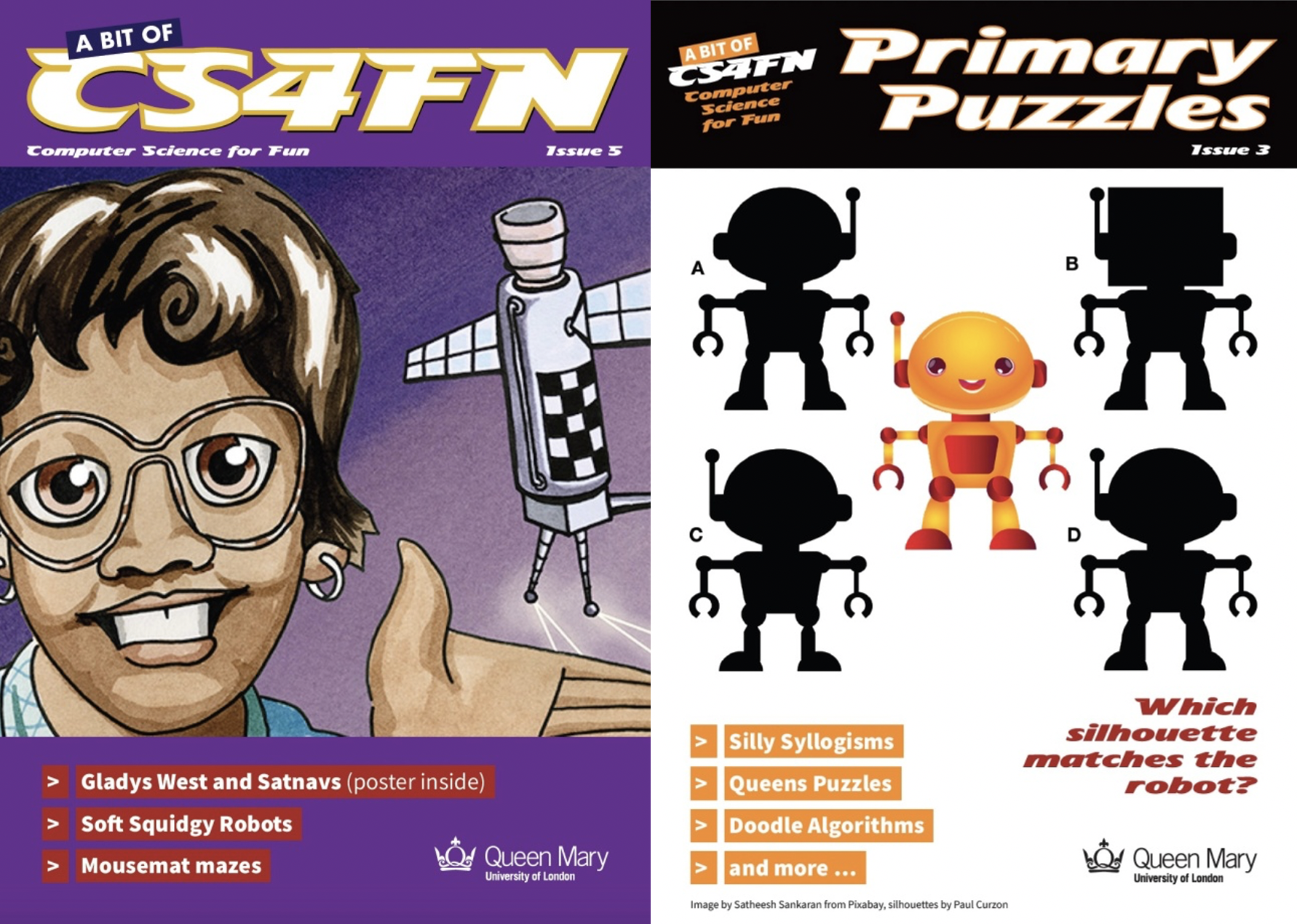
This week and next our Mailing House will be posting out print copies of “A Bit of CS4FN issue 5” along with “Primary Puzzles issue 3” to our subscribing UK teachers and home educators. Both contain puzzles (more in the puzzle book!) and are intended to be written on. Everyone can download PDF copies (for printing, though the computing stories in issue 5 can be read on a device) from our main CS4FN downloads site.
The booklets are aimed at 8-12 year olds and for a bit of added encouragement we have some printable certificates for children who’ve either attempted some of the puzzles or who’ve completed them. Find the previous puzzle books here (includes links to certificates for each booklet). Because we’ve spotted that lots of people visit this site from the US (hello!) we’ve also added some certificates on US letter paper size.
How do you use them? What do you think of them? Please tell us
We love hearing how teachers, parents and home educators use these with their children or class and we’re keen to know what you (and your children) think of our resources. If you’d like to tell us we’ve created a short form here.
3a. Events with Paul / CS4FN
Paul Curzon and / or the CS4FN team will be presenting at the following events this summer.
24 May
King’s Festival of Artificial Intelligence Family Day (tickets) – an all day family friendly event in London (at King’s Strand campus) on the last day of their 5-day Festival of AI. Come and play ‘Program a Postcard!‘ with the CS4FN team.
23 June
DSH Playful Computing Conference – Lead Teachers 2025 from Digital Schoolhouse (information) – Paul is speaking at this event. (Note that you will need to click the ‘Contact the organisers’ button to get a password for this event
24 June
Playful Computing Conference 2025 from Digital Schoolhouse (information) – Paul is speaking in the morning. In-person event at University of Westminster – Harrow campus
Barts and Queen Mary science Festival 2025 (information) – “A family-friendly science festival for older secondary school children”. Paul is scheduled to speak in the afternoon, from 2.35 to 3pm. In-person event at QMUL’s beautiful Charterhouse Square campus.
3b. Other events and activities
Our page of computer science (and related) talks and events for teachers, home educators, children & young people, families, interested adults lists a wide variety of activities in London and elsewhere.
ICT for Education run a series of regional computing conferences for schools which aim to “help teachers and schools get the most out of technology and raise standards of learning and educational provision.”
- Norwich – 9 May 2025
- Brighton – 13 June 2025
Festival of Computing – 2 July 2025 – Craig’n’Dave are running this conference for secondary school teachers : “Get hands-on with cutting-edge CPD sessions, hear from top industry speakers, and connect with like-minded teachers. Whether you’re looking to refine your teaching approach or explore the latest in computing education, this is the event you can’t afford to miss.”
Save the date – Computing At School conference – 24 October 2025
Moon Landing Coding Adventure – open to primary schools (project for 5-8 year olds) until December 2025, one of several projects funded by the Department for Transport and Civil Aviation Authority’s “Reach for the Sky” funding, to help children find out about aviation careers.
4. I’m A Computer Scientist, Get Me Out Of Here
“The I’m a Computer Scientist activity supports your students’ science capital, showing them how the things they’ve learned about computing, programming, and technology relate to real-world careers. By discussing their questions and ideas with the experts, students see the relevance of their studies and gain insight into the value of computer science in their everyday lives. Take part with your students: https://imacomputerscientist.uk/signup/t/”
Sign up for I’m A Scientist Get Me Out of Here / NCCE – Computer Science edition
Teachers: connect your students with working computer scientists and support them to see science as something “for them”.
“IASGMOOH” run regular online, text-based live-chats between schools and scientists covering different areas of the STEM curriculum, science research and careers and what it’s like to be a scientist. They will be doing more sessions on computer science and teachers can sign up to be kept informed when the next events are running.
The online, student-led I’m a Scientist activity is being supported by the National Centre for Computing Education to help your students see where their studies could take them.
Take part with your students: https://imascientist.org.uk/signup/t/ncce/
5. Government consultation – Narrowing the digital divide in schools and colleges
The UK Government has an open consultation on this, which closes on 23 May 2025. If you’d like to contribute please visit this page to download the documentation and fill in the survey.
6. The Children’s Manifesto for the Future of AI
In February 2025 the Children’s AI Summit was held at Queen Mary University of London in partnership with The Alan Turing Institute and 150 children were invited to share their thoughts on artificial intelligence. You can read the resulting report here.
7. Quirks and oddities – computer scientists at play
We decided to extend April Fool’s and throughout April (and probably beyond!) we’re sharing examples of some of the more surprising things computer scientists have created.
Keep in touch
Find CS4FN on these social pages: BlueSky | LinkedIn (Paul Curzon) | Twitter/X | Mastodon
Subscribe to our blogs: CS4FN (CS4FN articles) / Teaching London Computing (resources for teachers). You’ll get an email when we publish a new post.
If someone has forwarded this to you and you’d like to subscribe to our newsletters please see the orange form here.
Previous newsletters
Subscribe to be notified whenever we publish a new post to the Teaching London Computing blog.

This blog is supported through EPSRC grant EP/W033615/1.
Subscribe to be notified whenever we publish a new post to the Teaching London Computing blog.
This blog is supported through EPSRC grant EP/W033615/1.
 Teaching London Computing: A RESOURCE HUB from CAS LONDON & CS4FN