

Each chapter presents you with the Conjuring then the Computation; teaching you a conjuring trick then linking it to a facet of computer science or computational thinking in a fun way.
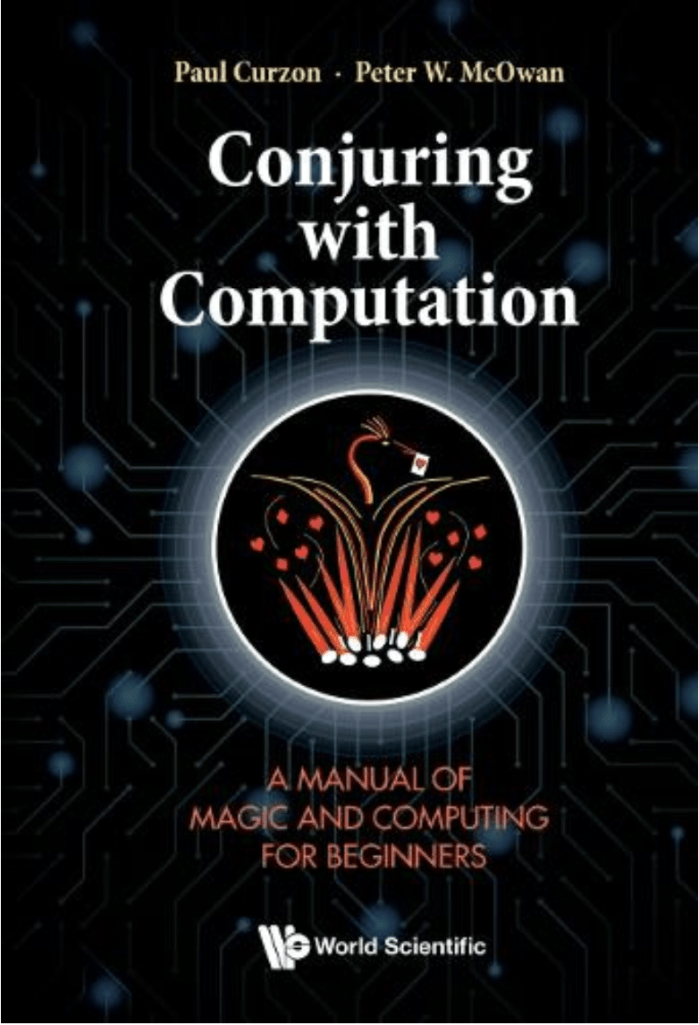
Conjuring with Computation: A manual of magic and computing for beginners by Paul Curzon and Peter W. McOwan. Available in hardback and now in paperback (details below).
There are also two bonus chapters availalble free on the Conjuring with Computation website (see details below).
Publisher: World Scientific Publishing Co Pte Ltd
Number of pages: 420
Where to find the book
- Waterstones – hardback | paperback (ordered from the publisher – 2 weeks)
- Blackwell’s – hardback | paperback
- Foyles – hardback | paperback
- WH Smiths – hardback | paperback is not listed online
- Amazon – hardback | paperback, also available as Kindle
- World Scientific Publishing (based in Singapore) – the publisher: all formats
At time of writing the paperback is ~£30, e-Book £25.
The hardback is £64 from WH Smith, £70 from Amazon but £135 from the other publishers.
About the book
The team behind Computer Science for Fun (CS4FN), brings you Conjuring with Computation: A Manual of Magic and Computing for Beginners. Develop your skills as a magician while also learning the basics of computer science by exploring its links to magic. Each chapter explains how to do a simple magic trick, step-by-step, then uses the trick to introduce linked fundamental ideas in computer science in a fun way.
By reading the book you will learn to do self-working tricks, be able to hold magic shows, create your own versions of tricks, and with creativity even invent your own.
We cover:
- Find out your friends’ superpowers!
- Self-working card tricks
- Magical jigsaws, boxes and other objects
- False shuffles and cuts
- False choices
- Magic with books and pictures
- Mentalism, clairvoyance and tricks with ghosts
- Magic built on technology
You will also learn how computation underpins conjuring, answering questions like:
- What is computation?
- Why are the skills of a computational thinker, such as decomposition, abstraction and generalisation, so important?
- Why is data represented in different ways?
- How is easy-to-use software created?
- How does maths underpin programming?
- What are the basics of cyber security and privacy?
- Why must we all understand how computing technology affects society?
The book includes profiles of computer scientists, alongside magicians with links to technology, through history.
Master conjuring and thinking computationally.
Hardback: 9789811264337
Paperback: ISBN: 9789811299308
Paul Curzon is a Professor of Computer Science at Queen Mary University of London as was Peter McOwan who died in 2019. Together they founded CS4FN in 2005.
About the bonus chapters (free)
Bonus Chapter 51: The Sixth Finger – Virtual Reality and Robotic Limbs
Conjuring: You show volunteers that they have an invisible sixth finger that they were not aware of. Even though they cannot see it, they can feel it.
Computation: Robotic body augmentation research involves exploring how to give people robotic limbs to increase their abilities.
Bonus Chapter 52: Magically Winning by Symmetry – Invariants and Loops
Conjuring: You play a coin game you can’t lose, powered by symmetry and by a magicians trick.
Computation: To be sure that algorithms containing loops work, computer scientists think about invariants: the things that do not change as a the steps of the algorithm are followed.
Even more magic and computing (free)
Plus all of our other free magic booklets can be downloaded as PDFs.
Subscribe to be notified whenever we publish a new post to the Teaching London Computing blog.

This blog is supported through EPSRC grant EP/W033615/1.
 Teaching London Computing: A RESOURCE HUB from CAS LONDON & CS4FN