
Teaching London Computing: A RESOURCE HUB from CAS LONDON & CS4FN

Menu

Skip to content
  • Home
  • Puzzles
  • Booklets
  • Activities
    • Learning about Machine Learning
      • The Intelligent Piece of Paper Activity
      • The Brain-in-a-bag Activity
      • The Sweet Learning Computer Activity
    • Christmas Computing
    • Halloween Computing
    • Valentine Computing
    • Magic-based Activities
      • The Invisible Palming Activity
      • Magical Book Magic
      • The Australian Magician’s Dream Activity
      • The Red Black Mind Meld Activity
      • The Four Aces Activity
      • The Teleporting Robot (and Melting Snowman) Activity
    • Puzzle based activities
    • Art-based activities
    • Craft-based activities
    • Sort Algorithms
      • The Bubble Sort and Sort Dance Activities
      • The Divide and Conquer Sorting Activity
      • The Punch Card Sorting Activity
    • JFLAP: Creating Finite State Machines
    • The 20-questions Activity
    • The Box Variable Activity
    • The Assignment Dry Run Activity
    • The create-a-face activity
    • The Emotion Machine Activity
    • The Imp Computer Activity
    • Microwave Racing Video
    • The Locked-in Activity
    • The Punch-card searching activity
    • The Spit-not-so Activity
    • The Sodarace Evolution Activity
    • The Soda Constructor Physics Activity
  • Mix Subjects
  • Research
  • Resources
    • Home Learning
    • Re-using our material
    • A cs4fn guide to Secondary School Computing Topics
    • Video CPD
    • Primary School Resources
    • Puzzles, Computer Science and Computational Thinking
      • Puzzle Book 1
      • Bakuro and Binary
      • Pixel Puzzles and Images
      • Computational Thinking: Number Hive Puzzles
      • Computational Thinking: Cut Block Logic Puzzles
      • Word Searches and Linear Search
      • Compression Code Puzzles
      • Spot the Difference and Debugging
    • Magic and Computational Thinking
      • Magic Book 3 – for schools
      • Computational Thinking: Magical Book Magic
    • Great Reading for budding computer scientists
    • Books
    • Developing computational thinking
      • Abstraction
      • Algorithmic Thinking
      • Decomposition
      • Evaluation
      • Generalisation
    • Other Useful Resources
    • Computing Summer Schools in London
  • Courses/Workshops
    • Online-live-lectures
    • CAS London 2020 Conference
    • Teacher training in London
    • Teaching GCSE Computing
      • GCSE Computing CPD Resources
        • Introduction and Programming Challenges
        • 1: Introducing Python Expressions and Variables
        • 2: Binary
        • 3: Conditional Statements and Booleans
        • 4: While Loops
        • 5: Computer Components
        • 6: Arrays and Testing
        • 7: Networks
        • 8: Functions
        • 9: Logic Circuits
        • 10: Files
    • Teaching A-level Computing
      • A-level Computing CPD Resources
        • 1: GCSE Python Recap
        • 3: Arrays and Exceptions, Representing information
        • 2: Searching and Sorting
        • 4: Recursion
        • 5: Computer architecture
        • 6: Object Oriented Programming
        • 7: Running programs and operating systems
        • 8: Software development
        • 9: Data Structures
        • 10: FSM, Regular expressions, Syntax and parsing
    • Workshops
      • 1. Computational Thinking: Searching to Speak
      • 2. Invisible palming! Intelligent paper? So what is an algorithm?
      • 3. Programming unplugged: learning programming without computers
      • 4. Computational Thinking: it’s about people too
      • 5. Interdisciplinary Computational Thinking through Modelling
      • 6. Explorers need maps: Abstraction, Representations and Graphs
      • 7. KS2 and KS3 Computing Unplugged
      • 8. The Magic of Computing
      • 9. GUI Programming in Python
      • 10. Turtle Graphics: from Visual to Textual Programming
      • 11. Sorting Unplugged
    • miniCPD – short courses
      • miniCPD – Controlled Assessment
      • miniCPD – GUI Programming in Python
      • miniCPD: Introduction to Arduino
    • TechPathways Courses
      • Games Development Course 2020
      • 3DAmi Animations Course 2020
      • GIS Course 2020
    • ABC for Schools
    • LCT Centre Online Roundtable
    • Semantic Waves Course 2020
    • Industry pedagogy course Nov/Dec 2020
  • Diversity
    • Women in Computing
    • Black history
    • LGBTQ+
    • Disability
  • Sign up
  • Contact
  • Blog
    • Testimonials
    • Project private
    • Index / Site-map
    • Volunteering
    • Previous courses
  • Home Learning
  • An illustration showing a hand holding a smartphone with its camera app open, capturing an image of a cartoon purple cat. The camera screen displays the cat framed with a square outline, and several facial features—such as the eyes, ears, and nose—are highlighted with smaller boxes and connected by thin lines, illustrating an AI recognition process. The cat is slightly blurred in the background outside the phone screen, emphasising the focus on the camera's view.
  • A microphone against a blurred backdrop of seats in a lecture theatre
  • Royal Institution RIGB logo
6 January 2025 by Jo Brodie

[Free] London event: World Logic Day – 14 January 2025 at QMUL (in-person and online via Teams)

(Also, tomorrow: London / hybrid at Gresham College is “Who’s Afraid of Robots?” at 6pm)

To celebrate World Logic Day QMUL has put together a free afternoon hybrid symposium with a couple of sessions that are relevant to schools and teachers (most of the rest of the symposium is aimed at an academic audience).
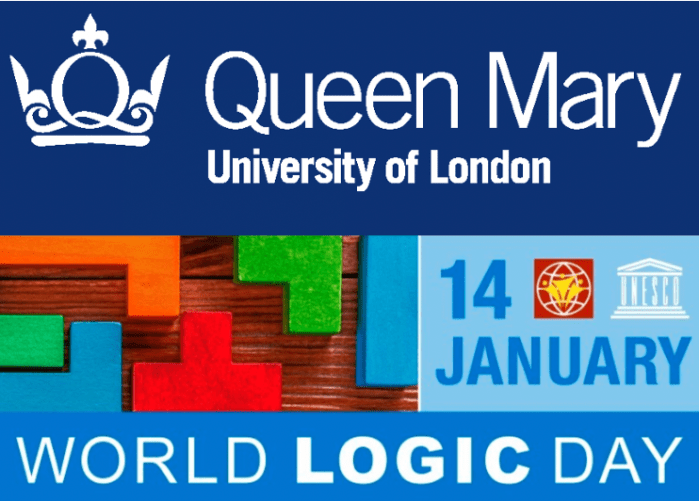
QMUL logo and the event logo.

The full programme, which runs on Tuesday 14 January from 1.30pm to 6.45pm (in-person and on Teams) can be found here https://sites.google.com/view/wld25/home. I do slightly wish they’d called it “Does Compute” though ;)

From 6-6.45pm there will be a public-focused ‘science outreach’ talk..
Self-reference and Paradoxes: To Infinity and Back!
Paulo Oliva, QMUL
Ever since the Greeks discovered that self-reference can lead to paradoxes (with the sentence “All Cretans are liars”, proclaimed by a Cretan), the fascination with self-referential objects has occupied the minds of artists, philosophers, mathematicians, logicians and computer scientists. In this lecture we will go through some other surprising examples of self-reference, including in language, arts and computing, and discuss how these can lead to puzzling paradoxes and to amazing inventions — such as computers!

… and at the various breaks throughout the afternoon CS4FN’s Paul Curzon will be doing magic tricks to demonstrate some logical principles.

Conjuring with Logic
Paul Curzon, QMUL
Would you do a magic trick in front of a live audience if you were not  sure it always works? Would you release a program before you were sure  it was free from bugs so always worked? But in each case how can you be  sure? Just like programs, magic tricks are based on algorithms so they can be verified to be correct in similar ways. By demonstrating some simple tricks we will explore how to prove they always work, and in so doing demonstrate how Computer Scientists use logic and proof to verify that critical algorithms, programs and hardware always do the right  thing too.
Find out more about Logic for Fun at https://cs4fn.blog/logic-and-deduction/
Sessions are at 2.30-3pm, 4-4.30pm and 5.30-6pm – I expect these sessions might not show up on the Teams stream and are probably in-person only.

If you know children and teenagers who like magic we have lots of free PDF booklets about magic and computer science, and magic and maths here https://cs4fndownloads.wordpress.com/magic/ (there’s also a non-free book at the top of the page called Conjuring with Computation). See also our* CHI 2012 conference paper “Teaching HCI through magic” about using magic to enthuse students about human-computer interaction and teach core concepts.

*’our’ as in my colleagues, I’m not one of the authors.

Both Paulo and Paul run sessions for QMUL’s ‘franchise’ of the Royal Institution’s Masterclasses in Computer Science scheme which brings ~14/15 year olds onto campus for a series of computing-themed interactive workshops. Lots of other universities and schools do these too and there’s a maths-themed version as well. Paul also runs fun computer science workshops for younger children at the Ri (he’s one of the five EPSRC-funded public engagement with ICT champions).

Find out more about Logic and Deduction

Logic and Deduction

Subscribe to be notified whenever we publish a new post to the Teaching London Computing blog.


This blog is supported through EPSRC grant EP/W033615/1.

Share this:

  • Click to share on X (Opens in new window) X
  • Click to share on Facebook (Opens in new window) Facebook
  • Click to email a link to a friend (Opens in new window) Email
Like Loading...

Related

This entry was posted in events, Logic and tagged events, free, hybrid, Logic, London, magic, online, public engagement, QMUL - Queen Mary University of London, schools, Teams, technology, World Logic Day. Bookmark the permalink.

Post navigation

Teaching London Computing – Newsletter #15 – Winter 2024-2025
Techy Talks Winter 2025 – talks, workshops, events for families / schools / teachers

Search this blog

Enter your email address to follow this blog and receive notifications of new posts by email.

Join 889 other subscribers
Follow Teaching London Computing: A RESOURCE HUB from CAS LONDON & CS4FN on WordPress.com

Blog Stats

  • 2,704,984 hits
  • RSS - Posts
  • RSS - Comments
Blog at WordPress.com.
  • Reblog
  • Subscribe Subscribed
    • Teaching London Computing: A RESOURCE HUB from CAS LONDON & CS4FN
    • Join 889 other subscribers
    • Already have a WordPress.com account? Log in now.
    • Teaching London Computing: A RESOURCE HUB from CAS LONDON & CS4FN
    • Subscribe Subscribed
    • Sign up
    • Log in
    • Copy shortlink
    • Report this content
    • View post in Reader
    • Manage subscriptions
    • Collapse this bar
 

Loading Comments...
 

    %d