


By Paul Curzon, Professor of Computer Science in the School of Electronic Engineering and Computer Science at Queen Mary University of London

This article was originally published in Sapientia (March 2024) the newsletter from ICT for Education.
“To keep pace with the changes, challenges and opportunities in the primary and secondary education sectors, register for ICT for Education’s termly newsletter here or e.mail il@ictforeducation.co.uk.“
Games, magic and puzzles provide a fun way for students to learn about concepts, but how do we do this effectively to ensure it is more than play? One answer is semantic waves, which are based on the idea that a good explanation follows a wave structure, moving between a technical concept that is hard to understand to concrete things the learner already understands and, critically, back again (Figure 1). What matters is that a lesson involves both unpacking the concepts into things that are easy to understand and repacking them again into the technical terminology.
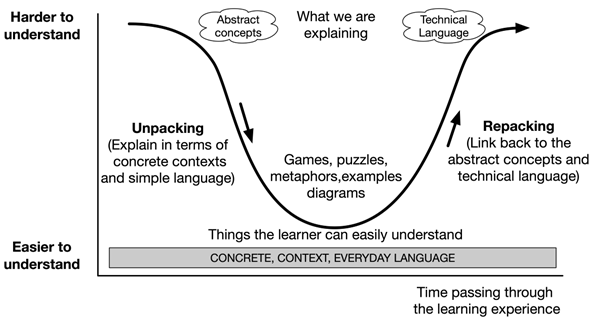
The profile of a less effective lesson might have all the abstract and technical steps but it flatlines high. The lesson never links to everyday things the learners already understand. A lesson can also flatline low. It remains throughout about a puzzle, say, and never really links to the technical concept, so no one learns about it. The lesson is just play. More subtle is the down escalator where the abstract concept is unpacked using a concrete example, or into easy to understand ideas, but the activity ends there. There is no repacking to link the concrete back to the concept actually being learned. Again, the learners leave thinking it was just play.
Algorithms are a core concept that primary school students are expected to understand. You could give students a word search puzzle as a way to learn about algorithms, as following an algorithm is a way to solve such a puzzle. A student might scan rows for the first letter of a word in the word list then scan in each direction for the rest of the word. If the students are just given a word search to do, though, they may learn nothing. They are being flatlined low.
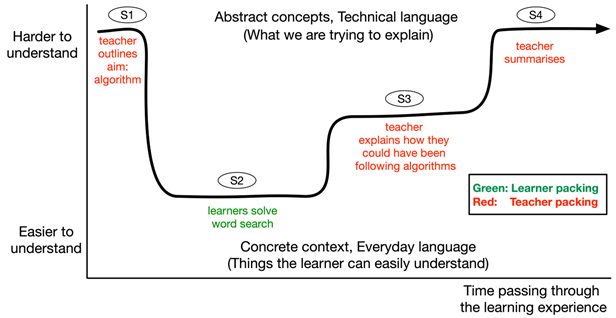
If, instead, we outline the aim of the lesson as being about algorithms, ask if any students know what an algorithm is, explain that it is a series of steps that guarantees a result, point out that it can be used to solve puzzles, and then set a word search to do, we have descended a wave from top to bottom in a series of steps. However, if we stop there, we have a down escalator and students may learn little about algorithms.
If, as they are doing the word search, we prompt them to think about how they are doing it – are they randomly scanning, hoping words jump out or are they following an organised method that guarantees finding a word? – we are now making them move up a semantic wave, making links between a word search and the idea of an algorithm. Once some of the students’ ideas have been shared, we can suggest they use a way that does guarantee finding a word and even write down the steps they are following. We are then repacking a little more. Then, as they solve the puzzle, they repack further. Finally, we ask them to summarise what an algorithm is and how it can be used to solve a word search before we wrap up with a final summary.
This considers algorithms in the context of puzzles. Ultimately, students need to connect the concept to programs. A final point could be to make this link with a further activity that builds on the idea and creates a new wave based on a technical programming example that links word search algorithms to writing a program, perhaps a program to find a given word in a list.
We need to take care that the steps focus on the thing we want the students to be unpacking or repacking, here, algorithms / steps that guarantee a result. With a word search, that may mean we do not want them struggling with spelling instead of thinking of ways to guarantee finding a word. We should ensure words used are at the right level for each student.
We can build a way to improve lesson plans from these ideas using sketchy semantic profiling. This also allows us to quickly and easily reflect on and improve lesson plans. It involves drawing a rough profile based on the main steps of a lesson plan and then asking some simple questions. Draw a curve downwards if the next step uses more concrete examples or more everyday language or context. Draw a curve upwards if the next step becomes more abstract or more technical. Figure 2 shows a semantic profile of a simple word search lesson.
The questions are:
1. Does the profile drawn have a rough ‘u’ or ‘n’ shape?
- If we are flatlining, add steps to make links that step up or down.
- If following a down escalator, add steps that link back up to the concept.
- If the curve drops off a cliff edge, going from aim to activity, add intermediary steps.
2. How high and how low does the curve go?
- If we don’t link all the way back to the abstract concepts add a final step to do so.
- If the examples are very technical, link to some everyday context.
3. Who is doing the unpacking and repacking: teacher or learner?
- If the packing is mostly done by the teacher, make the learner do some steps.
4. Does each step focus on the target learning outcome of the lesson?
- If a step directs students to think about something else that is not our immediate aim, modify the activity so it meets the aim.
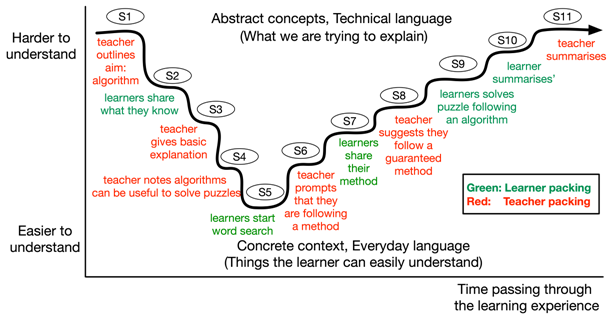
lesson plan avoiding the cliff edge and with more student repacking.
Draw sketchy semantic profiles of your lesson plans, then think about these questions. You could make your lessons both more effective and much more fun.
• For more on Computer Science for fun, visit: cs4fn.blog
• For fun classroom activities, visit: teachinglondoncomputing.org/resources/
Further reading
• “Semantic waves describe an ideal conceptual journey for novice learners to follow, shifting between expert and novice understanding, abstract and concrete context, and technical and simple meanings. It is part of Legitimation Code Theory (Karl Maton, 2013).”
• Semantic Waves are also referenced in the UK Government’s Research review series: computing (16 May 2022)
• Quick Read: Using semantic waves to improve explanations and learning activities in computing (13 February 2020) NCCE
• How we’re learning to explain AI terms for young people and educators (13 June 2023) Raspberry Pi Foundation, see in particular the section called “Using education research to explain AI terms”
Subscribe to be notified whenever we publish a new post to the Teaching London Computing blog.

This blog is supported through EPSRC grant EP/W033615/1.
 Teaching London Computing: A RESOURCE HUB from CAS LONDON & CS4FN