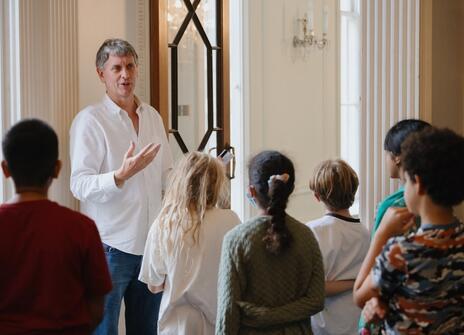


Every year in August Prof Paul Curzon runs several workshops for young people at the Royal Institution (‘the Ri’) on Albemarle Street (off Piccadilly) in London. This is part of a suite of Holiday Workshops the Ri hosts during the summer holidays, on all sorts of science and tech (STEM) topics.
Paul’s sessions are listed below, followed by information about other workshops that may also be of interest.
The workshops generally cost £40 (£32 for Ri members).
About Paul Curzon
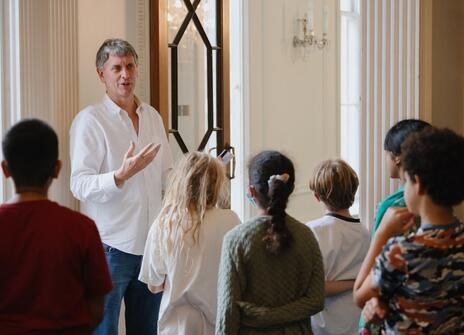
Paul Curzon is a Professor of Computer Science at Queen Mary University of London and a National Teaching Fellow. He runs Computer Science for Fun a magazine about the fun side of computing, and has been giving linked Computing Magic Shows for 10 years.
Paul also runs Teaching London Computing creating inspiring activities for teachers to use in class.
The magic of computer science workshops
When you learn to be a magician, it turns out you are also learning the skills needed to be a great computer scientist: computational thinking.
In this workshop, Paul Curzon will demonstrate real magic tricks, showing the group how they are done so they can do the tricks themselves.
Students will then use the magic to learn the linked basics of computer science. They’ll see what computational thinking is all about and how both magicians and computer scientists rely on it.
with Prof Paul Curzon (CS4FN and Teaching London Computing)
• Ages 7-8, Tuesday 13 August, 11am to 1.15pm
• Ages 9-11, Tuesday 13 August, 2.15-4.30pm
• Ages 7-8, Monday 19 August, 11am to 1.15pm
• Ages 9-11, Monday 19 August, 2.15-4.30pm
📃 We have three free booklets about computer science and magic which you can download as PDFs, we also have a couple of mathematical magic books and Illusioneering. For keen magicians there is also a book you can buy from any good bookshop. See this link or the panel just below.
For teachers and home educators we recommend our classroom activities on computing and magic.
Artificial Intelligence, but where is the intelligence? workshops
We all know the movie plots where evil robots and computers take over the world, but what is the reality? This workshop explores artificial intelligence, the field of science that tries to build ‘thinking machines’.
How are they built? Are they really intelligent? And what is intelligence anyway? We will also ask some interesting questions about a well-known ‘thinking machine’, you! Along the way we will play some games including building a working brain out of rope, tubes, and you, and playing snap with it.
with Prof Paul Curzon (CS4FN and Teaching London Computing)
• Ages 7-8, Friday 16 August, 11am to 1.15pm
• Ages 9-11, Friday 16 August, 2.15-4.30pm
📃 We have a free booklet on artificial intelligence for this age group at this link, or the panel below. For teachers and home educators we also recommend Raspberry Pi’s Experience AI suite of lessons.
Other computer science and related workshops
These are taught by other people.
Download a timetable of the Ri’s full programme of Holiday Workshops in PDF format here.
Codes and ciphers
• Age 7-8, Tuesday 6 August, 11am to 1.15pm
• Age 9-11, Tuesday 6 August, 2.15-4.30pm SOLD OUT
Computing with cards and dominoes
• Ages 13-15, Tuesday 6 August, 11am to 3pm (£55/44)
Electrical circuits
• Ages 9-11 (morning session), Thursday 8 August, 11am to 1.15pm
• Ages 9-11 (afternoon session), Thursday 8 August, 2.15-4.30pm
Crafting with Code
• Ages 9-11 (morning session), Wednesday 21 August, 11am to 1.15pm
• Ages 9-11 (afternoon session), Wednesday 21 August, 2.15pm to 4.30pm
Domino computing master class
• Ages 12-14, Tuesday 27 August, 11am to 3pm £55/44)
Additional material
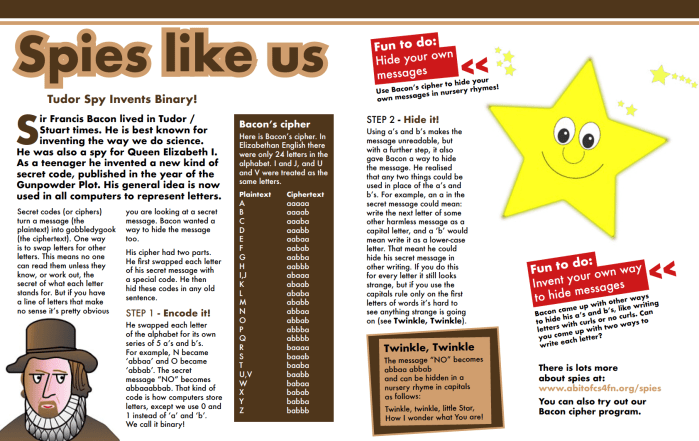
On pages 2 and 3 in the 2nd issue of A Bit of CS4FN, our mini version of CS4FN for ~8-12 year olds
Subscribe to be notified whenever we publish a new post to the Teaching London Computing blog.

This blog is supported through EPSRC grant EP/W033615/1.
 Teaching London Computing: A RESOURCE HUB from CAS LONDON & CS4FN