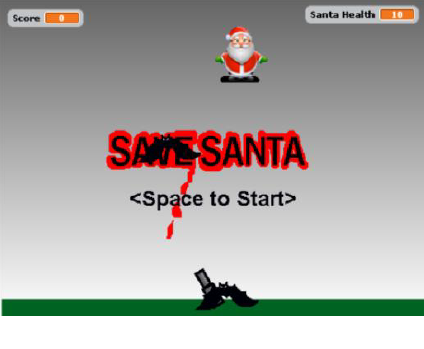
‘Save Santa’ Christmas game in Scratch, shoot the bats that are trying to interfere with his gift delivering :) via @CompAtSch

Computing At School (CAS) is a free resource hub (with info about events and classroom resources) for computer science teachers in the UK. There’s a thriving community section in which people can share their ideas for activities, and one of them is this game ‘Santa Shoot’ game, from Conor Grimes. Players need to shoot down bats that are getting in Santa’s way.

It’s free to become a CAS member and once you’ve done so you’ll be able to access the Scratch game and play it in your classroom.

The game was written in 2012 but thanks to a comment posted more recently the thread has resurfaced.

Game details: Santa Shoot Christmas Game

savesanta

Short description:
Simple Scratch Christmas Activity

Full description:
Key Stage 3 Programming Activity
Level: (Beginner / Intermediate/)
Duration: (1 – 2 Periods)
Teaches: (Basic Scratch programming)


Secondary computing teachers eligible for Teacher Industrial Partners’ Scheme (TIPS) from @ntlstemcentre

Teachers may be interested in TIPS (the Teacher Industrial Partners’ Scheme) which gives STEM teachers an authentic experience of what takes place in modern engineering and technology organisations. The aim is to enable teachers to link their subject to the range of careers open to their students.

The National Science Learning Network, which runs the scheme, has arranged work placements with BP during the spring term.

Become a BP Partner School – 3 places available
BP is looking for three secondary teachers of science, technology, engineering, mathematics or computing to undertake a two-week work placement during the spring term 2015.

The placement is part of the Teacher Industrial Partners’ Scheme (TIPS), linking engineering and technology employers with local schools. By giving you an authentic experience of what takes place in modern engineering and technology organisations, you can help your students understand how your subject links to a diverse range of career opportunities at all levels.

The main base will be at the International Centre for Business & Technology at Sunbury with visits to the oil trading headquarters at Canary Wharf, a supply depot on the south coast and a fuel development centre near Reading.

What will it cost and are there any bursaries?
The fee to take part in TIPS is £360.

Teachers from state-funded schools, academies and colleges can receive an ENTHUSE Award bursary of £1400 to help with supply cover and other costs.

How to apply
To participate, you must be available to leave the classroom from the 6 to 23 of February 2015.

For information on how to apply, visit the website below to register:
www.sciencelearningcentres.org.uk/consortia/national/teacher-industrial-partners-scheme

About the NSLN
The National Science Learning Network is the UK’s largest provider of subject-specific CPD. It comprises the National Science Learning Centre in York, and a wider network of 50 Science Learning Partnerships across England.


What are London teachers’ needs for the new Computing curricula? We have a survey…

Teaching London Computing is a project that is run jointly from Queen Mary University of London (QMUL) and King’s College London (KCL). We’re funded by the Mayor of London and Department for Education to provide support to teachers in London who are delivering the new Computing curricula (GCSE and A-level).

This includes computing subject knowledge and pedagogical support through a range of continuing professional development courses, free workshops (with fun unplugged-style activities) and free printable resources for use in the classroom.


***London Computing teachers*** – please fill in our short survey
We would like to understand more about the training needs that Computing teachers in London have and we’ve developed a short survey to help us find out more. If you are a Computing teacher based in London your participation will be very helpful. There’s an opportunity to sign up for class sets of free booklets once you’ve completed the survey which should take no more than five minutes to complete.

Please visit http://bit.ly/TLCsurvey2015a to take part in our survey and pass this link on to colleagues.


About us
The Teaching London project developed from cs4fn (Computer Science for Fun, a popular outreach project from QMUL to enthuse schoolchildren about computer science) and, in partnership with the Education department at KCL, we are providing resources for teachers who are introducing programming concepts and computational thinking into the classroom. We aim to nurture an inspiring Computing education for pupils across London.

Next courses
We’ve two new courses starting in the New Year.

Research
We’ve published a number of research articles about computer science education, selected examples below.

Black J, Brodie J, Curzon P, Myketiak C, McOwan PW and Meagher LR (2013). Making computing interesting to school students: teachers’ perspectives. Proceedings of the 2013 Conference on Innovation and Technology in Computer
Science Education (ITiCSE 2013), 255–260. New York: ACM.

Myketiak C, Curzon P, Black J, McOwan PW and Meagher LR (2012) cs4fn: a flexible model for computer science outreach. In Proceedings of ITiCSE ’12 Proceedings of the 17th ACM annual conference on Innovation and technology in computer science education, Pages 297-302, ACM New York. DOI: 10.1145/2325296.2325366

Bell T, Curzon P, Cutts Q et al. (2011) . Introducing Students to Computer Science With Programmes That Don’t Emphasise Programming. Proceedings of ITiCSE 2011, The 16th Annual Conference on Innovation and Technology in Computer Science Education ACM SIGCSE. 391-391.
10.1145/1999747.1999904


Website: http://teachinglondoncomputing.org Twitter: http://twitter.com/TeachingLDNComp